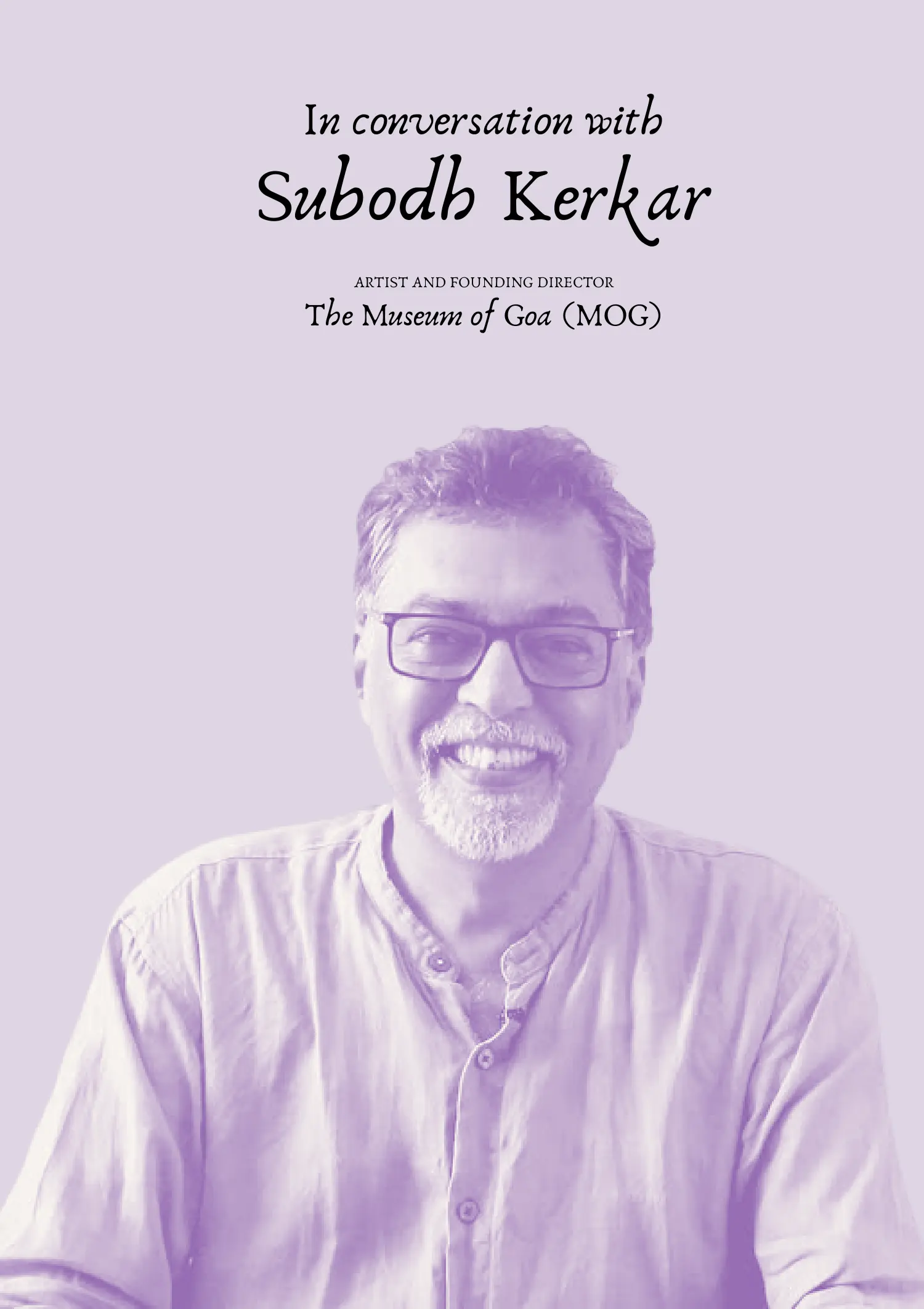
You call the Museum of Goa (MoG) a pedagogical experiment in narrating history. What did you have i n mind while you conceptualised it, and what was the process of actually bringing it to life?
I'm originally a medical doctor and I became an artist in the last 35 years and I'm an avid reader of history. Because of my interest in history, all the works which I started creating, history became a footnote to them. They are works of contemporary art, but they are created, in a way, in response to history. And that led to a new idea of museums. I would claim, the way I make museums is, a new way of making museums.
The idea of a museum is actually a colonial idea. A museum is, to put it rather crudely, a storehouse of old objects with labelling. And this is what is seen in all the museums, with maybe some exceptions. I do like to go to these museums, but after some time one tends to get a little bored, especially if information is not available, many a times, it starts to look like more of the same.
When I visited Berlin, I visited the Asian Museum in Berlin where the director had created an interesting experiment. This museum was similar to a traditional museum with artefacts and labelling but along with some contemporary art. For example, in the Chinese section, there was a work by Ai Weiwei. There was an interactive work of a Japanese artist in the Japanese section. This triggered a thought, why can't we make a Museum of history using contemporary art? That's precisely what I decided to do. My own work has been not a representation of history, but rather a work in response to history. I created a 15-20 minute documentary for the Museum of Goa, that tells you the basic histories of Goa and the rest of what you see in the museum is an experience and are contemporary works of art created in response to histories.
My next museum is the Museum of Beer. Most beer museums across the world are connected to a brewery. They show you the process of making beer, you sample it, coupled with some fun activities and there is merchandise. My Beer Museum is actually a Museum of contemporary art created in response to beer history and beer culture. I'm using beer as a vehicle to popularise contemporary art.
The Museum of Goa aims to bridge cultural gaps and bring art to a larger audience. How do you envision achievin g this goal and what strategies have you implemented so far? Do you think you have been successful ?
In a country of 1.3 billion people, not more than a few lakh people connect with contemporary art. Even corporate heads, engineers, and doctors have no idea about contemporary art because they have never been exposed to it. For example, recently at an event, I asked a group of 1500 architects and designers if they had heard the names of 10 Indian artists such as Subodh Gupta, Sudarshan Shetty, Riyas Komu, Jitish Kallat, Bose Krishnamachari, S. H Raza, F. N. Souza, V. S. Gaitonde, Vivan Sundaram, hardly 30-40 people raised their hands.
I think majority of the Indian population have never had an opportunity to connect with art. As an artist, I started to worry if I was going to create art only for the eyes of a few. Of course you create art for yourself, but still, an artist needs an audience. So that's why I felt the need to create a museum. All my friends thought that I was a total fool and they said that nobody would show up. But the museum happened, and today we get from 100 to 500 people coming every day paying a ticket of 300 Rs.
The best example of appreciation I have received, there was a group of farmers who came from Sindhudurg in Maharashtra. They told me one of their neighbours, who is also a farmer, had come to Goa and he saw our signages and he visited the museum. He went back and told them to go to Goa, not to visit the beach because ‘Their beach is exactly like ours but go to the Museum of Goa.” That was so lovely!
The other appreciation I get is from children. So there is a kind of sort of connection I think we are able to develop. But one museum is not enough. Next, I'm doing the Beer museum in Goa . In a remote site in Maharashtra, I am also creating two museums, Museum of Gandhi and Museum of Maharashtra, as well as a sculpture park. I hope to bring like minded people together, and conduct this experiment to prove that art can change the socioeconomic structure of a village. I believe that development has to happen holding the finger of aesthetics.
Considering the diverse range of events and activities that are hosted at MoG, how do you balance between preservin g the institutions vision and responding to evolving audience interest?
In general, you can't imprison art in a compartment. You can't be an artist unless you read newspapers. There's no compartment like, this is art and this is not art. Art is an expression of time, so you should be aware of everything that is happening during that time. Whether it is culinary arts, music or cinema, politics, an artist is a sensor, receptor and transmitter of ideas in a society and so everything is valid.
Histories of Goa is a permanent exhibition at MoG that highlights lesser known histories of the States past. Yo u also say that the collection is dynamic. How do you sort of balance between the two?
Initially when I started the MOG, it was intended to be just my own work because I was working on history. Then I started giving lectures on history to other artists and encouraging them to create works for us. We have at least 30-40 artists who have created works for MOG now and our policy is to have as many artists as possible. We are a dynamic museum, we are a hybrid of a museum and a gallery, but some work is permanent so we are more a museum than a gallery. We ask artists to come up with ideas, sometimes we fund the work, sometimes we buy the work and we keep the work for sale at the museum. But at the same time, we are not art dealers, we are art promoters.
You said you get as many artists as you can, So what is your criteria for selecting these artworks or artists? Does it have to be connected to the history of Goa?
The curatorial policy which I follow is named Tukaram policy, or the Kabir policy. The saint movement was a very important movement all over India, and saints like Tukaram, Namdev, Jnaneshwar took the wisdom of Vedas to common people in local languages and in simple poems which could communicate with everybody. I want to be the Tukaram of contemporary art. Tukaram's poems are, perhaps some of the best poems in the world, but they are simple and easy to understand. So communicating with our audience is a priority to us. And then of course the selected works of art should not be forgettable. It is a very simple curatorial policy.
How do you see your role as an artist intersecting with your role as a curator and a museum director to do these sort of sometimes become conflicting?
No, I don't think so. Because this becomes conflicting when you are in competition with other artists. I'm beyond competition. Basically I believe that competition should be amongst horses, not amongst human beings. So that's why there's no conflict
Going ahead, what are your aspirations for the Museum of Goa? How do you envision its growth and impact in the larger museum sector or cultural landscape of India?
The MOG is not a very huge museum. My dream will be to set up something like the MOG in every state, self sustainable museums should be everywhere. I definitely am encouraging a second line of leadership where there are more people to follow this idea. So far I have not received 1 Rupee from any CSR funding but I feel if people see that this is a sincere effort, I see no reason why they would not support it.
For the new project, I had a meeting with all the Panchayat members of the village and they were all in support and there are about 5000 villages in that village and I'm going to have a public meeting to the village about this project. So I will have at least over 3000 people attending it. The community will be part of this experiment of seeing how art can aid development.
One final question, what would you want the future of the museum sector to look like?
Future of the museum sector like any other sector has to respond to the new needs, which is very difficult, because I feel no public art of substance has happened in this country after Hampi. We have a lot of good artists, but the people who are in charge of choosing art have no business choosing art. I believe we have to educate, liberal arts should be taught, especially decision makers who are at the centre of activities should also have some kind of training in art history.
View original pages, photographs & credits
Originally published in Museum Mosaic 2023, published 2024.
Part of our annual review. Descriptions reflect the publication’s reporting period.