Artefacts Without Address
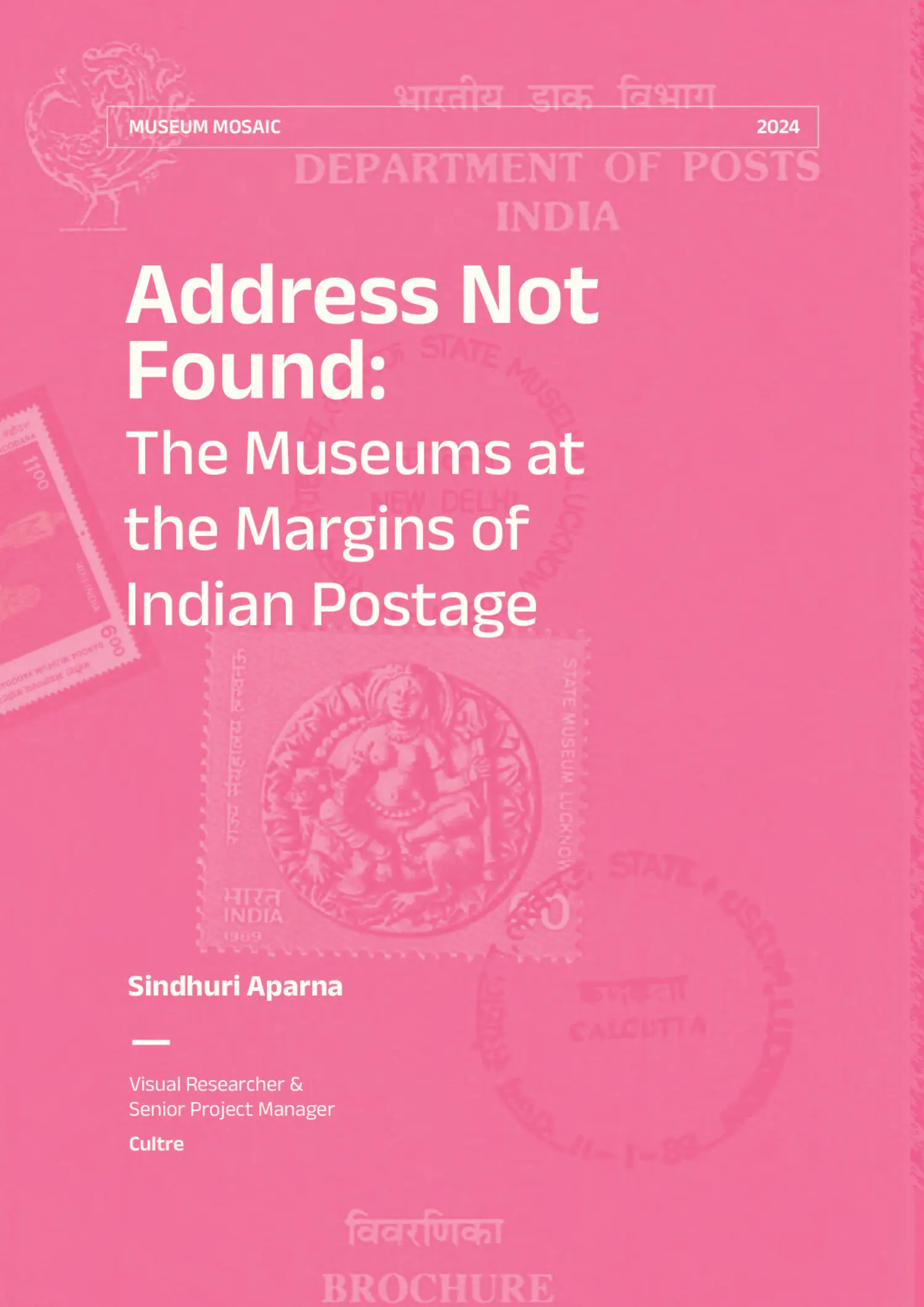
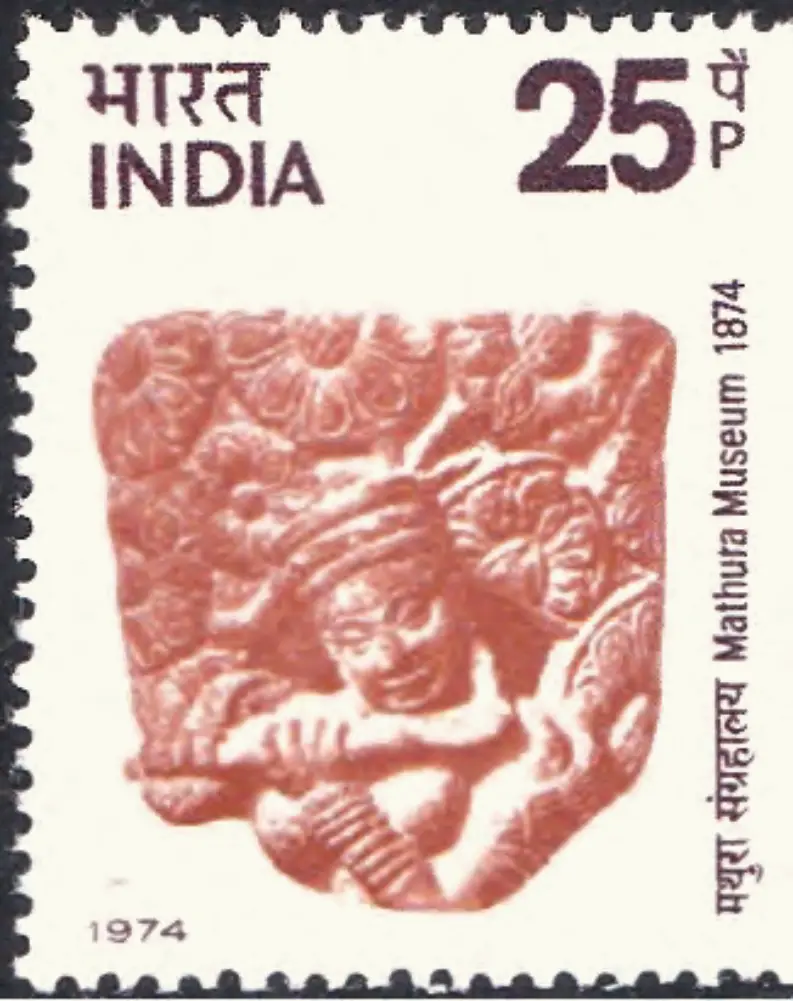
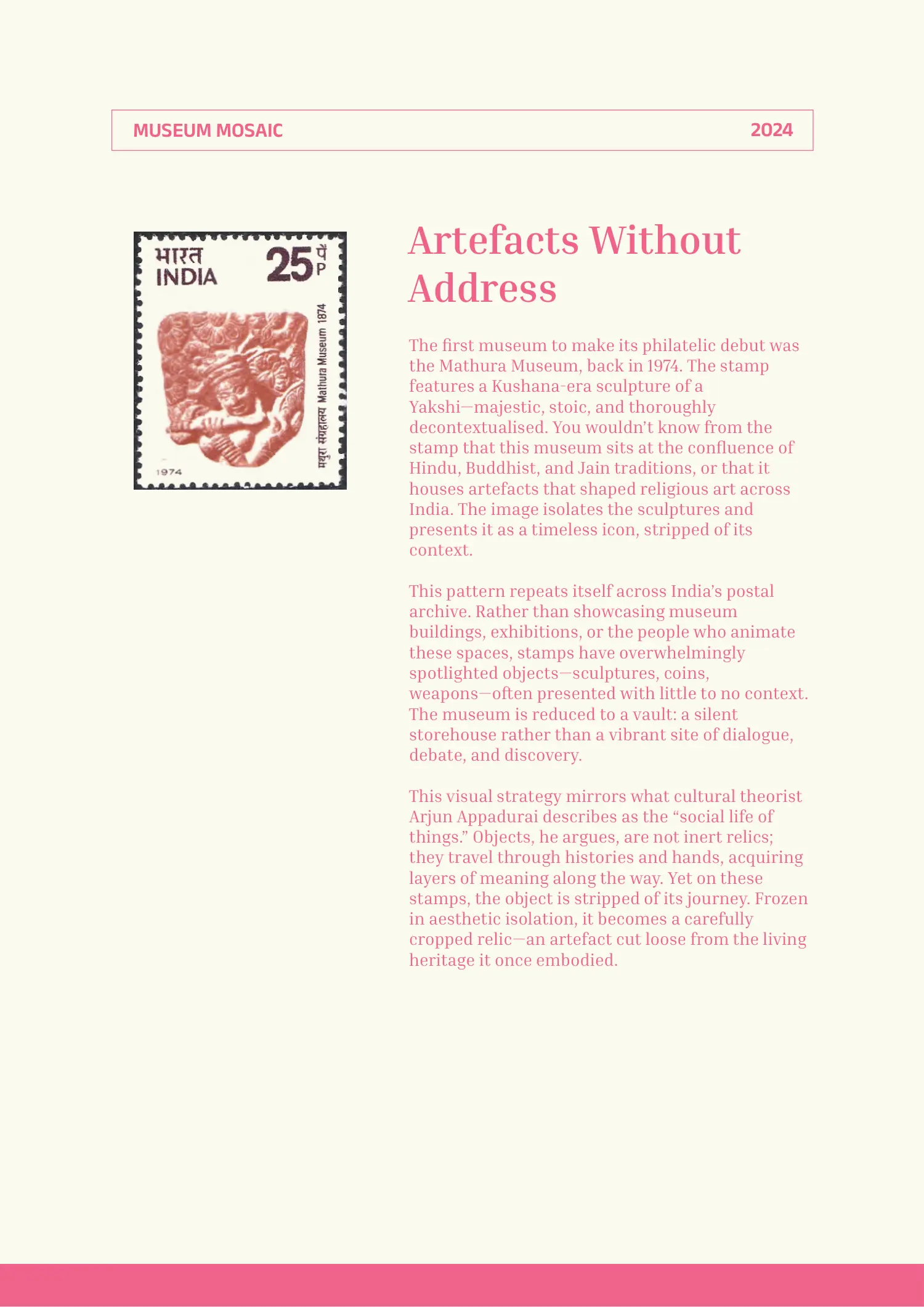
The first museum to make its philatelic debut was the Mathura Museum, back in 1974. The stamp features a Kushana-era sculpture of a Yakshi—majestic, stoic, and thoroughly decontextualised. You wouldn’t know from the stamp that this museum sits at the confluence of Hindu, Buddhist, and Jain traditions, or that it houses artefacts that shaped religious art across India. The image isolates the sculptures and presents it as a timeless icon, stripped of its context.
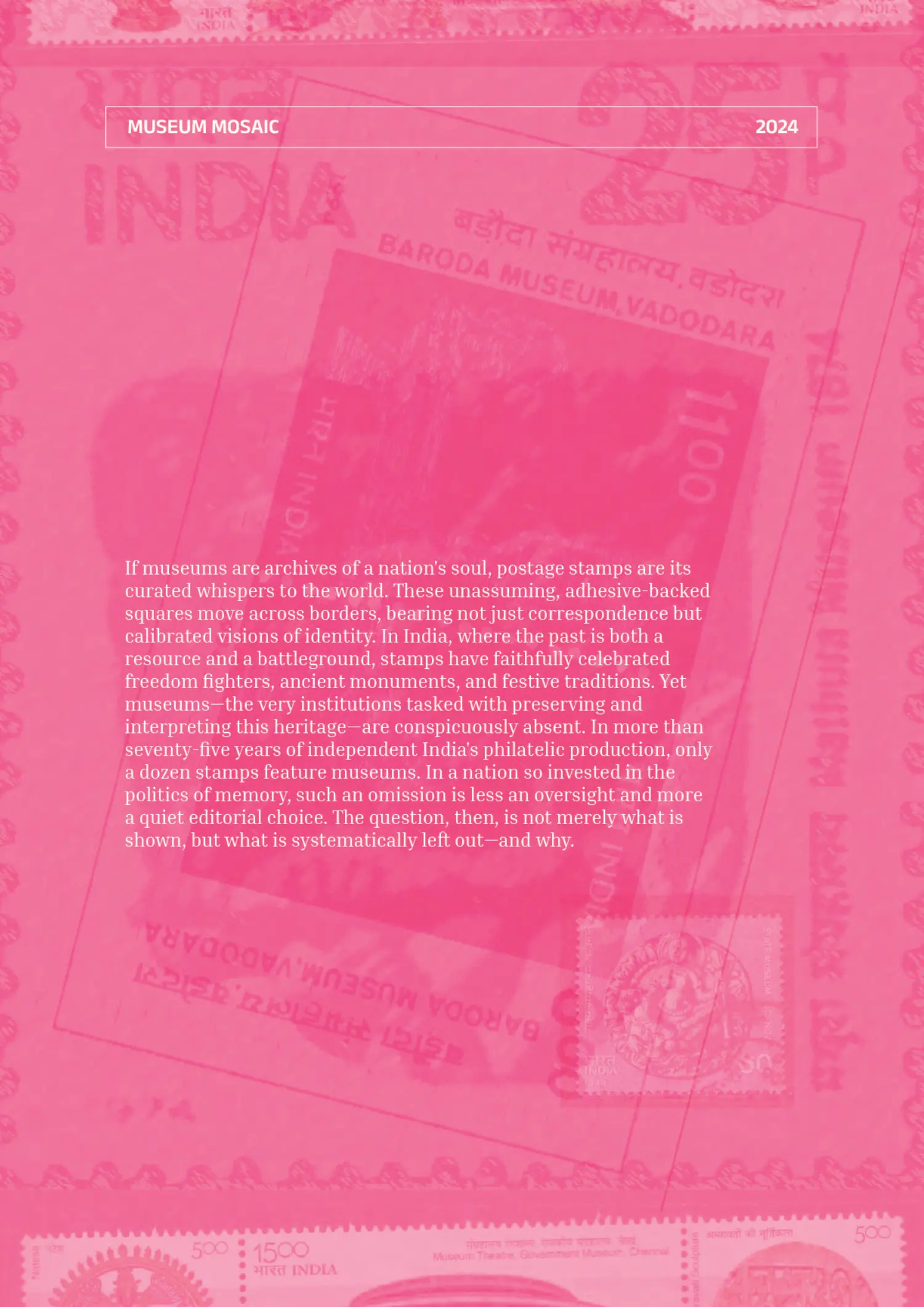
This pattern repeats itself across India’s postal archive. Rather than showcasing museum buildings, exhibitions, or the people who animate these spaces, stamps have overwhelmingly spotlighted objects—sculptures, coins, weapons—often presented with little to no context. The museum is reduced to a vault: a silent storehouse rather than a vibrant site of dialogue, debate, and discovery.
This visual strategy mirrors what cultural theorist Arjun Appadurai describes as the “social life of things.” Objects, he argues, are not inert relics; they travel through histories and hands, acquiring layers of meaning along the way. Yet on these stamps, the object is stripped of its journey. Frozen in aesthetic isolation, it becomes a carefully cropped relic—an artefact cut loose from the living heritage it once embodied.
The 1978 Quartet: Stamps as Syllabus
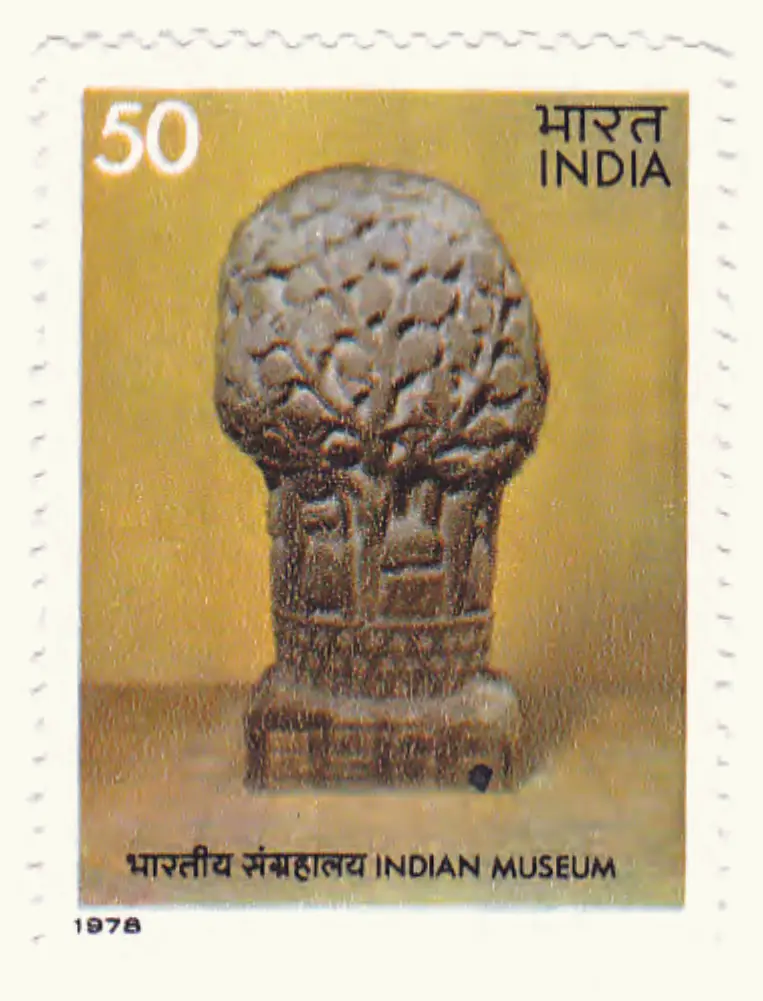
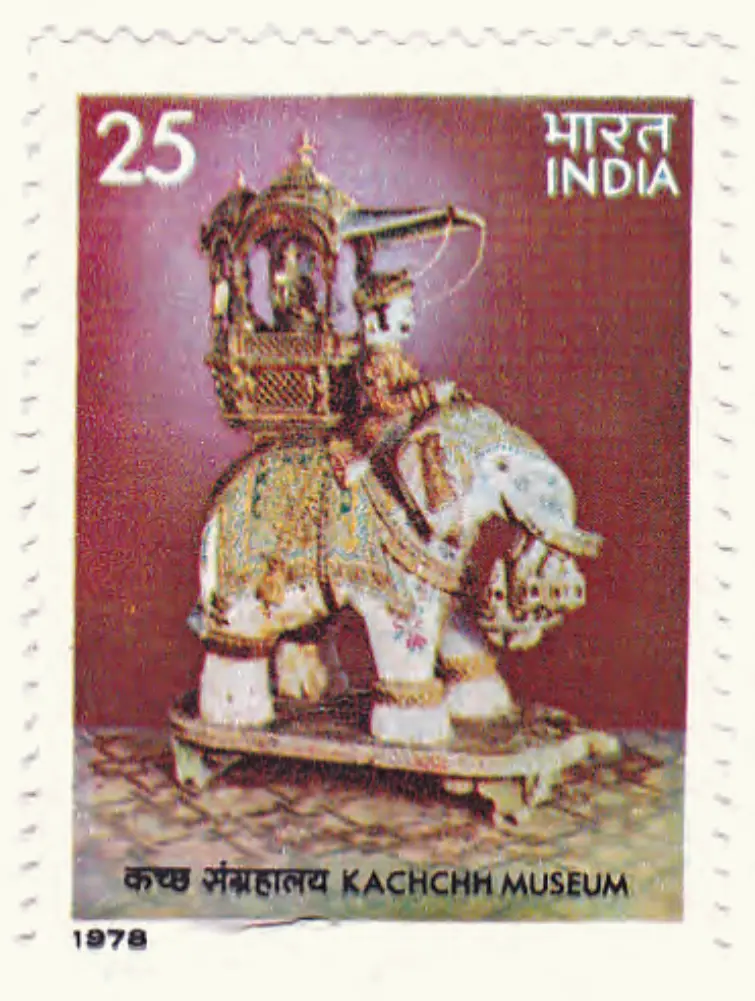
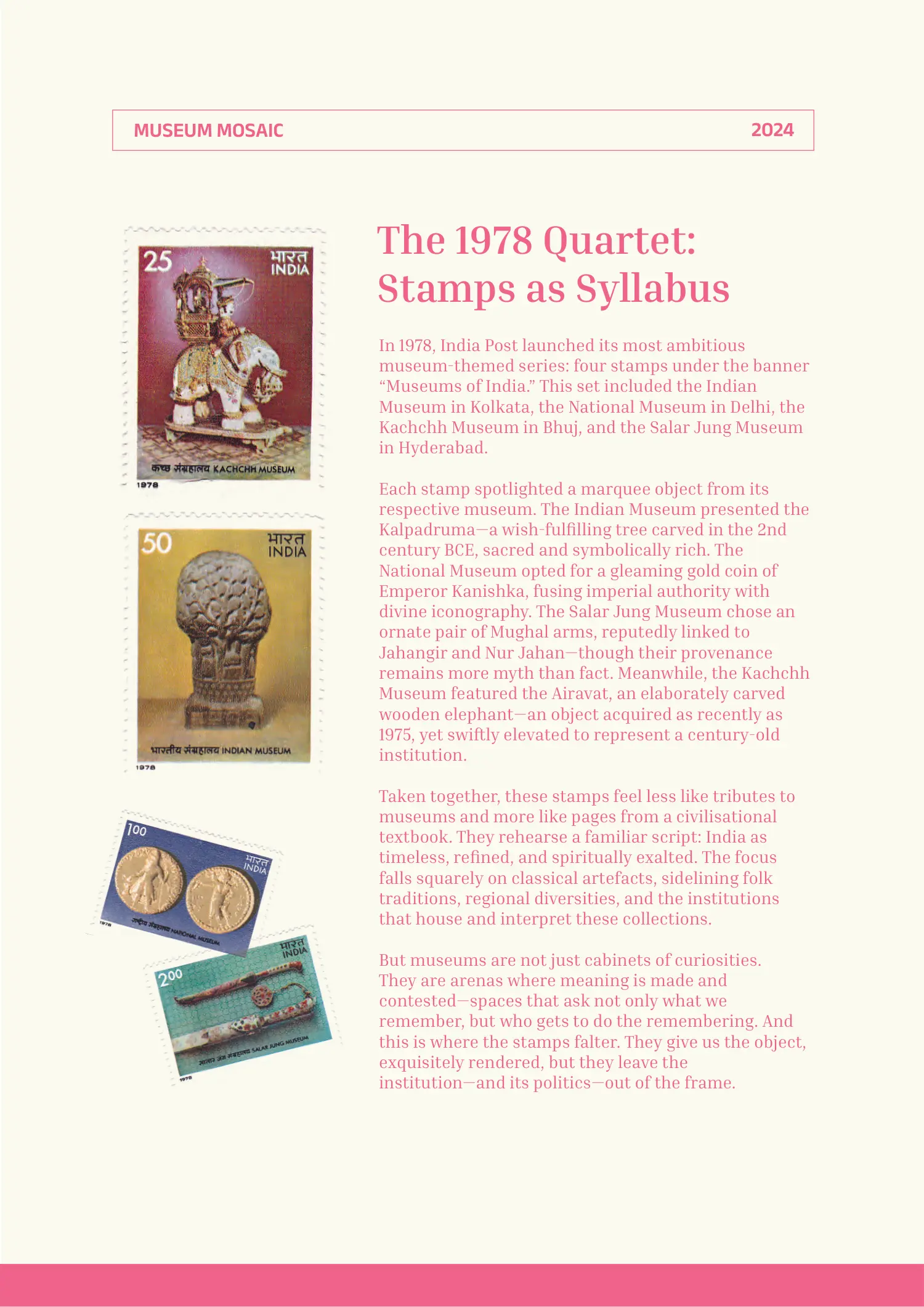
In 1978, India Post launched its most ambitious museum-themed series: four stamps under the banner “Museums of India.” This set included the Indian Museum in Kolkata, the National Museum in Delhi, the Kachchh Museum in Bhuj, and the Salar Jung Museum in Hyderabad.
Each stamp spotlighted a marquee object from its respective museum. The Indian Museum presented the Kalpadruma—a wish-fulfilling tree carved in the 2nd century BCE, sacred and symbolically rich. The National Museum opted for a gleaming gold coin of Emperor Kanishka, fusing imperial authority with divine iconography. The Salar Jung Museum chose an ornate pair of Mughal arms, reputedly linked to Jahangir and Nur Jahan—though their provenance remains more myth than fact. Meanwhile, the Kachchh Museum featured the Airavat, an elaborately carved wooden elephant—an object acquired as recently as 1975, yet swiftly elevated to represent a century-old institution.
Taken together, these stamps feel less like tributes to museums and more like pages from a civilisational textbook. They rehearse a familiar script: India as timeless, refined, and spiritually exalted. The focus falls squarely on classical artefacts, sidelining folk traditions, regional diversities, and the institutions that house and interpret these collections.
But museums are not just cabinets of curiosities. They are arenas where meaning is made and contested—spaces that ask not only what we remember, but who gets to do the remembering. And this is where the stamps falter. They give us the object, exquisitely rendered, but they leave the institution—and its politics—out of the frame.
Framing the Object, Forgetting the Institution
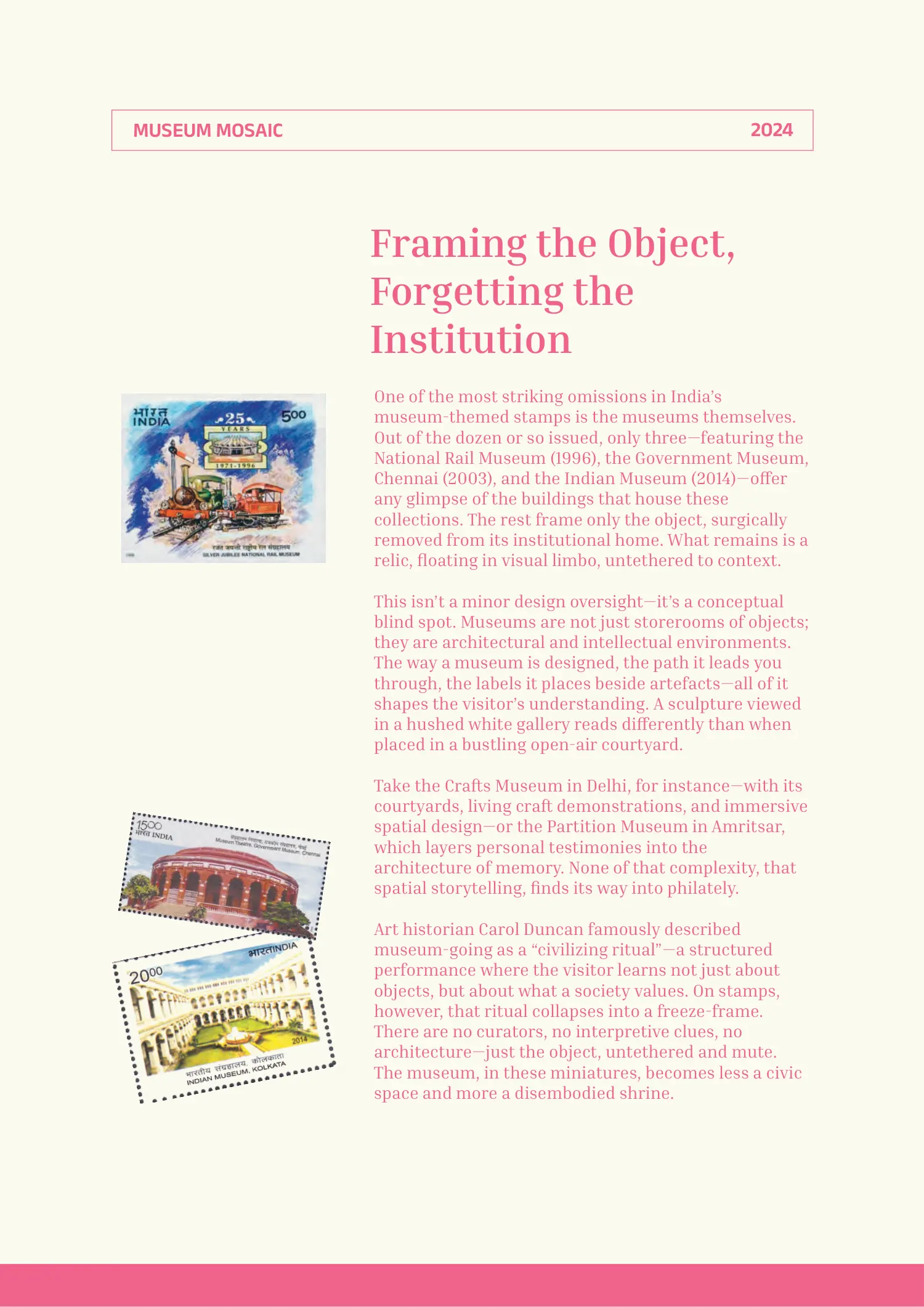
One of the most striking omissions in India’s museum-themed stamps is the museums themselves. Out of the dozen or so issued, only three—featuring the National Rail Museum (1996), the Government Museum, Chennai (2003), and the Indian Museum (2014)—offer any glimpse of the buildings that house these collections. The rest frame only the object, surgically removed from its institutional home. What remains is a relic, floating in visual limbo, untethered to context.
This isn’t a minor design oversight—it’s a conceptual blind spot. Museums are not just storerooms of objects; they are architectural and intellectual environments. The way a museum is designed, the path it leads you through, the labels it places beside artefacts—all of it shapes the visitor’s understanding. A sculpture viewed in a hushed white gallery reads differently than when placed in a bustling open-air courtyard.
Take the Crafts Museum in Delhi, for instance—with its courtyards, living craft demonstrations, and immersive spatial design—or the Partition Museum in Amritsar, which layers personal testimonies into the architecture of memory. None of that complexity, that spatial storytelling, finds its way into philately.
Art historian Carol Duncan famously described museum-going as a “civilizing ritual”—a structured performance where the visitor learns not just about objects, but about what a society values. On stamps, however, that ritual collapses into a freeze-frame. There are no curators, no interpretive clues, no architecture—just the object, untethered and mute. The museum, in these miniatures, becomes less a civic space and more a disembodied shrine.
The Politics of What Gets Remembered
Why have so few museums found a place on Indian stamps? Part of the answer lies in what Pierre Bourdieu called “symbolic power” — the state’s quiet but profound ability to define what counts as legitimate culture. Museums that foreground regional, folk, or subaltern histories often don’t fit easily into the grand, orderly narrative of ancient splendour and civilisational continuity. Their collections are layered, contested, and at times, politically inconvenient.
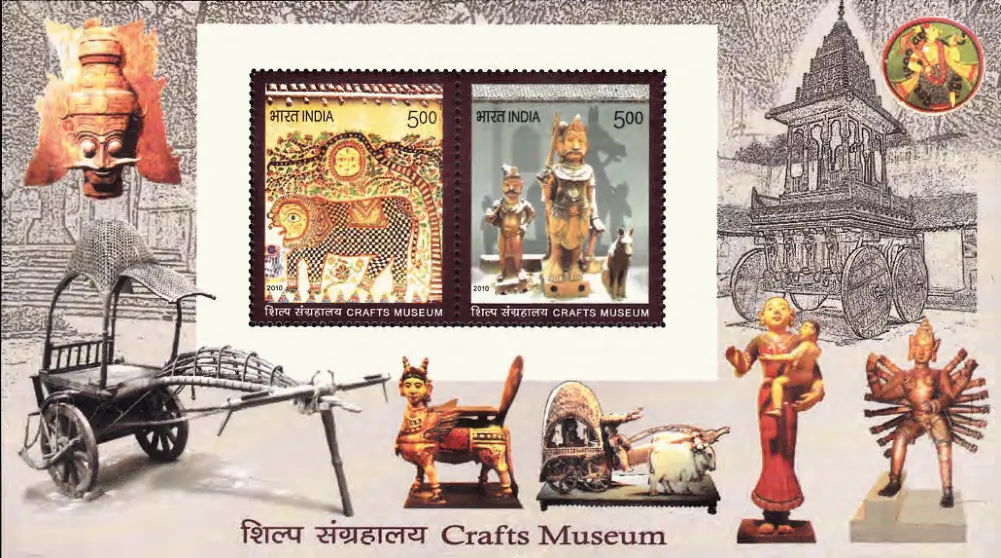
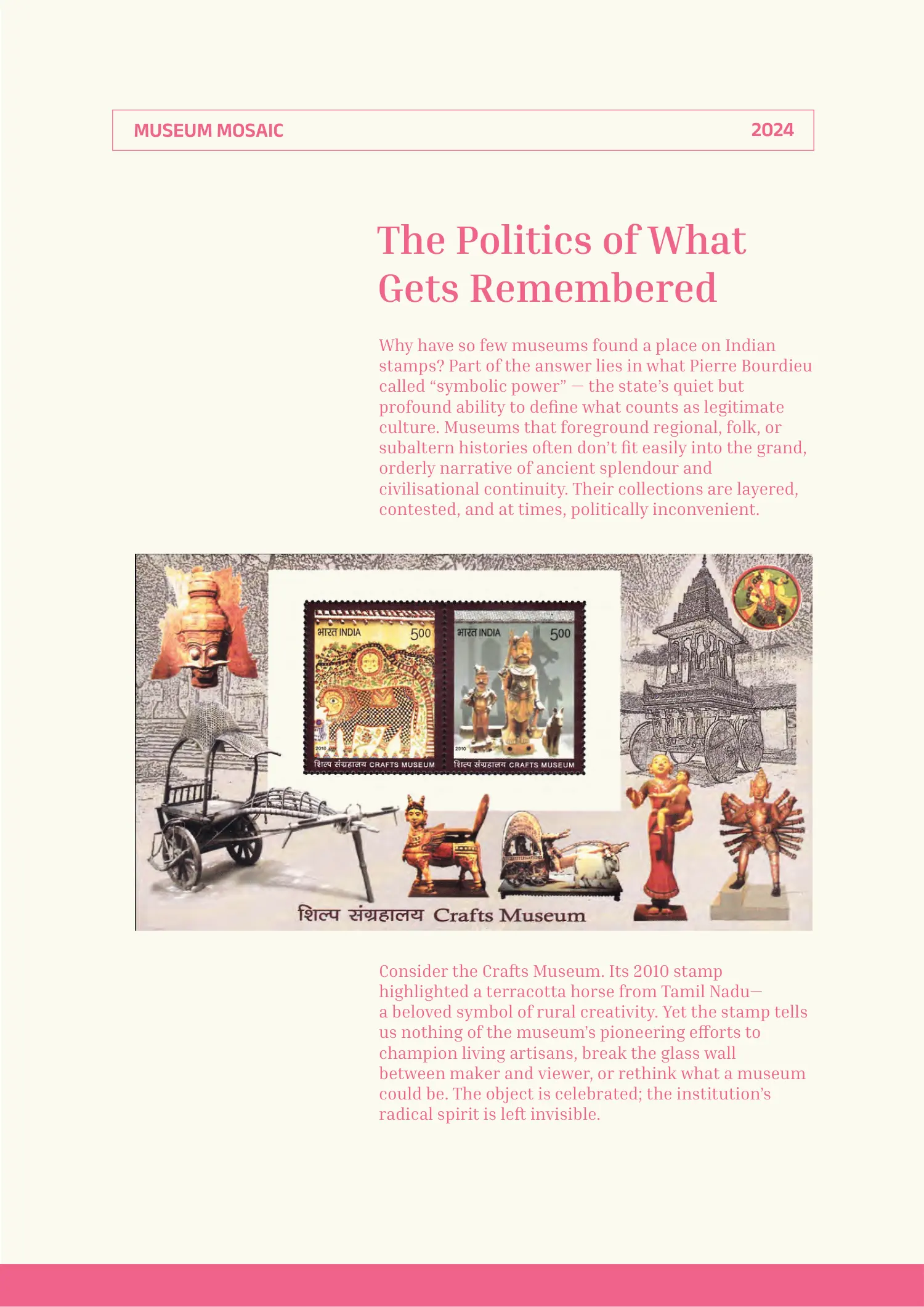
Consider the Crafts Museum. Its 2010 stamp highlighted a terracotta horse from Tamil Nadu— a beloved symbol of rural creativity. Yet the stamp tells us nothing of the museum’s pioneering efforts to champion living artisans, break the glass wall between maker and viewer, or rethink what a museum could be. The object is celebrated; the institution’s radical spirit is left invisible.
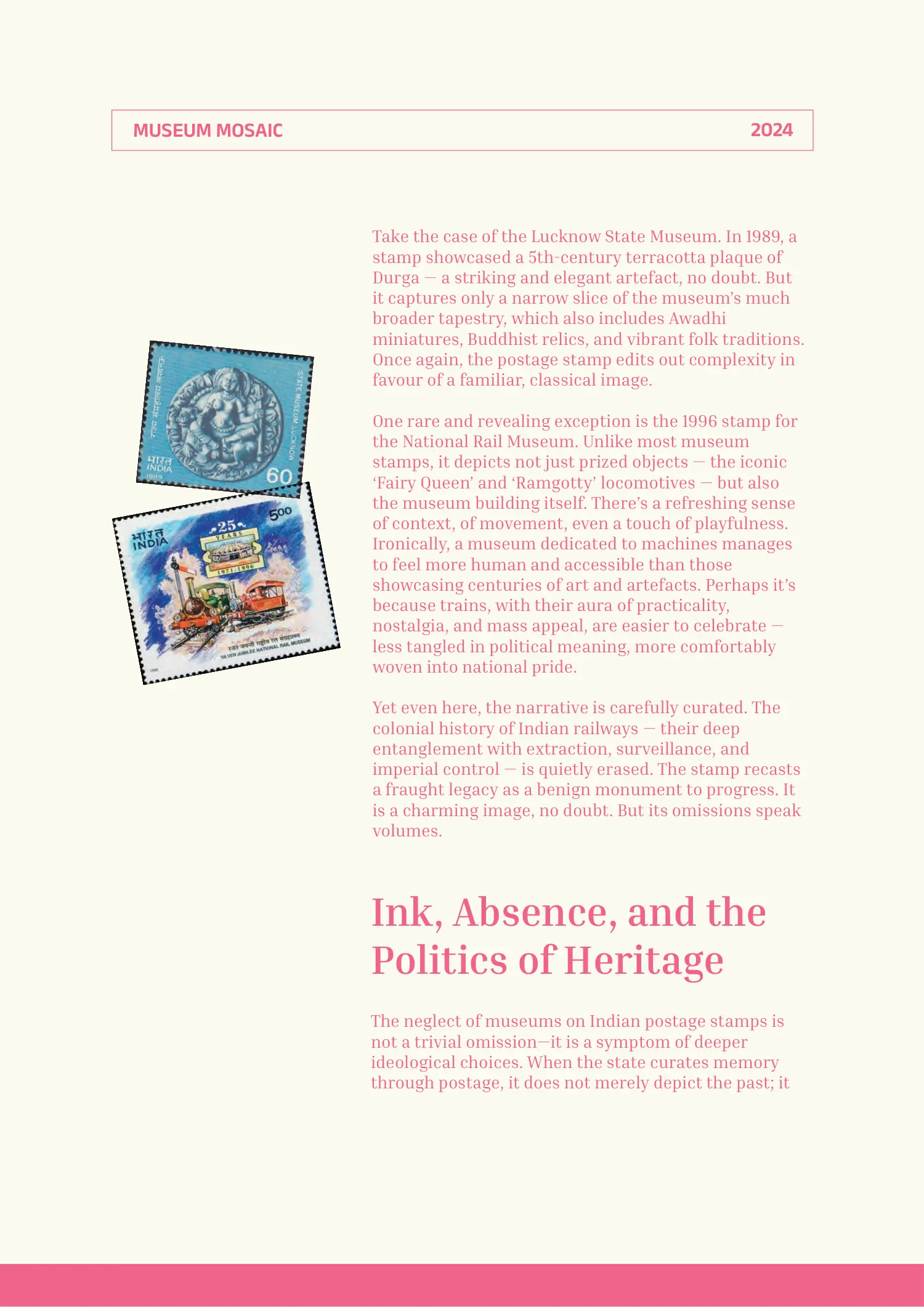
Take the case of the Lucknow State Museum. In 1989, a stamp showcased a 5th-century terracotta plaque of Durga — a striking and elegant artefact, no doubt. But it captures only a narrow slice of the museum’s much broader tapestry, which also includes Awadhi miniatures, Buddhist relics, and vibrant folk traditions. Once again, the postage stamp edits out complexity in favour of a familiar, classical image.
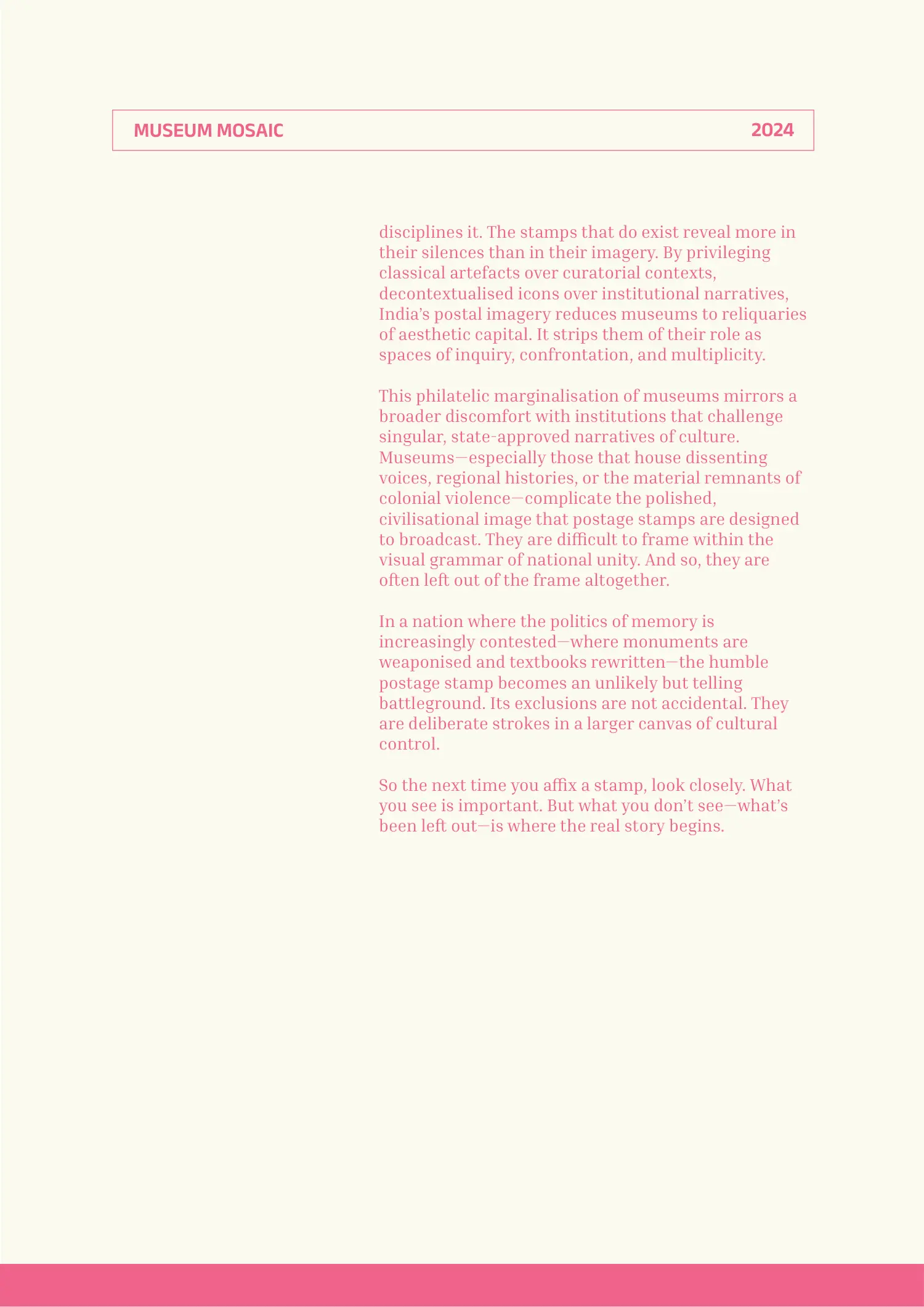
One rare and revealing exception is the 1996 stamp for the National Rail Museum. Unlike most museum stamps, it depicts not just prized objects — the iconic ‘Fairy Queen’ and ‘Ramgotty’ locomotives — but also the museum building itself. There’s a refreshing sense of context, of movement, even a touch of playfulness. Ironically, a museum dedicated to machines manages to feel more human and accessible than those showcasing centuries of art and artefacts. Perhaps it’s because trains, with their aura of practicality, nostalgia, and mass appeal, are easier to celebrate — less tangled in political meaning, more comfortably woven into national pride.
Yet even here, the narrative is carefully curated. The colonial history of Indian railways — their deep entanglement with extraction, surveillance, and imperial control — is quietly erased. The stamp recasts a fraught legacy as a benign monument to progress. It is a charming image, no doubt. But its omissions speak volumes.
Ink, Absence, and the Politics of Heritage
The neglect of museums on Indian postage stamps is not a trivial omission—it is a symptom of deeper ideological choices. When the state curates memory through postage, it does not merely depict the past; it
disciplines it. The stamps that do exist reveal more in their silences than in their imagery. By privileging classical artefacts over curatorial contexts, decontextualised icons over institutional narratives, India’s postal imagery reduces museums to reliquaries of aesthetic capital. It strips them of their role as spaces of inquiry, confrontation, and multiplicity.
This philatelic marginalisation of museums mirrors a broader discomfort with institutions that challenge singular, state-approved narratives of culture. Museums—especially those that house dissenting voices, regional histories, or the material remnants of colonial violence—complicate the polished, civilisational image that postage stamps are designed to broadcast. They are difficult to frame within the visual grammar of national unity. And so, they are often left out of the frame altogether.
In a nation where the politics of memory is increasingly contested—where monuments are weaponised and textbooks rewritten—the humble postage stamp becomes an unlikely but telling battleground. Its exclusions are not accidental. They are deliberate strokes in a larger canvas of cultural control.
So the next time you affix a stamp, look closely. What you see is important. But what you don’t see—what’s been left out—is where the real story begins.
View original pages, photographs & credits
Originally published in Museum Mosaic 2024, published May 2025.
Part of our annual review. Descriptions reflect the publication’s reporting period.