“Light creates ambiance and feel of a place, as well as the expression of a structure.”
— Le Corbusier
In the hushed stillness of a museum, light is both an artist and a guardian. It reveals the subtleties of a master’s brushstroke, the contours of ancient sculpture, the fragile fibres of an heirloom textile—yet if left unchecked, it can also be the agent of their slow demise. The art of museum lighting, then, is a dance between exposure and restraint, perception and protection.
The 2011 Mandala guide on museum lighting provides a thoughtful, technically sound framework for designing lighting systems that both celebrate and conserve our cultural heritage. It emphasises the necessity of approaching light not just as a tool of visibility, but as a curatorial decision with far-reaching consequences. This provides a guideline that allows us to consider many factors to provide an efficient and comprehensive means to design. It also brings forth the dual mandate key to designing: Preserve and Exhibit. At the heart of museum lighting lies a central paradox: the very light needed to display artefacts can also cause their deterioration. This is due to light’s energy, which initiates photochemical reactions and thermodynamic damage, especially in light-sensitive materials. The guide categorises artefacts into four sensitivity levels—from insensitive materials like stone and metal to highly vulnerable items such as silk, newsprint, and watercolour. For example, delicate materials in the high-sensitivity category must be exposed to no more than 50 lux, with strict annual exposure limits to prevent irreversible fading or yellowing.
Light, after all, is more than just illumination. It is radiation, including ultraviolet (UV) and infrared (IR) rays, which can bleach colours, dry out organic materials, and weaken centuries-old bindings and pigments. The design of any museum lighting system must start with a deep understanding of the physical and chemical limits of the items it seeks to reveal. A lack of understanding can cause an effect that is exactly the opposite of what is intended; rather than highlighting the beauty, it can cause severe destruction. In a way, lighting can make or break museums and displays. Thus, we must design with clear understanding.
Effective museum lighting is never incidental. It is a carefully planned orchestration of source types, intensities, beam angles, and control mechanisms. It encapsulates a range of lighting strategies, each tailored to different display types and architectural contexts. A few examples of them are:
Track-Mounted Spot Lighting: Highly flexible and ideal for emphasising key artefacts. Beam angles are finely tuned—from narrow spots (<10°) to wide floods (>45°)—to sculpt the perception of space and form.
Wall Wash Lighting: Used for uniform illumination across large surfaces or clustered displays, offering visual coherence without casting distracting shadows.
Showcase Lighting: Especially important for small, sensitive objects. These use top-mounted, controlled fixtures to avoid glare and highlight texture and detail without overwhelming the item.
Indirect Lighting: Deployed in high-ceiling spaces for a diffuse, ambient glow. Though aesthetically soft and glare-free, it requires high ceiling reflectance and careful energy management.
Colour rendering is another critical component. A high Colour Rendering Index (CRI), ideally approaching 100 (the quality of daylight), ensures that viewers see the artwork in its truest tones. This is particularly important in galleries featuring fine arts and textiles, where colour perception is integral to appreciation. This brings us to a key component of today's day and age technology and its integration.
Technology plays an ever-expanding role in mitigating the risks of light damage. Filters are used to strip out UV and IR components, reducing heat and radiation exposure. Fiber optics, LED systems, and advanced dimmers now offer precise control with minimal heat output. Tools like skin tone filters, daylight conversion lenses, and anti-dazzle screens further refine the light experience for both the object and the observer. Energy efficiency is also at the forefront of museum lighting design. By using smart controls and selectively illuminating only what needs to be seen, designers reduce power consumption while enhancing visual impact. Vertical illumination, for instance, has been shown to create a stronger perception of brightness using less energy than horizontal lighting strategies.
Given all of the above, there is a key component in bringing the entire puzzle together – The human factor.
At the end of the day, lighting is about storytelling. It is the invisible thread that connects viewer to object, emotion to context. Museums are not merely spaces for viewing—they are environments for experiencing, and light is the medium that shapes that experience. When lighting is done right, it disappears. What remains is awe, wonder, and connection.
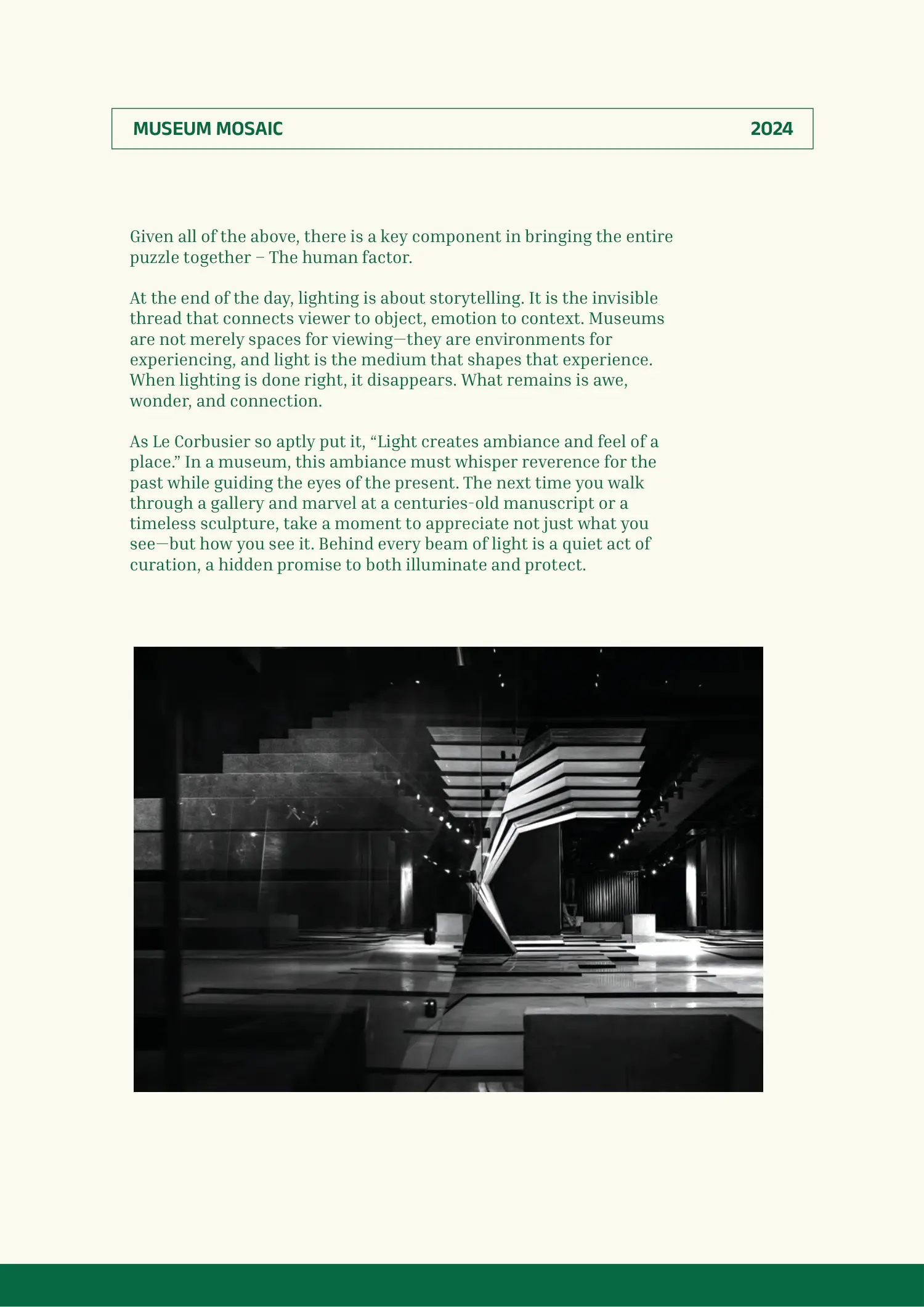
As Le Corbusier so aptly put it, “Light creates ambiance and feel of a place.” In a museum, this ambiance must whisper reverence for the past while guiding the eyes of the present. The next time you walk through a gallery and marvel at a centuries-old manuscript or a timeless sculpture, take a moment to appreciate not just what you see—but how you see it. Behind every beam of light is a quiet act of curation, a hidden promise to both illuminate and protect.
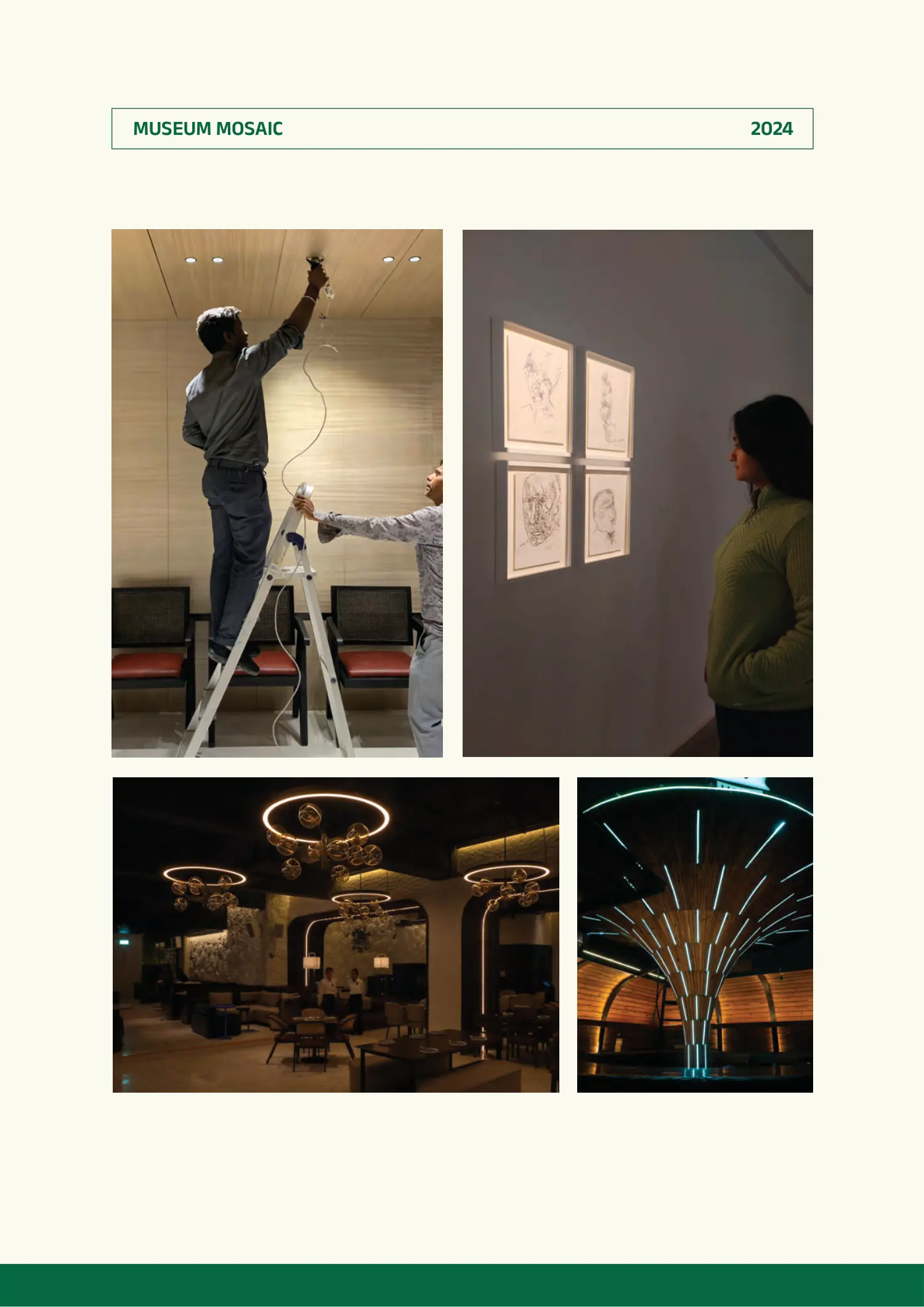
View original pages, photographs & credits
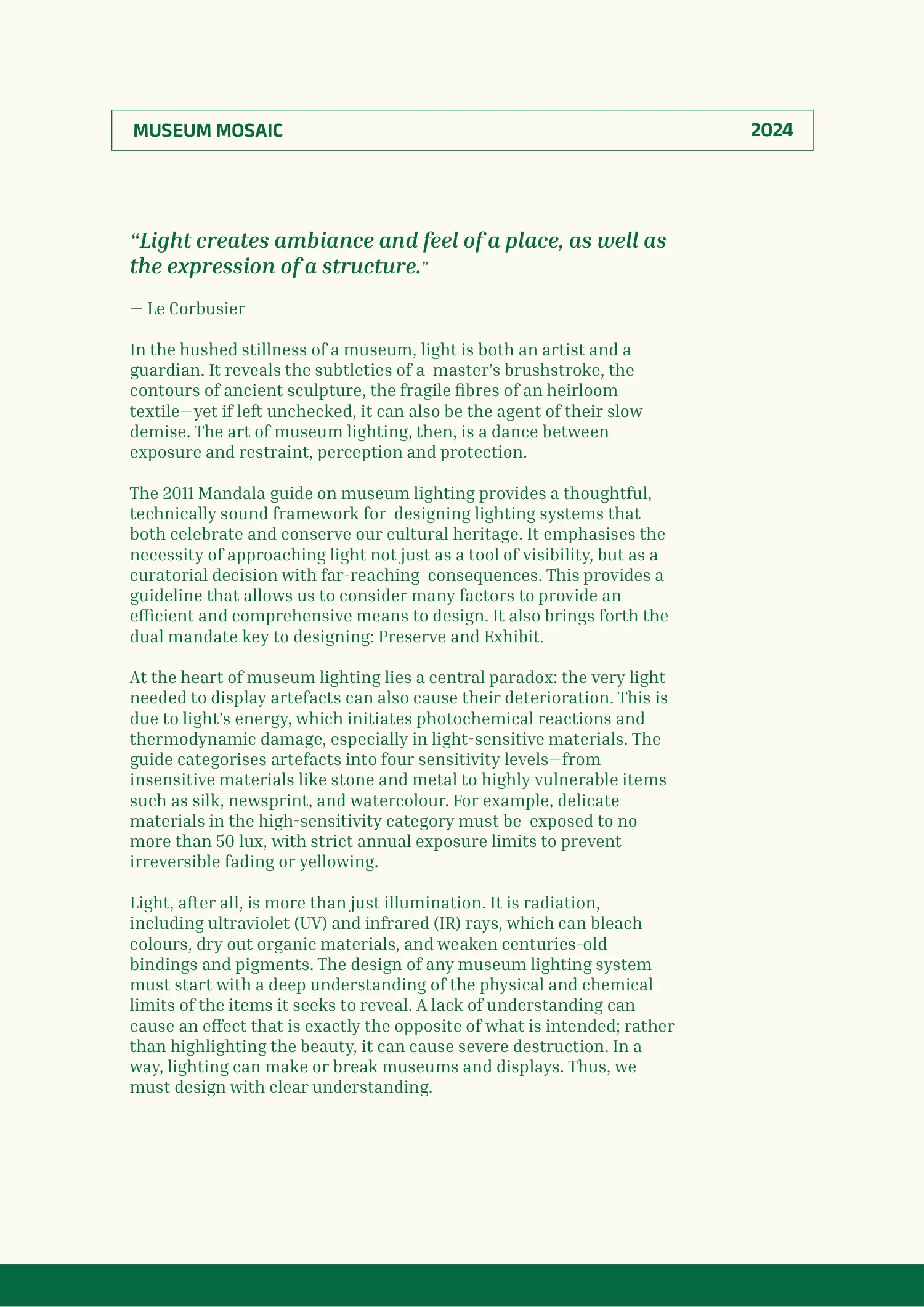
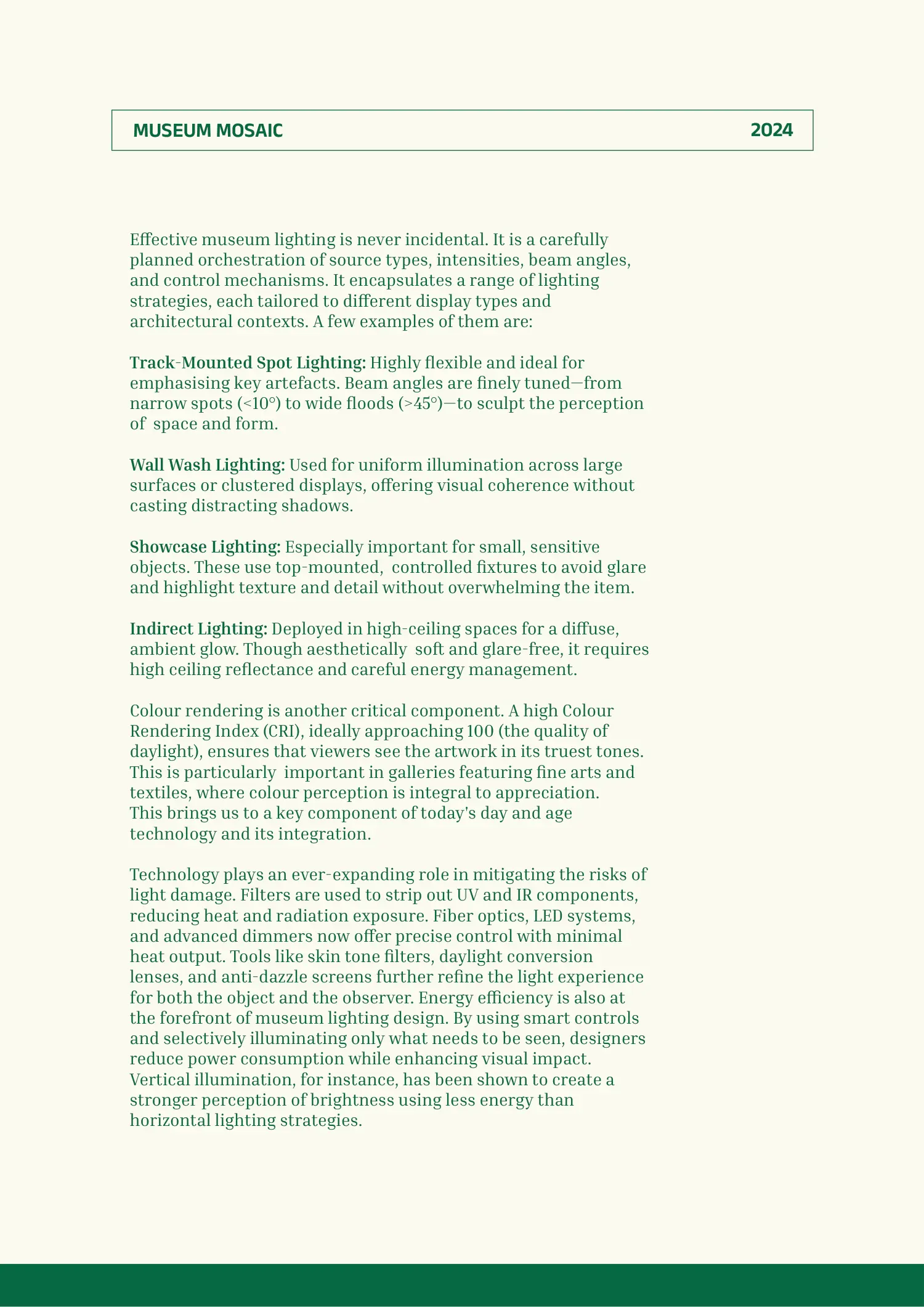
Originally published in Museum Mosaic 2024, published May 2025.
Part of our annual review. Descriptions reflect the publication’s reporting period.