Museum Mosaic 2025
Museums should move beyond listless descriptors of art works and embrace live stories associated with these works.
-Professor A Damodaran, Author and Visiting Professor, Indian Institute of Management, Bangalore and Ahmedabad University
Technology is not a threat to tradition. It is its boldest amplifier. The stories woven into centuries-old art deserve to be
heard by millions, not just the few
who walk through our doors. When
we embrace digital tools with
intention, we don't modernise a
museum; we future-proof a culture.
Museums as places of education
typically feature physical objects
from their collections. With the
advent of digital, museums have
aggressively implemented various
digital technologies to reach out to
a wider audience group. However, it
still tends to be one-way traffic.
Perhaps there is an opportunity for
museums to create some space for
visitors to share and showcase their
collections, with appropriate
guardrails/guidance. That will make
museums a really living, breathing,
constantly evolving organisation
embedded in the
-Abhishek Poddar, Founder-Trustee, Museum of Art and Photography
community.
One of the most innovative directions
-Dr. Abira Bhattacharya, Deputy Curator (Anthropology) at the National Museum, New Delhi
museums should embrace in the years
ahead is living, participatory storytelling: an approach in which visitors
are not merely passive viewers
but active contributors to the meaning and interpretation of an
exhibition. The future of museums
lies in moving beyond one-way interpretation toward a dialogic and multi-vocal experience. In this model, an
object does not speak through a single authoritative curatorial voice alone. Instead,
it becomes a site of layered narratives, where
multiple perspectives coexist: academic, community-based, emotional, and experiential.
For example, the Piprahwa gem relics of Lord
Buddha displayed in The Light and the Lotus exhibition at the Rai Pithora complex provide an extensive curatorial note explaining its chronology and excavation context, the archaeologist’s interpretation, its
philosophical significance alongside the story of its
repatriation and historic reunification with the other findings of the Piprahwa stupa. The use of design elements and advanced digital interactive audio/visual tools emphasise the story of Piprahwa, transforming the museum from a space of
display into one of dialogue and co-creation. In addition, by organising talks, curatorial walkthroughs, and activities, community voices and youth engagement have been emphasised upon within the
curatorial framework, creating emotionally resonant, human-centred
narratives rather than static object-led displays. This project, executed by the Ministry of Culture, interprets history through
reconstructed environments and public participation using immersive storytelling shaped by community memory and lived
experiences.
Ecological sustainability, social harmony and well-being, and human environment. A museum for me is a place to showcase tangible and/or intangible heritage in an aesthetically pleasing atmosphere derived from local cultures. The museum is for one and all – a place where education and enjoyment go hand in hand.
-Dr. Achal Pandya, Professor and Head of Department, Conservation, Indira Gandhi National Centre for the Arts
-Professor (Dr.) Amareswar Galla, Pro-Chancellor and Distinguished Professor of Indigeneity and Inclusive Museum & Heritage Studies, Kalinga Institute of Social Sciences
Center the museum’s identity around a single signature object. This object
can evolve into a recognisable mascot and serve as a traveling
ambassador – first across the
country, and eventually internationally. Its journey can
unfold both physically and digitally, through platforms like
Instagram, public projections,
and museum facades. By
following a strong storytelling approach, the object becomes a narrative
device through which audiences connect with the museum’s history and
purpose. Over time, this concept can expand into
a collection of many
such objects, each carrying and sharing
its own story.
Museums in a rapidly changing world — marked by geopolitical tensions, escalating climate crises, and deepening social inequalities — demand renewed attention to how museums curate, interpret, and communicate narratives about the past, present, and future. How can museums remain relevant and reflexive as they confront contemporary realities? Intercultural and intergenerational dialogue remain pressing priorities as institutions grapple with contested histories, shifting demographic landscapes, and the need for reconciliation and community building. How can museums craft narratives that respond to diverse audiences; how can collections, exhibitions, and AI digital affordances expand participation; and how can institutions cultivate trust, care, and shared authority with the communities they serve? -Dr Alka Pande, Curator and Author
The museum needs play areas that instill wonder and fantastical imagination in the minds of its youngest visitors. From live archeological pits to playgrounds made by contemporary artists, the outdoors is where the visitors can process the stimulating visual journey they
take on inside. Artist Isamu Noguchi built the concepts of playscapes yet never actually built that concept. In India, several
artists like Ansh Kumar and Amrit Pal Singh among many others
are building artist designed universes for children where
tactility is at the core of self exploration.
-Anica Mann, Archaeologist and Curator
As a designer who hopes to design many many museums in
the future, I hope museums become more playful and irreverent with their collections. While permanent collections
will always remain the central attraction in any museum, it
would be interesting to see how the extended collections, especially items languishing in storages can be used to create
new narratives, in new formats to excite new audiences.
-Anjchita B. Nair,
CEO, Cultre
We have always
seen that curated
spaces come alive when
-Anumita Banerjee, Assistant Director of Archives,
National Archives of India
the "audience" becomes a co-creator, so the museums should wholeheartedly embrace lively, community
participation which will definitely ignite conversations and ideas which will last beyond the
physical limits of the museum.
From my
perspective, museums should
rethink accessibility not just
I am interested in exploring the potential
as entry, but as presence. This
for Indian
means extending beyond
their walls — placing
museum collections to
fragments of exhibitions in
public spaces like parks,
integrate themselves into
metros, and plazas, and
using façades as
dynamic surfaces to
the contemporary popular culture
project their
collections. In doing
so, the museum itself
landscape, whether through film, music, or other
becomes a living,
communicative
visual media. An intriguing precedent
interface, shifting
for this lies with the
from a passive
Gyeongju National
institution to an
active part of the
Museum in South Korea, which loaned the
urban fabric —
sound of the Divine Bell
engaging
people
of King Seongdeok (National Treasure No. 29,
through
everyday
encounters.
dated 771 AD) to the producers of the K-pop group, BTS, for their 2026 album. The resulting track,
-Arjun Bahl, Co-Founder, St+art India
titled after the artefact, surpassed 6 million streams
globally in its first week of
release, successfully generating international curiosity about the object's
historical significance.
A closer-to-home, though-not-exact example may
be the Amul girl’s topical vignettes. I believe there is a
lot of uncharted ground to
-Arundhati Mitter, Director, Flow India
experiment with, if our museums choose to do so.
Museums should rethink “immersive” through responsible
AI. Instead of fixed VR spectacles,
imagine adaptive galleries that respond to visitors in real time like AI
guides that shift narratives based on curiosity or multilingual chat interfaces
that interpret collections across 22 official languages of India. Behind the
scenes, predictive conservation and data-led curation will make institutions
smarter. Immersion should not be projection-heavy theatre but an intelligent,
responsive ecosystem that evolves with its
audience.
-Asad Laljee, CEO, Avid Learning
Museums
should evolve
into creating laboratories for imagination,
where objects spark not only
questions about the past but explorations of possibility. Through reinterpretation, empathy, and creative experimentation, visitors can imagine different perspectives, alternative uses, and
future scenarios. In doing so, museums become socially relevant in the present
and help communities practice
curiosity, creativity, and collective thinking about the
worlds they might build
together.
-Bilwa Kulkarni Poddar, Museum Education Consultant
Open Days and/or workshops offered where Art History meets History - intercultural and intergenerational exchanges to build community for and along with youth. We are losing our sense of belonging and in my experience, art has the power to engage and neutralise... just like music or dance.
-Chiara Nath, Multi-disciplinary designer
I think museums must
We have, for far too long, run
open themselves up
-Jahnavi Phalkey, Founding Director, Science Gallery Bengaluru
museums with the assumption that
radically – provide intellectual access with
the public visits us to
be impressed by our
no conditions, embrace cultural
diversity, be emotionally welcome,
collections, our knowledge, and our exquisite displays. We might
and focus on local
want to instead begin from a
communities.
-Deepthi Sasidharan,
desire to engage, to enter a conversation about collective concerns, and to create opportunities
for rescue from the relentlessness of
Co-founder, Eka Archiving Services
everyday life.
Traditionally, museums operate on a broadcast model: curators research, organise, and present a narrative, and the community passively
consumes it. The UNESCO 2015
Recommendation fundamentally shifted the
paradigm of what a museum should be: moving
from being merely static repositories of the past to
active agents of social cohesion, sustainable
development, and intercultural dialogue. To truly
embrace this community-centric mandate in the years
ahead, museums need to rethink their relationship with
the public.
-Junhi Han, Chief of Culture Sector, UNESCO, Regional Office for South Asia
As museums, we exist to serve our audiences and
perhaps it is time to change the nature of the relationship we share with them? When we designate
them as visitors there is already a power dynamic implicit. Our audiences are welcome to visit our spaces
over which we, rather than they, have ownership.
It is time to acknowledge the cultural knowledge that also
resides within our communities. Many of the works in our museums in India are objects that are still in use. They are part
of ritual and cultural practices even today and their practitioners are storehouses of knowledge on their symbolic and cultural value. If we can work towards a relationship of mutual
exchange where we recognise that we receive as much as we give,
we would all be so much richer for it.
-Kamini Sawhney, Head, Public Arts
Project, BLRHubba
There is an urgent need for more cultural spaces – especially near museums and art institutions – where visitors can enjoy multifaceted experiences, seamlessly moving from one event to another. Museums should plan a year-round series of events on their campuses, inviting enthusiasts to organise activities based on a pre-planned, widely advertised calendar.
-Komal Anand, Director, Urasvati Museum of Folklore
and Centre for Contemporary Art
Museums
should constantly be in the momentum of embracing new ideas, and use technology
to their advantage. No museum should, however, lose sight of what they primarily showcase. It could be anything
from utensils to data science. The
approach should engage the viewer, and the experience
-Lolita Dutta, Dean, World University of Design
has to be sensory.
-Mandira Row, Curator, Amar Nath Sehgal Museum Museums must embrace empathy as a core practice in an increasingly polarised, distracted world. We need to question how neutral museums are and if they are meeting the criteria for a reflective space where we can slow
down and encourage individual thinking. By
incorporating multiple voices and community
participation, museums can play an integral role in
reinforcing who we are. Beyond preserving objects
and building collections, museums can
shape consciences – using history to
build connection, inclusivity,
and meaningful social
impact for the
future. Museums should embrace collective intelligence by transforming exhibits into evolving, crowd-informed-narratives. Visitors can contribute memories, insights, and interpretations alongside expert views, creating dynamic knowledge layers around objects. With thoughtful use of digital tools and human inputs, museums can foster participatory knowledge while maintaining trust and scholarly integrity. Effectively implemented, this approach broadens representation, deepens
engagement, and advances the principle of 'leave no one
behind' central to the United Nations Sustainable
Development Goals.
-Meghna Vyas Arora, Government Employee
According to my vision, the museum should try to reach the visitor by different means. Visitors must be prompted to visit the museum. The museum should think about what visitors expect from the museum. If you keep them satisfied with innovative objects and information, they will definitely fall in love with the museum.
-Dr. N. R. Shah, Former Professor of Museology, The M.S. University of Baroda
Museums must evolve into
curiosity hubs where knowledge sticks through
seamless phygital integration. By avoiding
The next frontier for museums is human connection. Beyond the walls and collections, the institutions can become spaces where art sparks reflection and conversation, where visitors feel seen and heard. A museum that listens as much as it speaks can transform from a building into a living,
breathing companion for creativity
digital fatigue and embracing creative, low-cost technological models, we can ensure
and culture.
museums remain sustainable and accessible
-Nivedita Poddar, Founder, Art Fervour
to all. The vision is clear:
replace overwhelming complexity with bespoke
The one idea I believe museums must embrace
in the near future is this:
innovation, creating enduring educational experiences that bridge the gap between physical wonder and digital insight.
they must move beyond being repositories of objects and become active custodians of
-Pankaj Manchanda, Founder and CEO, Augtraveler
culture for the next generation.
Preservation is essential, but transmission is transformative.
Children cannot connect deeply through artefacts behind glass and long
explanatory panels alone. Museums need
to be interactive, immersive, and rooted in play – spaces where young minds can touch,
experiment, imagine, and co-create meaning.
By integrating sensory experiences and thoughtful digital tools, museums can turn passive viewing into lived engagement. When culture is experienced, not just displayed, it becomes
relevant, remembered, and carried forward.
-Preeti Goel Sanghi, Co-Founder & Director, ImmersiKriti
-Premjish Achari, Curator, Writer, and Filmmaker
I propose that museums must move beyond the logic
of permanence. Instead of
curating collections as fixed, authoritative narratives, they should
embrace epistemic porosity. This involves actively inviting communities, artists, and marginalised knowledge systems to
destabilise and rewrite institutional memory. The museum’s future lies not in preserving a singular past,
but in holding multiple, contested histories
simultaneously, with honesty and humility.
-Priya Kapoor, Founder- Director, International Heritage Conservation
Museums should embrace AI-powered “living collections,” where artefacts dynamically interact with visitors via augmented reality, revealing hidden narratives, restoration histories, or visitor-submitted stories tied to cultural heritage. This fosters deeper emotional connections, democratises expertise, and keeps static objects vibrantly alive, ensuring relevance in a digital era while honouring their timeless essence.
-R. B. Thiruvengadam, Founding Partner, Uri Design Studio
Mobile museums, in today’s time when museums are becoming gentrified along with art. I strongly feel a mobile museum can reach the larger public, thereby reducing the gap between a philistine and an aesthete.
-Dr. Rima Hooja, Director, Maharaja Sawai Man Singh II Museum
Museums have innovated many ways to increase visitors & local communities' interests. In my view, a 'Chill Zone' (calling it by appropriate names, keeping local cultural norms in mind) should be universalised. A space where museum visitors have an option for a time-out mid-way through their visit, in a congenial space, with the option of just doing nothing for short periods, or chatting with members of their group, or handling in-situ interactives and 3D models from the museum, or trying their hand at a basic pre-set conservation table.
This is visualised not as a cafe, nor a bookshop or museum store,
though the interiors and decor can replicate sections of that
museum's galleries - or be starkly in contrast. Museums
continue to be short on in-gallery seating spaces, so
comfortable seating should be provided, along
with a section for younger visitors to indulge
in play and interactives. Depending on
the volume of visitor movement in
special museums, there can be
more than one Chill Zone
in different zones, but
each should be
For me, the museum of tomorrow should feel like a place that belongs to everyone – genuinely
different.
open to those who might never have
considered crossing its doors. Accessibility is the vision. What I would also like is a rebuilding of the living heartbeat behind the objects on display. For instance, a ceramic bowl is
a conversation between earth, fire, the human hands of
the artisans, their processes, and knowledge passed down generations. These belong inside the gallery. For we need material
culture to go beyond being a relic and to become a story still being
told. That, for me, is the museum of the future.
-Ritu Sethi, `Founder-Trustee, Craft Revival Trust
Museums in India must evolve as inclusive cultural hubs that align with national priorities such as digital accessibility, ‘Ek Bharat Shreshtha Bharat’, and the preservation of diverse heritage. By integrating technology-driven engagement, regional narratives, and community participation, museums can move beyond static display spaces to become vibrant platforms for cultural dialogue, education, and soft power projection. Strengthening outreach, especially to younger audiences, and fostering collaborations at national and international levels will be key to making our museums future-ready.
-Dr. Sanjeev Kishore Goutam, Director General, National Gallery of Modern Art, New Delhi
Even as AI-driven technology is here to change the way we receive information and understand the past, present and future, museums which have been the repository of our collective history need to evolve and provide unique ways to access their invaluable collections. Given the widespread scale of destruction through war and violence, climate change and geographical challenges across key historic sites, documentation and digitisation is now a vital part of preservation. Museums need to share their knowledge not only through brick and mortar institutions, but through ever evolving platforms online. In
addition, they need to reflect the breathless
march of innovation through the
socio-politico-religious and
economic lens, and move beyond
portraying the past and be
equally adept in
capturing the present
and envisioning
our possible
future.
-Sanjoy K Roy, Managing Director, Teamwork Arts
In my ideal world, I would like museums to be spaces that give all of us a sense of belonging – an institution where no individual, whether from the local community or from an altogether different cultural or national context, should feel alienated as a member of humanity. It should record not only humanity's achievements but also its failures and vulnerabilities. They must equally serve as arenas of leisure, where families and friends may gather, converse, and rediscover the essence of human connection in an age increasingly mediated by technology.
-Dr. Savita Kumari, Associate Professor & Head, Department of History of Art, Indian Institute of Heritage
Museums should invest in thoughtfully curated gift shops that
extend their storytelling beyond
-Shalini Bansal, Co-founder, Museums22 and HopOn
gallery walls. Well-designed, representative and culturally rooted merchandise can carry
narratives into everyday life. Shops with unique and bespoke
merchandise not only generate meaningful revenue,
but also act as powerful PR engines, allowing visitors to
take a piece of the museum’s story home and share it further. A museum
shop can become the go
to Gift Shop!
-Shalinee Ghosh, Founder, FroggMag
I think Indian museums, especially government museums, should be allowed to accept donations and actively solicit private CSR partnerships, and to operate as independent entities to be able to self-sustain. This may help make them more vibrant, prolific and relevant for the public. Museums need to focus on spending their funds more on creating long term visitor experiences for all rather than ribbon cutting ceremonies for VIPs.
-Dr. Shikha Jain, Founder Director, DRONAH
People and emotions...giving choice to curate a customised museum experience to each and every visitor.
Instead of built
architectural statements, museums of
the future could inhabit the
post-industrial landscape of quarries (already used in some instances for archiving and storage) and subterranean structures of hollowed
out mines. Like sunken stepwells of the
past, where rain water harvesting and circulation of air was an integral ecological component, museums need to devise ways to work with the debris of human excess, to create spaces that
are accessible, serve as archival repositories and make
space for community building and knowledge sharing, instead of being panoptic, resource guzzling, behemoths of the
contemporary imagination.
- Professor Shukla Sawant, School of Arts & Aesthetics, Jawaharlal Nehru University
Neurodiversity access in museums ensures inclusive experiences for individuals with autism, ADHD, and sensory sensitivities. Strategies include quiet hours, sensory maps, trained staff, flexible lighting, and clear signage. Interactive exhibits can offer multiple engagement styles. By prioritising accessibility, museums become welcoming cultural spaces where diverse cognitive needs are respected, enabling all visitors to learn, explore, and feel comfortable and safe.
-Siddhant Shah, Founder, Access for All
To maximise impact, museums need two distinct evolutions. First, go beyond static displays and add human connection. Featuring resident artists, guides, and live actors ensures the space
feels constantly new, driving repeat visits. Second, serve as
society’s mirror. Curate themes that do more than
show history, they must leverage past
lessons to solve modern
challenges.
-Siddharth Bathla, Managing Director and Founding Partner, Design Factory India
Generative AI creates dynamic narratives tailored to audience segments. An AI-powered personalised museum app could tailor each visitor’s journey through dynamic recommendations, indoor navigation, and contextual storytelling. It would adapt in real time to interests, pace, and crowd
conditions, offering multilingual audio, AR
overlays, and accessibility features. Off-site, it
could extend engagement via curated
content, virtual tours, and updates,
transforming visits into continuous,
data-driven cultural
experiences for diverse
audiences across age
groups.
-Subrata Nath, Former Additional Director General at the National Museum, New Delhi
To reimagine museums as places of pause rather than pace. By presenting fewer objects, offering quiet seating, and using minimal interpretive prompts, these galleries would encourage deeper observation and personal reflection. Rooted in contemplative traditions, they would foster emotional engagement and mental stillness. To position museums as restorative environments that value attention, presence, and meaningful connection over rapid consumption, specially in the age of endless social media scrolling.
-Sunayana Rathore, Curator, Mehrangarh Fort Museum
-Tejshvi Jain, Founder and Director,
ReReeti Museums can become gentle
but powerful catalysts for climate action, inviting people not just to learn, but to care and act. Through their collections,
exhibitions, and programmes, they can nurture climate-conscious communities. By embracing net-zero practices themselves, museums can lead by example, inspiring collective
responsibility and more sustainable ways of living.
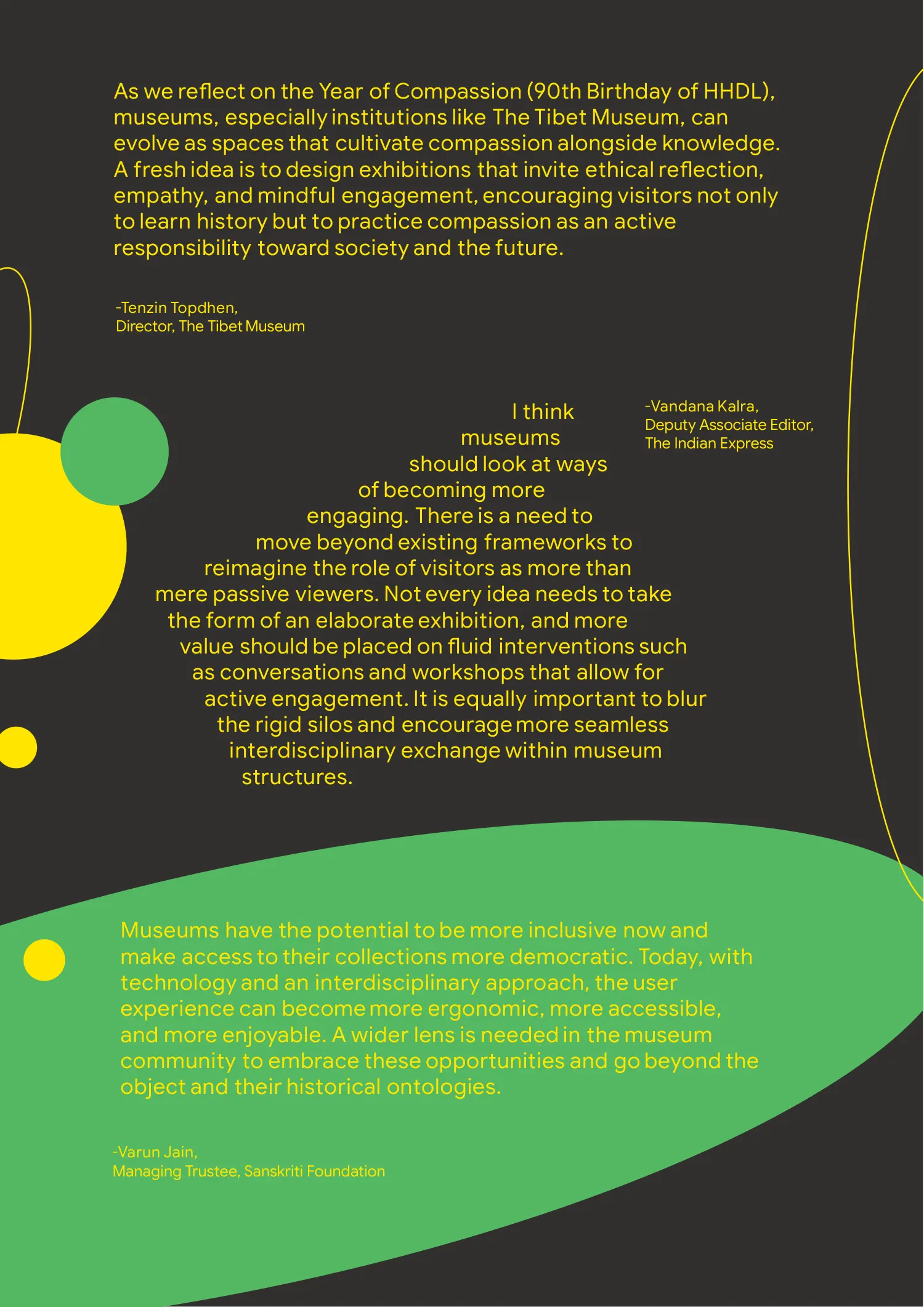
As we reflect on the Year of Compassion (90th Birthday of HHDL), museums, especially institutions like The Tibet Museum, can evolve as spaces that cultivate compassion alongside knowledge. A fresh idea is to design exhibitions that invite ethical reflection, empathy, and mindful engagement, encouraging visitors not only to learn history but to practice compassion as an active responsibility toward society and the future.
-Tenzin Topdhen, Director, The Tibet Museum
-Vandana Kalra, Deputy Associate Editor, The Indian Express
I think museums should look at ways of becoming more engaging. There is a need to move beyond existing frameworks to reimagine the role of visitors as more than mere passive viewers. Not every idea needs to take
the form of an elaborate exhibition, and more
value should be placed on fluid interventions such
as conversations and workshops that allow for
active engagement. It is equally important to blur
the rigid silos and encourage more seamless
interdisciplinary exchange within museum
structures.
Museums have the potential to be more inclusive now and make access to their collections more democratic. Today, with technology and an interdisciplinary approach, the user experience can become more ergonomic, more accessible, and more enjoyable. A wider lens is needed in the museum community to embrace these opportunities and go beyond the object and their historical ontologies.
-Varun Jain, Managing Trustee, Sanskriti Foundation
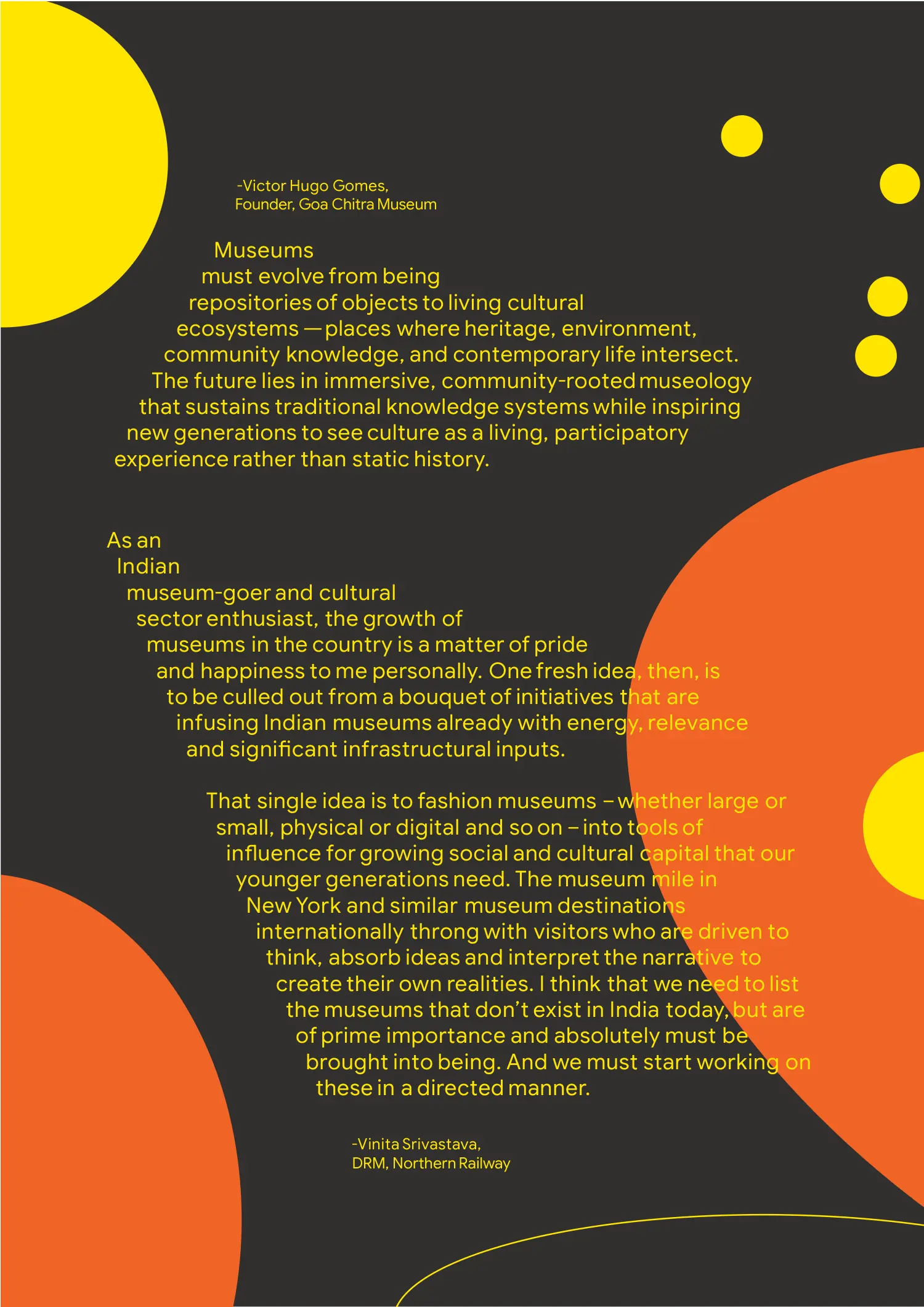
-Victor Hugo Gomes, Founder, Goa Chitra Museum
Museums must evolve from being repositories of objects to living cultural ecosystems — places where heritage, environment, community knowledge, and contemporary life intersect. The future lies in immersive, community-rooted museology that sustains traditional knowledge systems while inspiring new generations to see culture as a living, participatory experience rather than static history.
As an
Indian
museum-goer and cultural
sector enthusiast, the growth of
museums in the country is a matter of pride
and happiness to me personally. One fresh idea, then, is
to be culled out from a bouquet of initiatives that are
infusing Indian museums already with energy, relevance
and significant infrastructural inputs.
That single idea is to fashion museums – whether large or
small, physical or digital and so on – into tools of
influence for growing social and cultural capital that our
younger generations need. The museum mile in
New York and similar museum destinations
internationally throng with visitors who are driven to
think, absorb ideas and interpret the narrative to
create their own realities. I think that we need to list
the museums that don’t exist in India today, but are
of prime importance and absolutely must be
brought into being. And we must start working on
these in a directed manner.
-Vinita Srivastava, DRM, Northern Railway
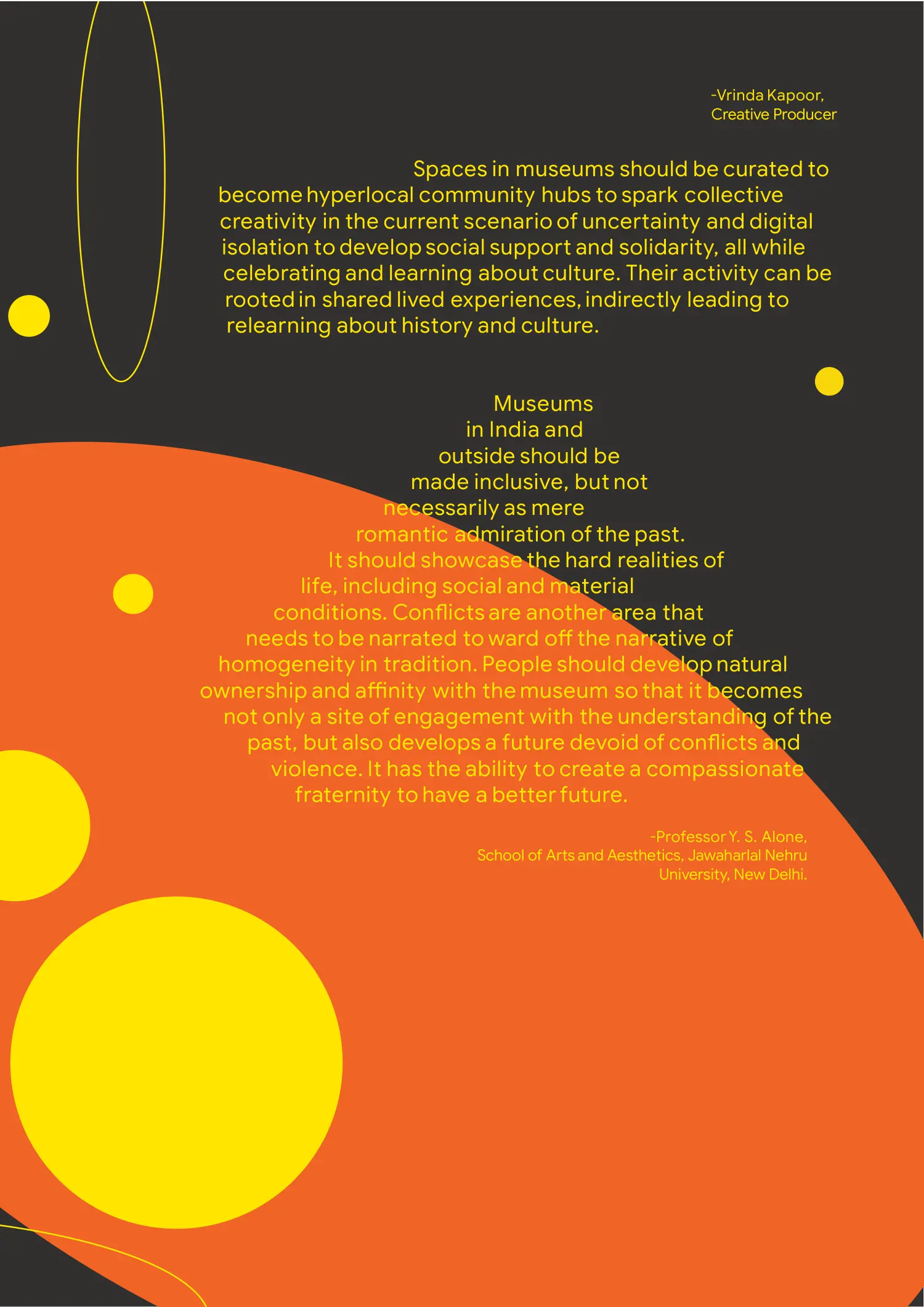
-Vrinda Kapoor, Creative Producer
Spaces in museums should be curated to become hyperlocal community hubs to spark collective
creativity in the current scenario of uncertainty and digital
isolation to develop social support and solidarity, all while
celebrating and learning about culture. Their activity can be
rooted in shared lived experiences, indirectly leading to
relearning about history and culture.
Museums in India and outside should be made inclusive, but not necessarily as mere romantic admiration of the past. It should showcase the hard realities of life, including social and material conditions. Conflicts are another area that needs to be narrated to ward off the narrative of homogeneity in tradition. People should develop natural ownership and affinity with the museum so that it becomes
not only a site of engagement with the understanding of the
past, but also develops a future devoid of conflicts and
violence. It has the ability to create a compassionate
fraternity to have a better future.
-Professor Y. S. Alone, School of Arts and Aesthetics, Jawaharlal Nehru
University, New Delhi.
View original pages, photographs & credits
Originally published in Museum Mosaic 2025, published May 2026.
Part of our annual review. Descriptions reflect the publication’s reporting period.