Benjamin Monserrate
Curatorial Associate & Educator, Museum of Christian Art (MoCA), Goa
Museum of Christian Art (MoCA), Goa
The Museum of Christian Art, established in 1994 at the Rachol Seminary and later relocated to the Convent of Santa Monica in 2002, has evolved into one of Goa’s most significant cultural institutions. Recognised as the first museum of its kind in Asia, it is dedicated to showcasing Indo-Portuguese art. Its founding was made possible through a collaborative effort between the Archdiocese of Goa, the Calouste Gulbenkian Foundation (Portugal), and INTACH, New Delhi. At the heart of the Museum’s collection lies a remarkable story of artistic exchange. Following the arrival of the Portuguese, European artistic traditions encountered local materials, techniques and aesthetic sensibilities. This interaction gave rise to a distinctive Indo-Portuguese style, where imported forms were reimagined through Goan craftsmanship. The result is evident across the collection, from intricately carved furniture and finely worked silverware to richly adorned textiles, each piece reflecting a vibrant synthesis shaped by skilled local artisans.
The ships that survived the long and perilous journey from Lisbon to Goa during the early Modern Age carried soldiers, merchants and missionaries to Indian shores. Among them was Saint Francis Xavier, whose life and legacy would leave an indelible mark on Goa and beyond. The collection at the Museum of Christian Art, Goa, offers valuable insight into how artists have interpreted the saint’s life and iconography, reflecting diverse perspectives on his spiritual journey and enduring influence.
All images are provided by the author
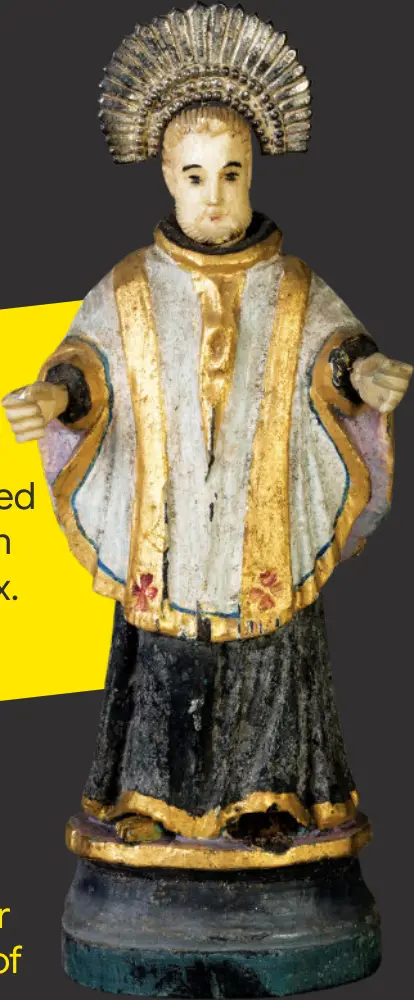
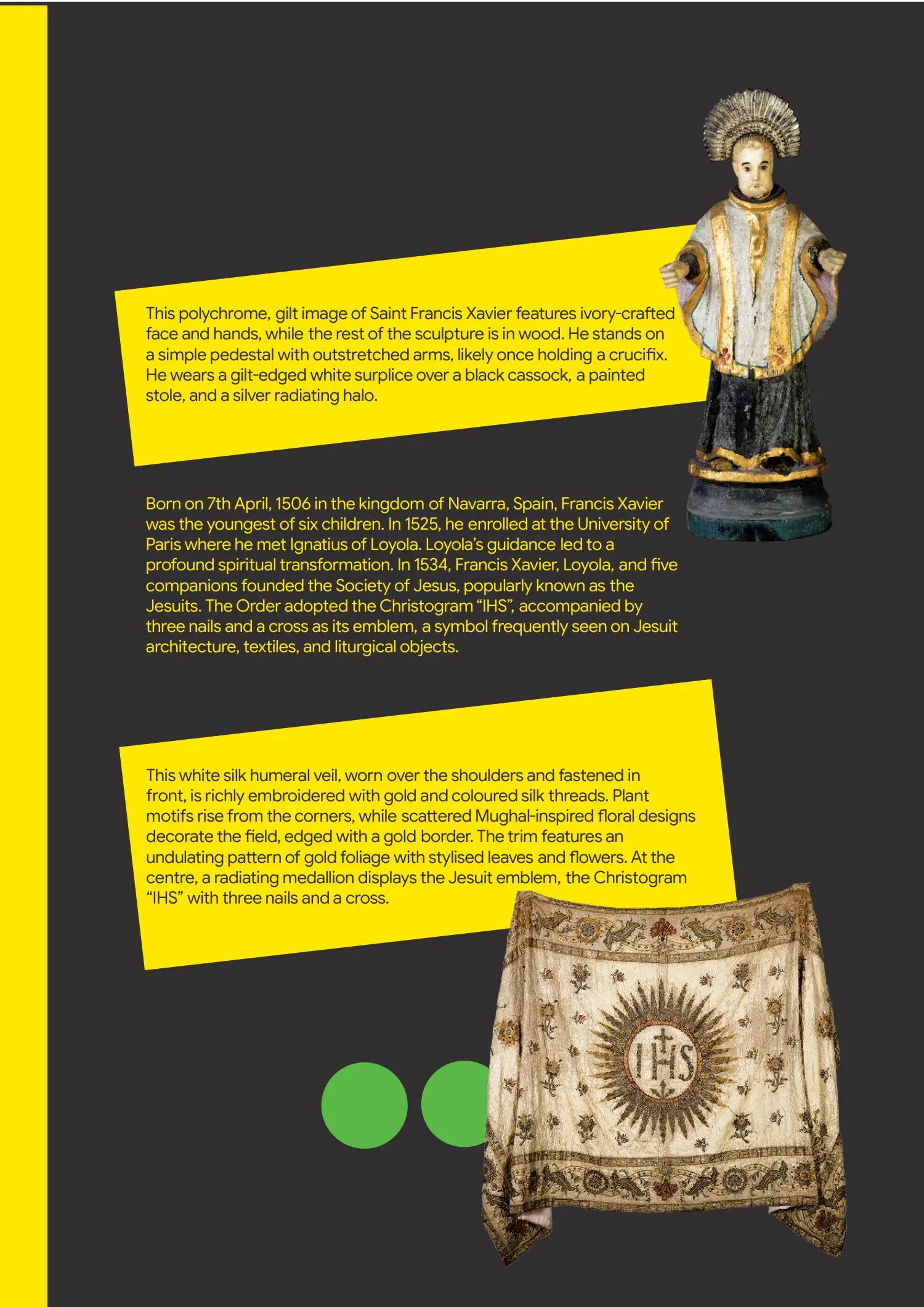
This polychrome, gilt image of Saint Francis Xavier features ivory-crafted face and hands, while the rest of the sculpture is in wood. He stands on a simple pedestal with outstretched arms, likely once holding a crucifix. He wears a gilt-edged white surplice over a black cassock, a painted stole, and a silver radiating halo.
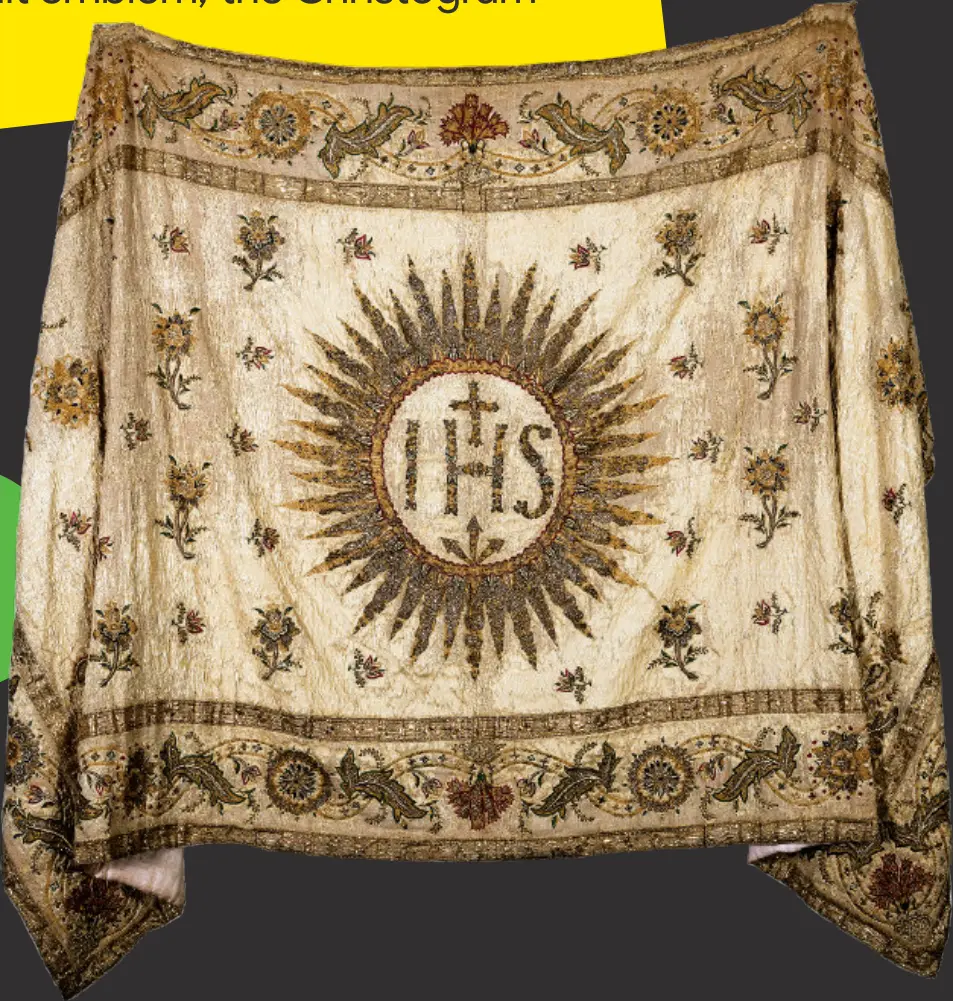
Born on 7th April, 1506 in the kingdom of Navarra, Spain, Francis Xavier was the youngest of six children. In 1525, he enrolled at the University of Paris where he met Ignatius of Loyola. Loyola’s guidance led to a profound spiritual transformation. In 1534, Francis Xavier, Loyola, and five companions founded the Society of Jesus, popularly known as the Jesuits. The Order adopted the Christogram “IHS”, accompanied by three nails and a cross as its emblem, a symbol frequently seen on Jesuit architecture, textiles, and liturgical objects.
This white silk humeral veil, worn over the shoulders and fastened in front, is richly embroidered with gold and coloured silk threads. Plant motifs rise from the corners, while scattered Mughal-inspired floral designs decorate the field, edged with a gold border. The trim features an undulating pattern of gold foliage with stylised leaves and flowers. At the centre, a radiating medallion displays the Jesuit emblem, the Christogram “IHS” with three nails and a cross.
In 1541, Francis Xavier set sail for India under the authority of Ignatius Loyola, the Pope and the King of Portugal. He arrived in Goa in 1542, which became the base for his missionary work over the next decade. From here, he travelled extensively across regions such as the Coromandel Coast, Malacca, and Japan.
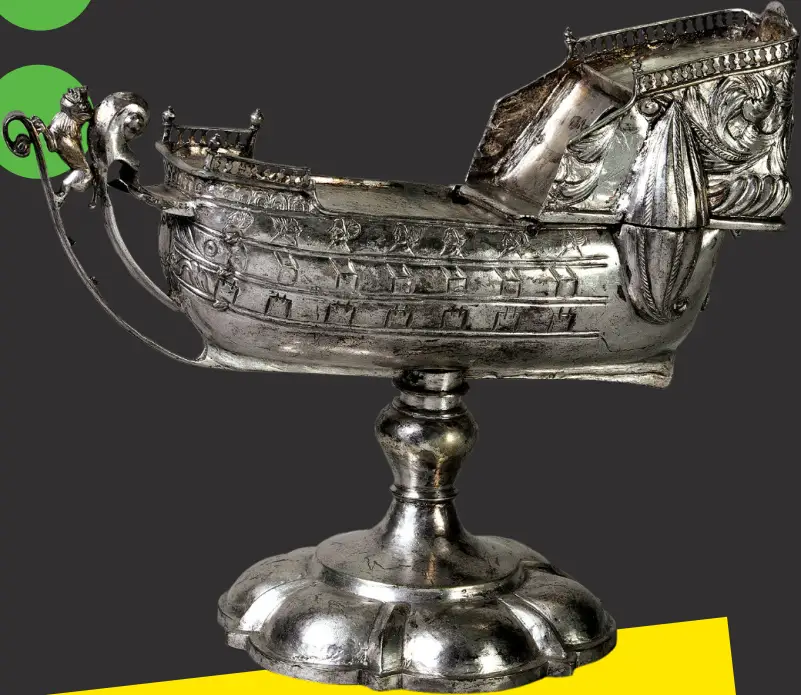
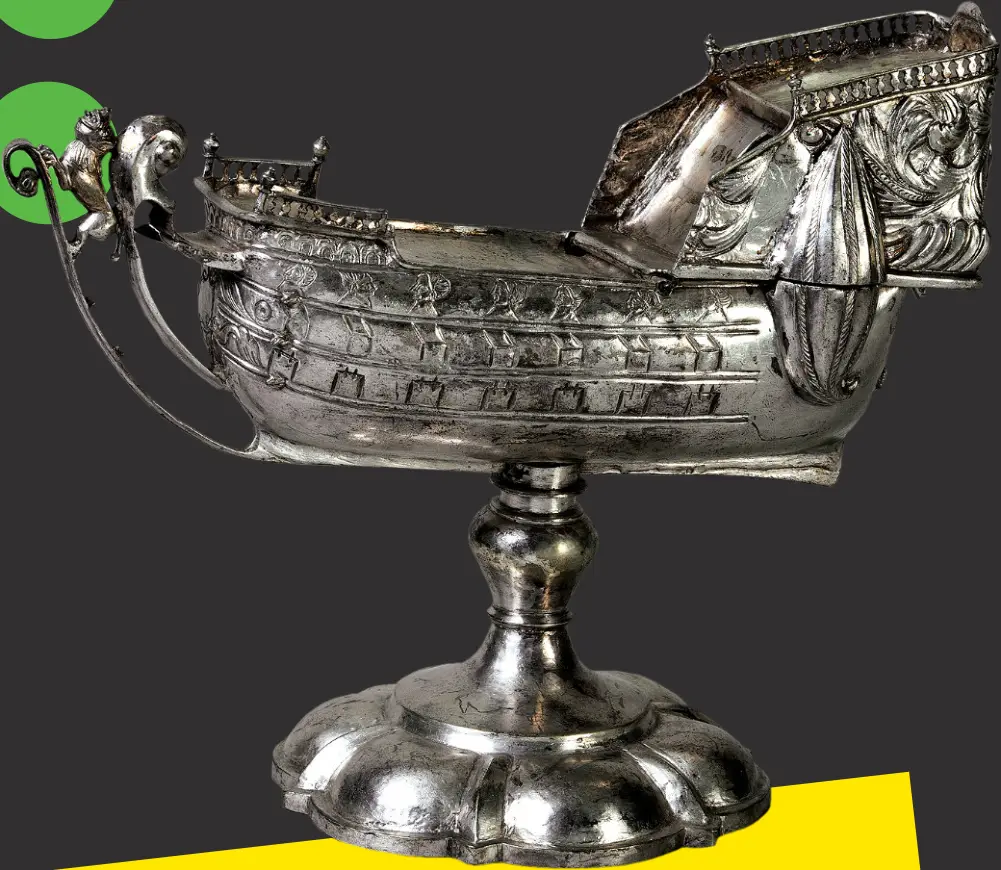
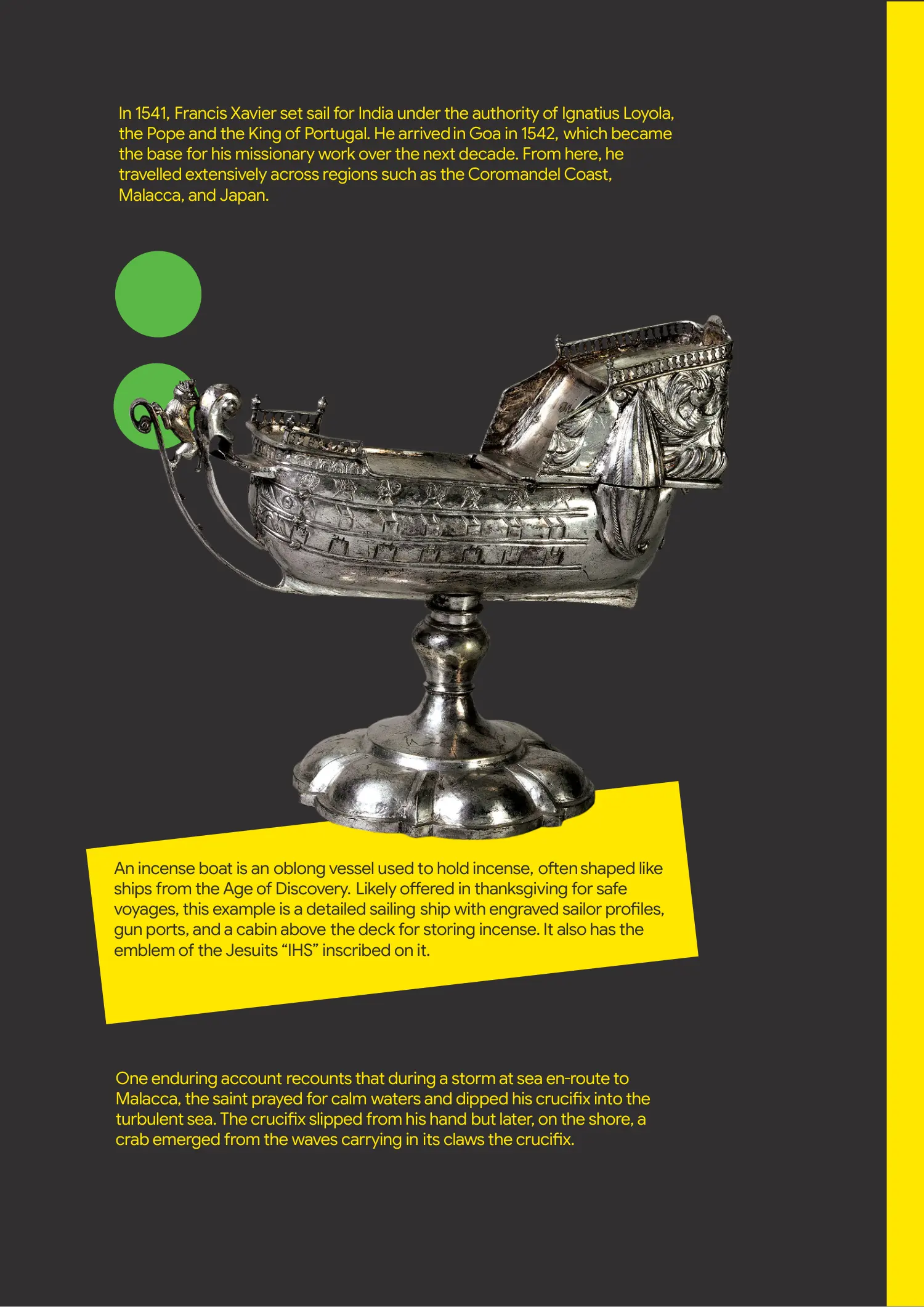
An incense boat is an oblong vessel used to hold incense, often shaped like ships from the Age of Discovery. Likely offered in thanksgiving for safe voyages, this example is a detailed sailing ship with engraved sailor profiles, gun ports, and a cabin above the deck for storing incense. It also has the emblem of the Jesuits “IHS” inscribed on it.
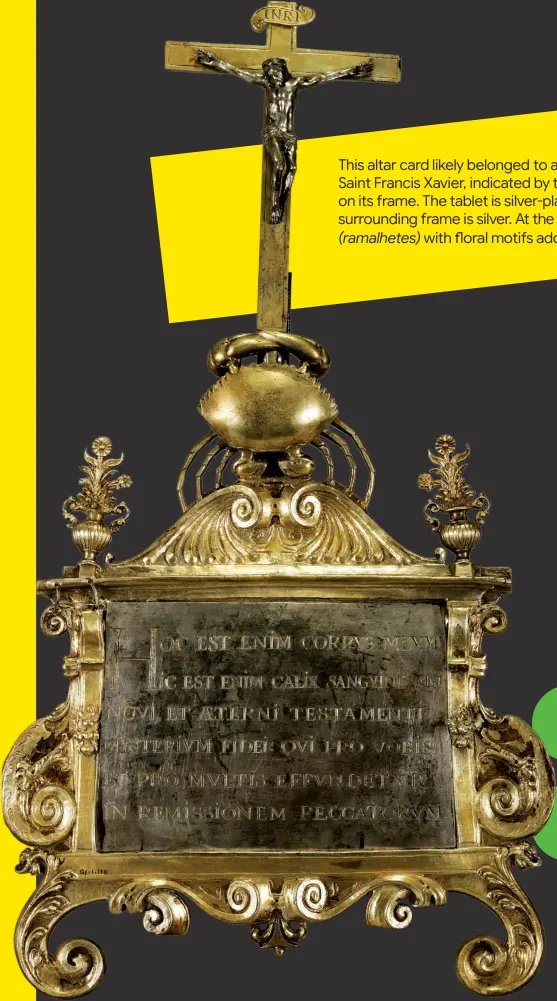
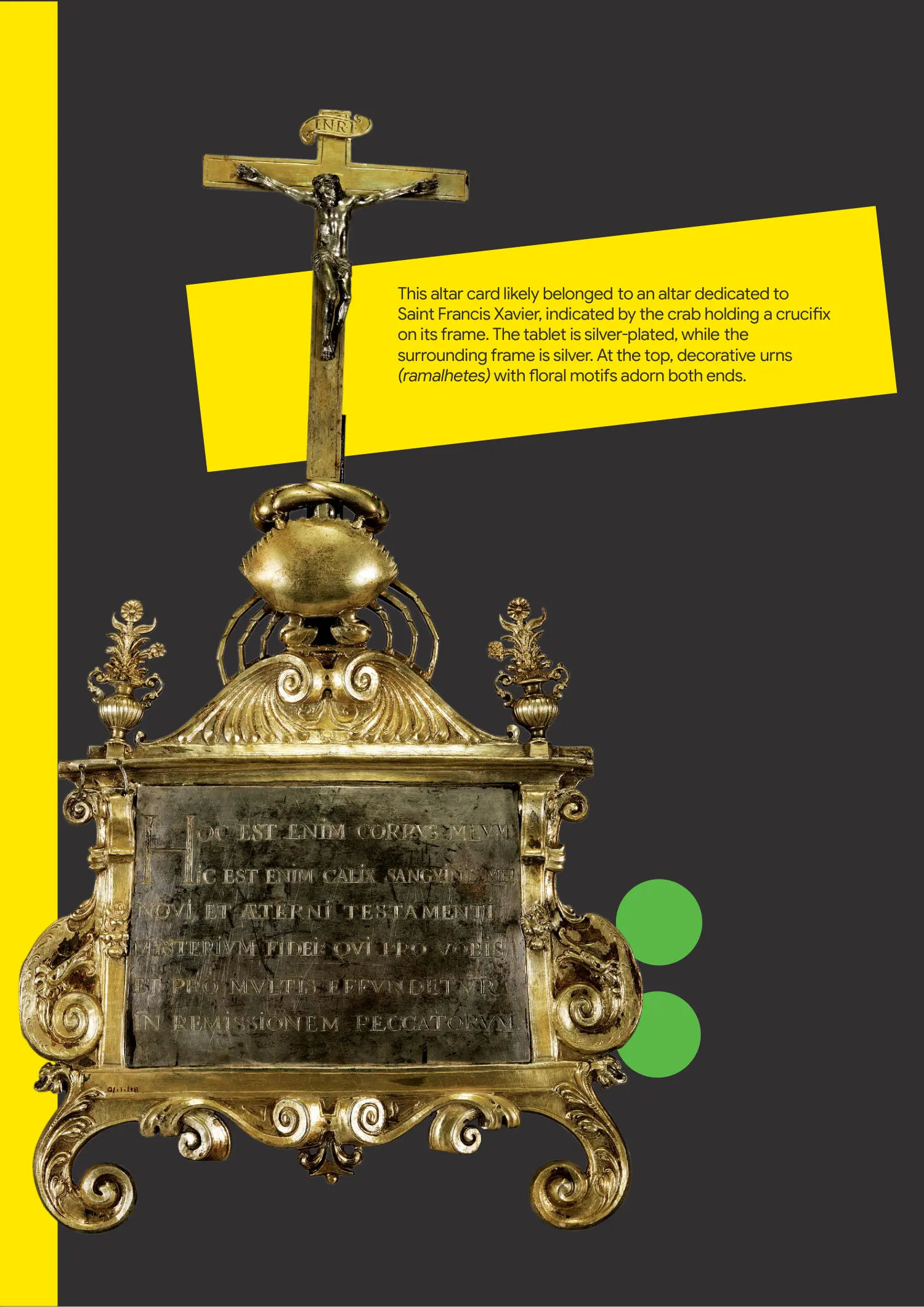
One enduring account recounts that during a storm at sea en-route to Malacca, the saint prayed for calm waters and dipped his crucifix into the turbulent sea. The crucifix slipped from his hand but later, on the shore, a crab emerged from the waves carrying in its claws the crucifix.
This altar card likely belonged to an altar dedicated to Saint Francis Xavier, indicated by the crab holding a crucifix on its frame. The tablet is silver-plated, while the surrounding frame is silver. At the top, decorative urns (ramalhetes) with floral motifs adorn both ends.
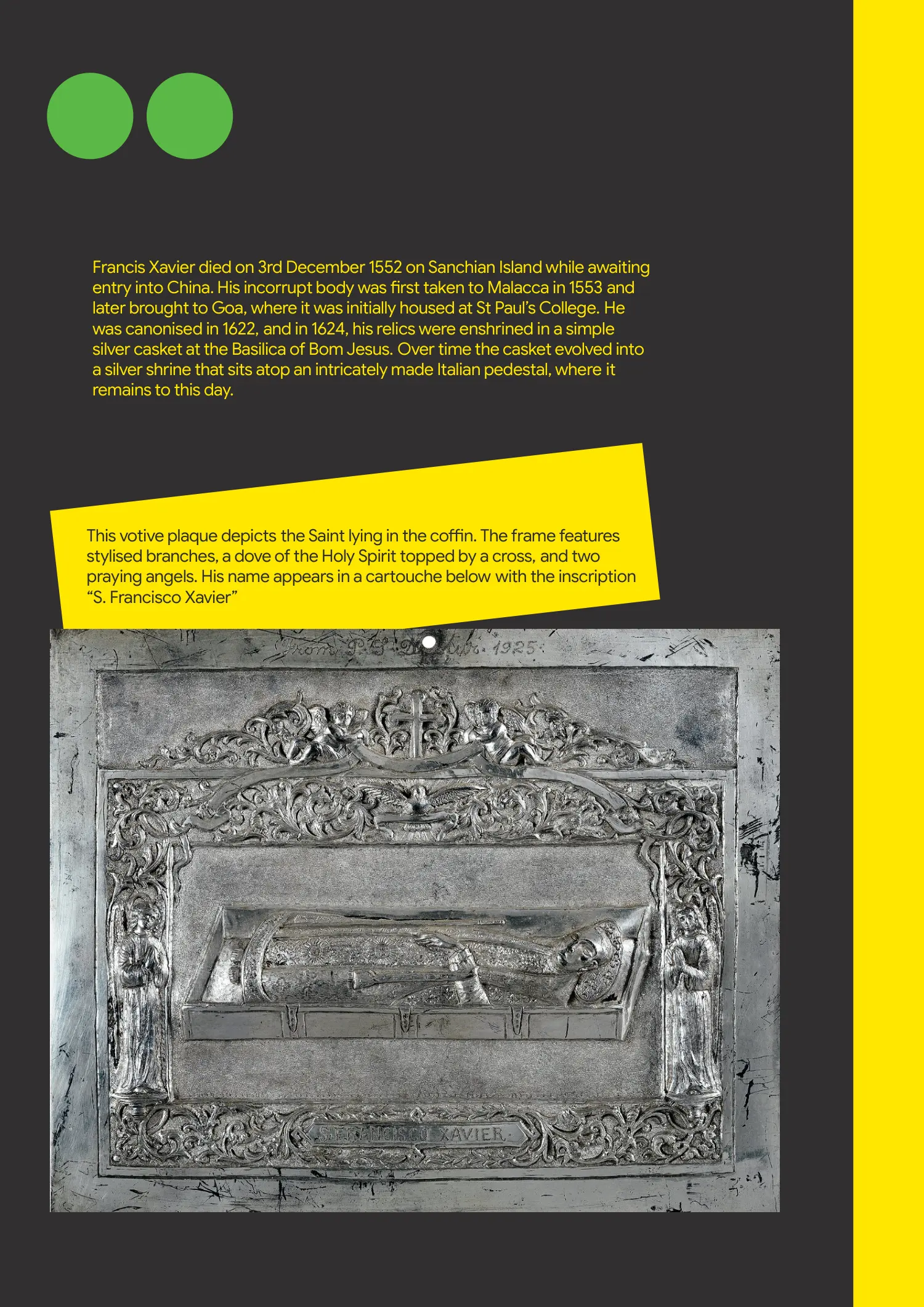
Francis Xavier died on 3rd December 1552 on Sanchian Island while awaiting entry into China. His incorrupt body was first taken to Malacca in 1553 and later brought to Goa, where it was initially housed at St Paul’s College. He was canonised in 1622, and in 1624, his relics were enshrined in a simple silver casket at the Basilica of Bom Jesus. Over time the casket evolved into a silver shrine that sits atop an intricately made Italian pedestal, where it remains to this day.
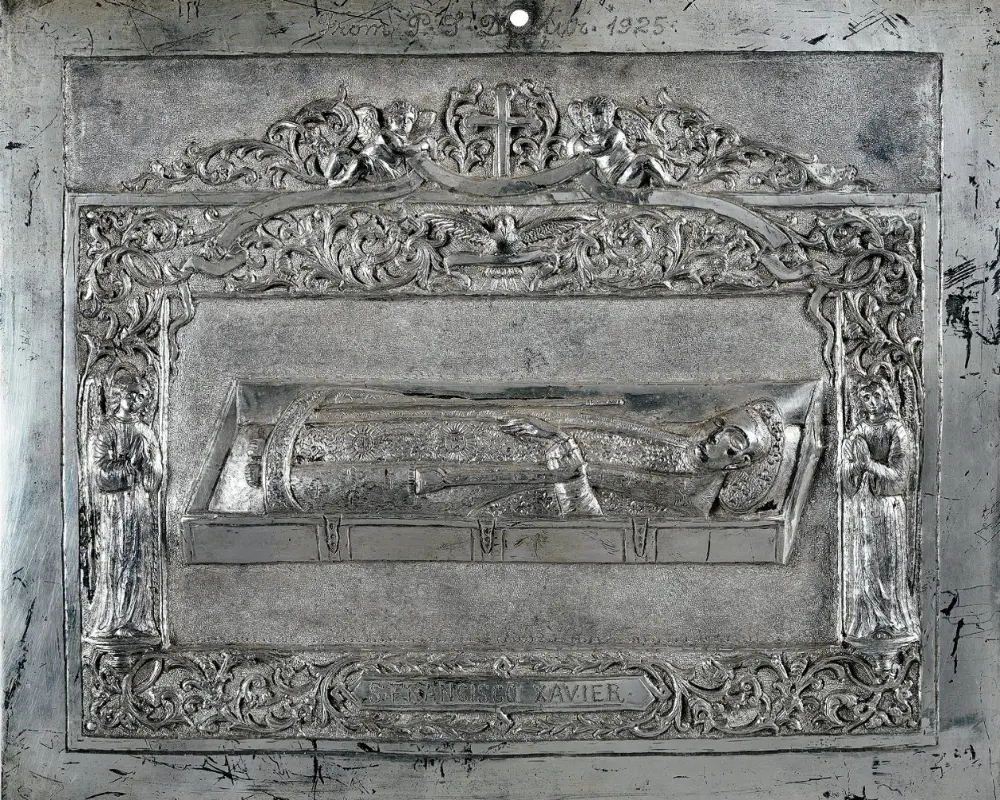
This votive plaque depicts the Saint lying in the coffin. The frame features stylised branches, a dove of the Holy Spirit topped by a cross, and two praying angels. His name appears in a cartouche below with the inscription “S. Francisco Xavier”
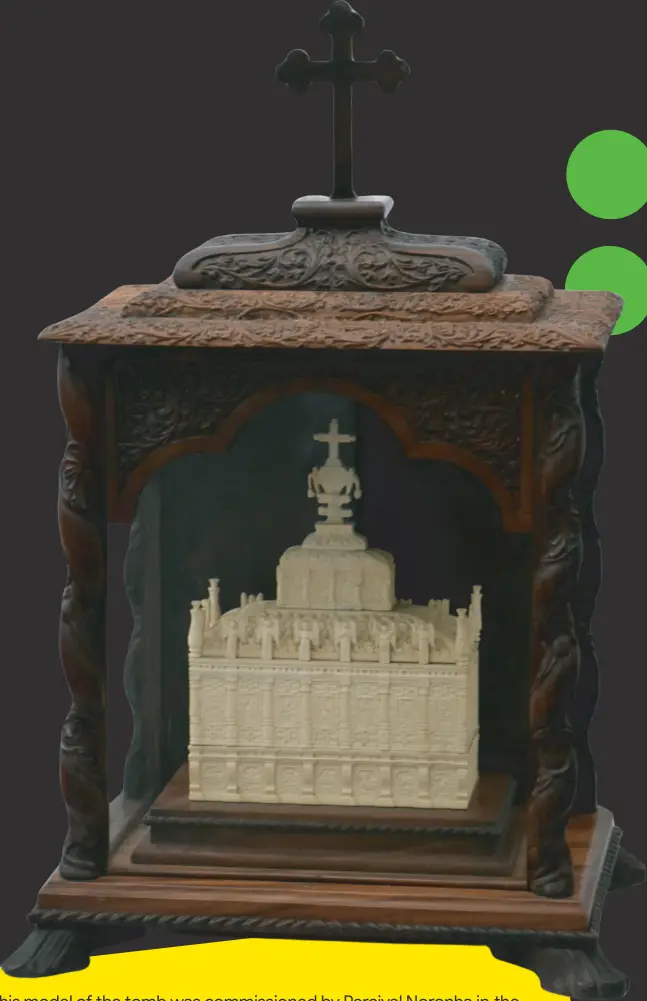
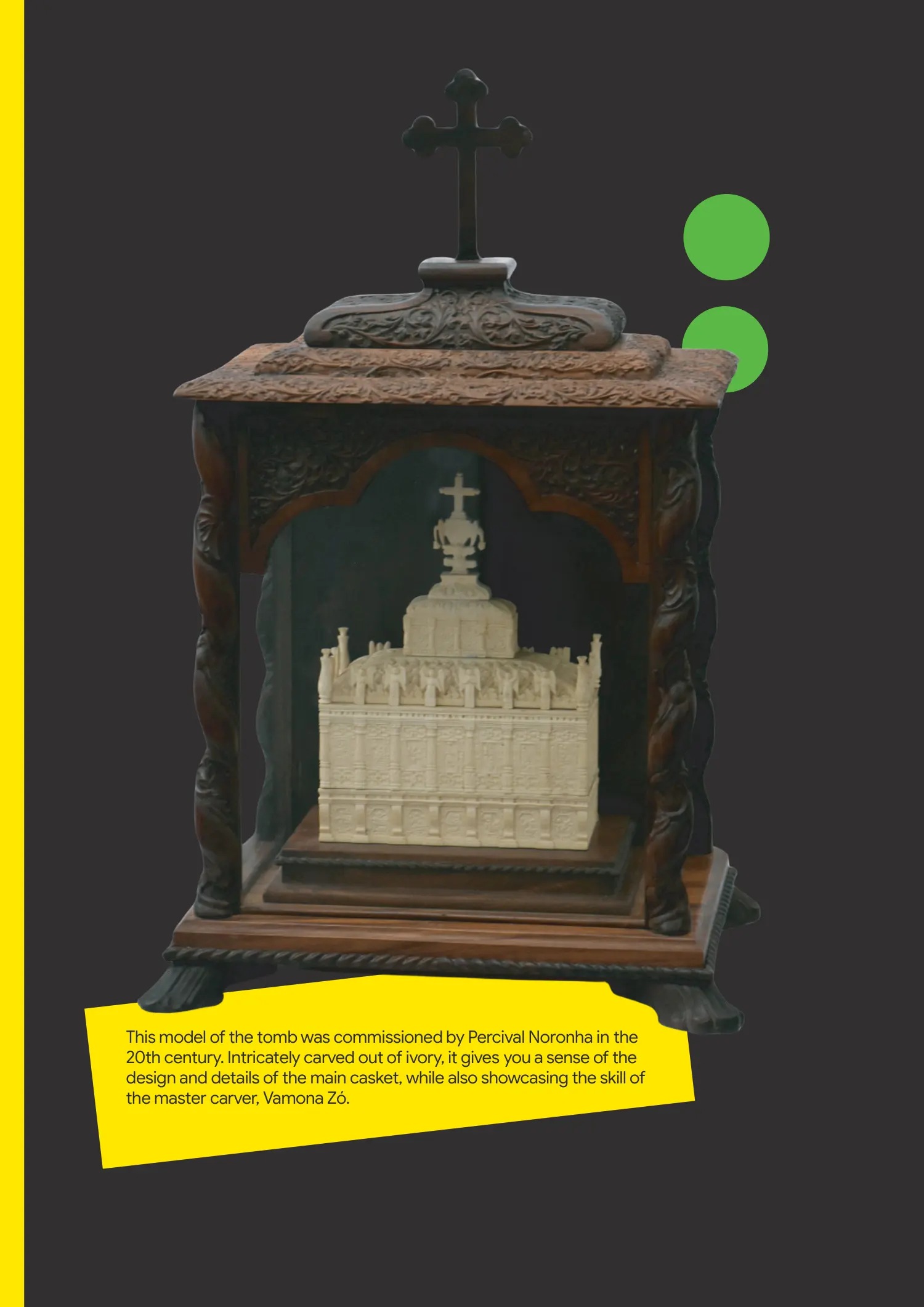
This model of the tomb was commissioned by Percival Noronha in the 20th century. Intricately carved out of ivory, it gives you a sense of the design and details of the main casket, while also showcasing the skill of the master carver, Vamona Zó.
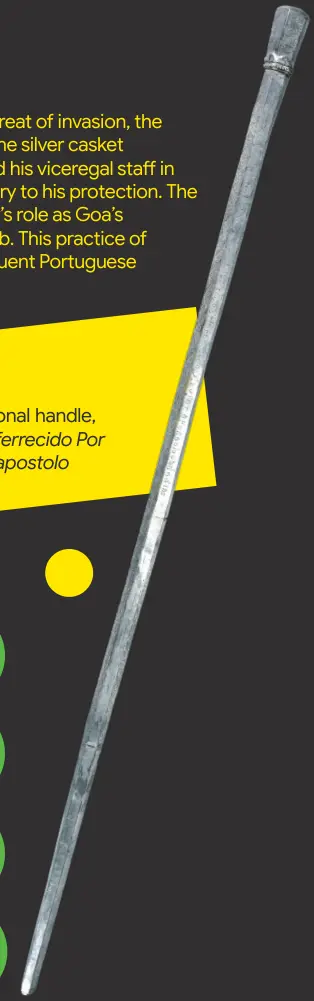
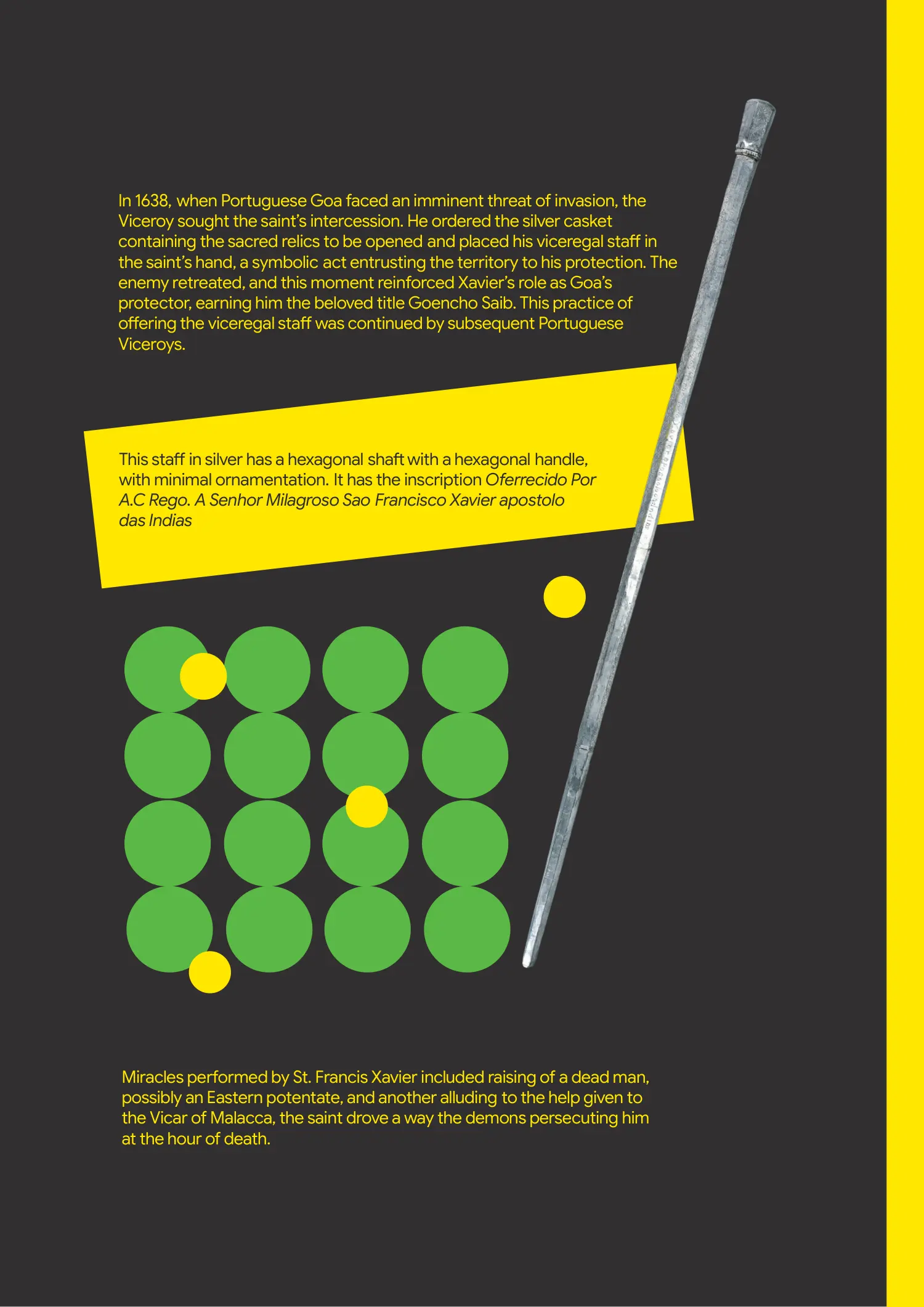
In 1638, when Portuguese Goa faced an imminent threat of invasion, the Viceroy sought the saint’s intercession. He ordered the silver casket containing the sacred relics to be opened and placed his viceregal staff in the saint’s hand, a symbolic act entrusting the territory to his protection. The enemy retreated, and this moment reinforced Xavier’s role as Goa’s protector, earning him the beloved title Goencho Saib. This practice of offering the viceregal staff was continued by subsequent Portuguese Viceroys.
This staff in silver has a hexagonal shaft with a hexagonal handle, with minimal ornamentation. It has the inscription Oferrecido Por A.C Rego. A Senhor Milagroso Sao Francisco Xavier apostolo das Indias
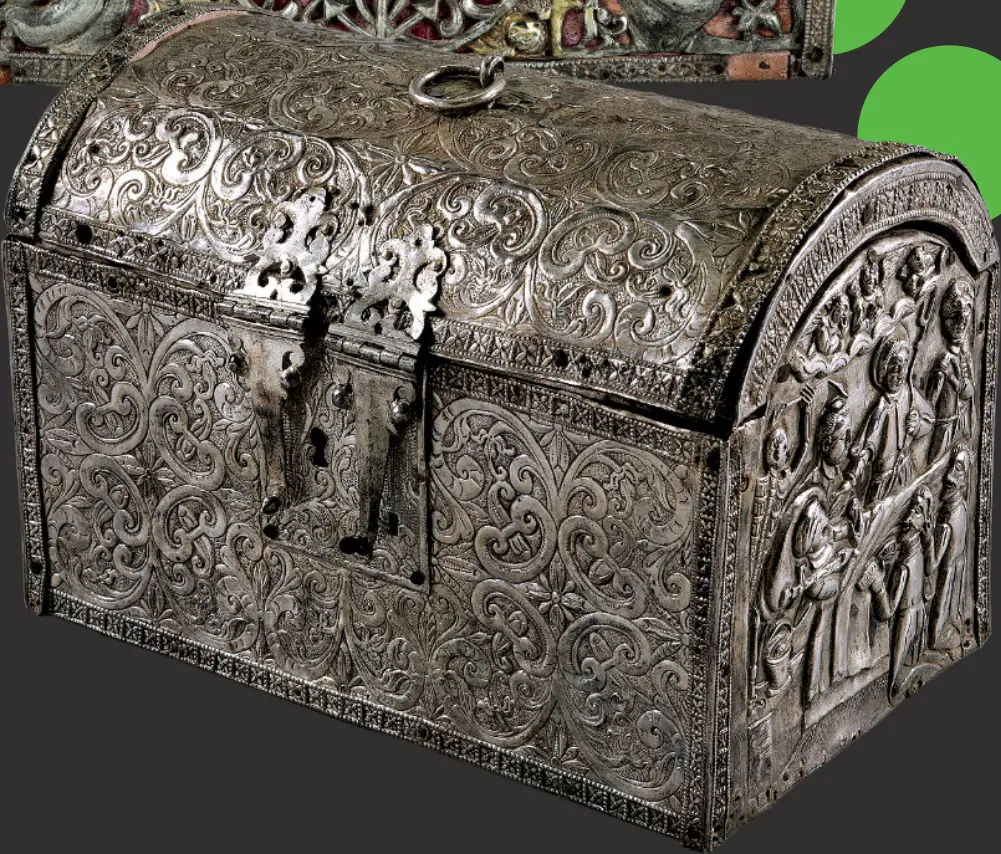
Miracles performed by St. Francis Xavier included raising of a dead man, possibly an Eastern potentate, and another alluding to the help given to the Vicar of Malacca, the saint drove a way the demons persecuting him at the hour of death.
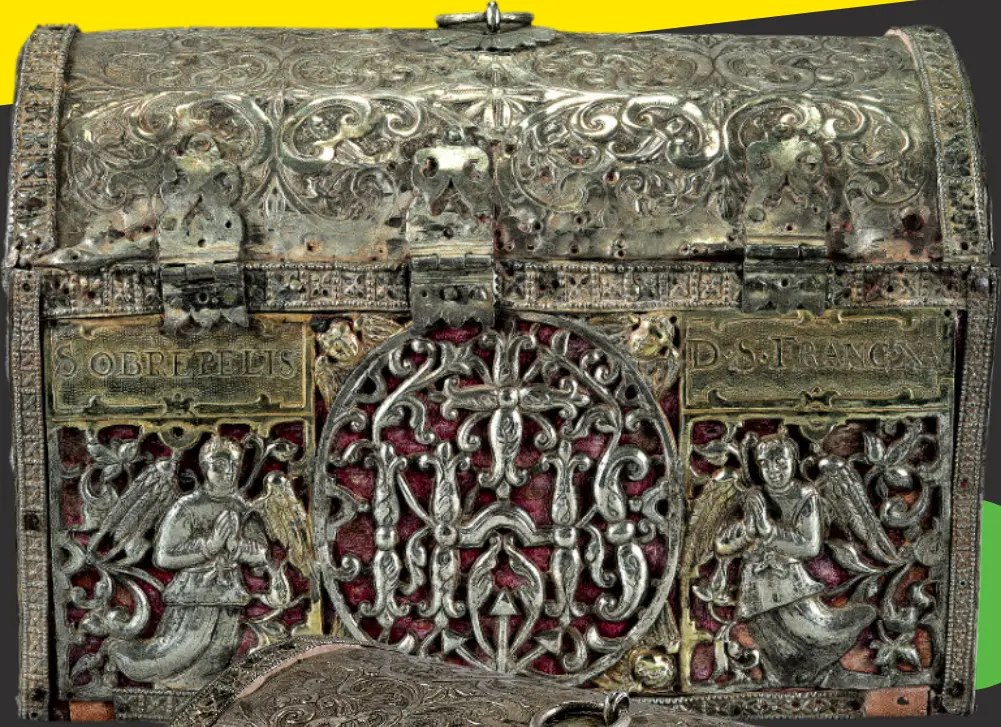
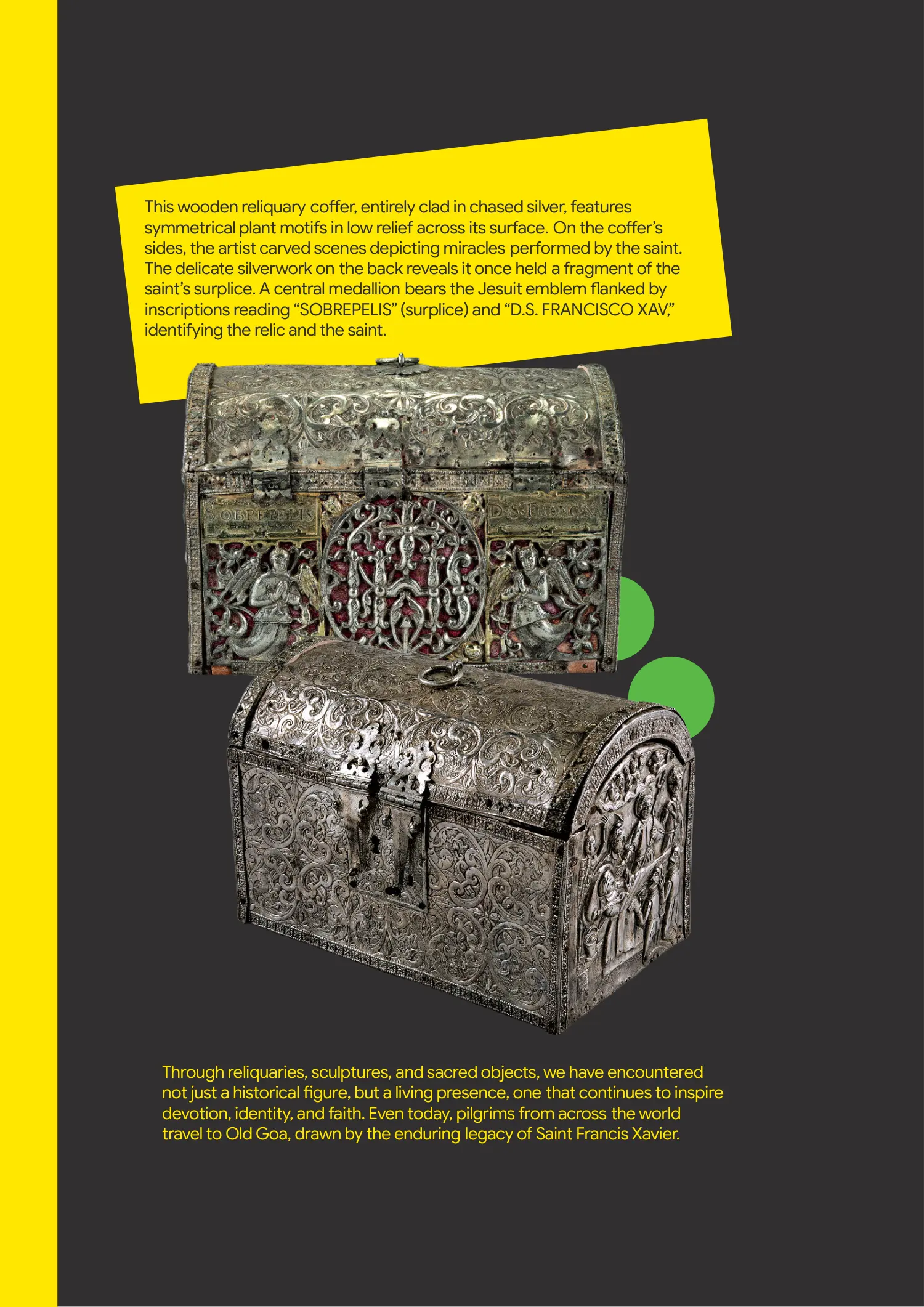
This wooden reliquary coffer, entirely clad in chased silver, features symmetrical plant motifs in low relief across its surface. On the coffer’s sides, the artist carved scenes depicting miracles performed by the saint. The delicate silverwork on the back reveals it once held a fragment of the saint’s surplice. A central medallion bears the Jesuit emblem flanked by inscriptions reading “SOBREPELIS” (surplice) and “D.S. FRANCISCO XAV,” identifying the relic and the saint.
Through reliquaries, sculptures, and sacred objects, we have encountered not just a historical figure, but a living presence, one that continues to inspire devotion, identity, and faith. Even today, pilgrims from across the world travel to Old Goa, drawn by the enduring legacy of Saint Francis Xavier.
View original pages, photographs & credits
Originally published in Museum Mosaic 2025, published May 2026.
Part of our annual review. Descriptions reflect the publication’s reporting period.