Shri Pratap Singh Museum, Kashmir
Set along the banks of the Jhelum in Srinagar, the Shri Pratap Singh (SPS) Museum is housed in what was once a summer guesthouse of 19th century Dogra rulers — a space that has, over time, become a repository of Kashmir’s many pasts. While the historic building is currently undergoing restoration, an adjacent new structure curates only a fraction of its 82,000 artefacts, offering a glimpse into a history that is layered and never entirely contained. Across the galleries, objects made of clay, stone, metal, and wood appear to belong to different times, rulers and traditions. Yet, when read together, these materials carry within them the imprint of Kashmir’s layered spiritual, political, and cultural traditions, where forms of belief have transformed and overlapped across centuries. Early objects press the sacred into surfaces that are embedded and are almost inseparable from the spaces they inhabit. Over time, the divine is given a body, fixed in stone, multiplied, and made visible. Metal allows these forms to travel with inscriptions and coins beginning to circulate authority beyond the monument, placing it into the hands of the masses. By the 19th century, materials took on an additional role altogether, not merely of representing, but also enforcing. This trail follows that movement, from clay to cannon, tracing how each material carries a different way of shaping the sacred, the state, and the self in Kashmir’s layered past.
Taha Mughal Historic Preservationist and Writer
Mohammad Fazil Panjwala, Independent Researcher
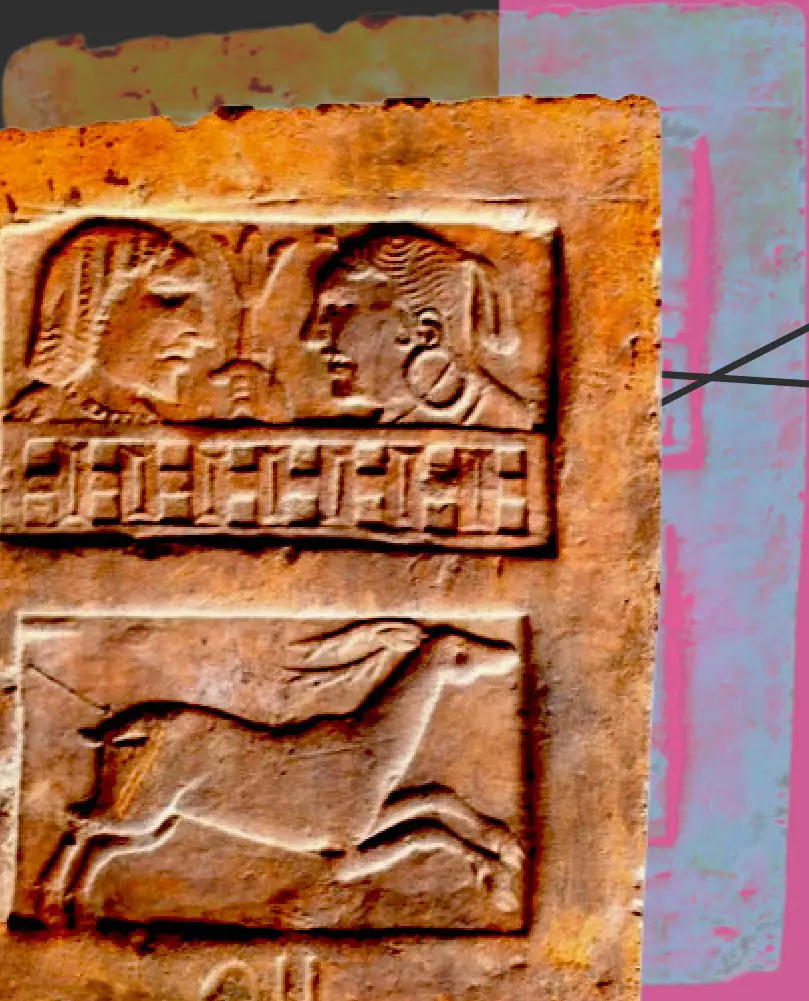
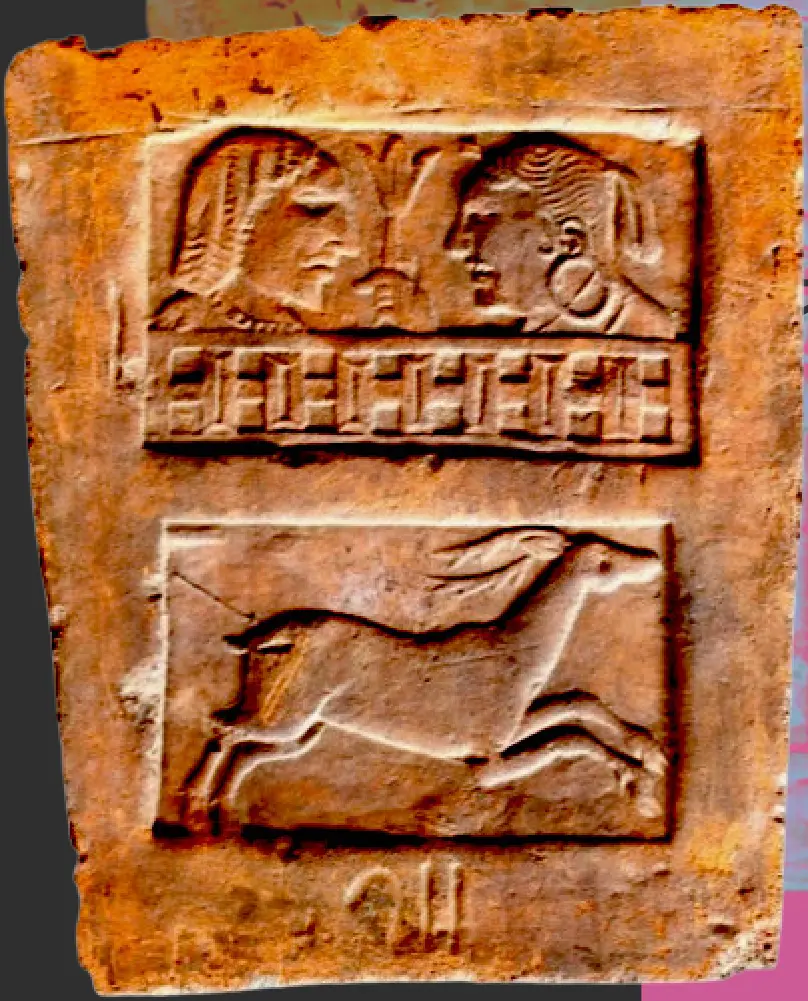
Terracotta tile
Harwan
4th Century CE
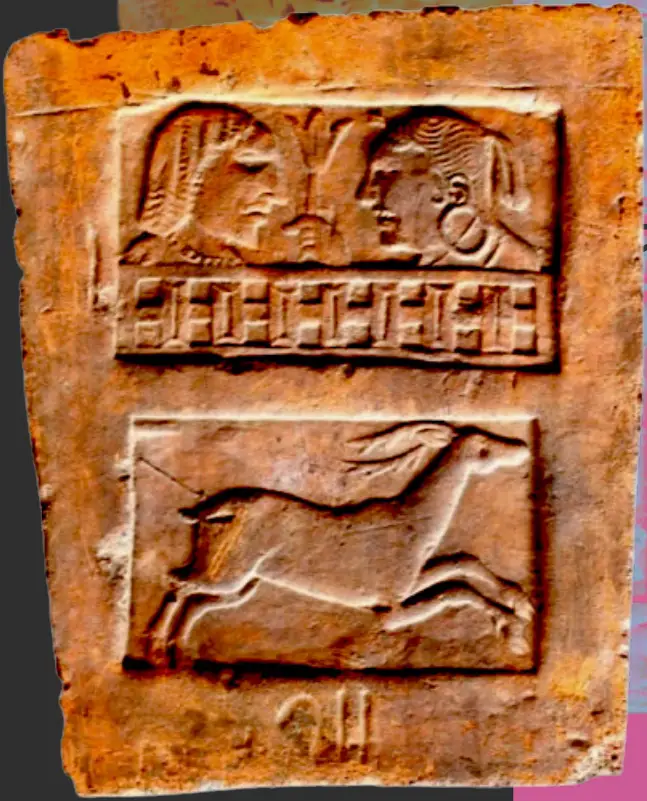
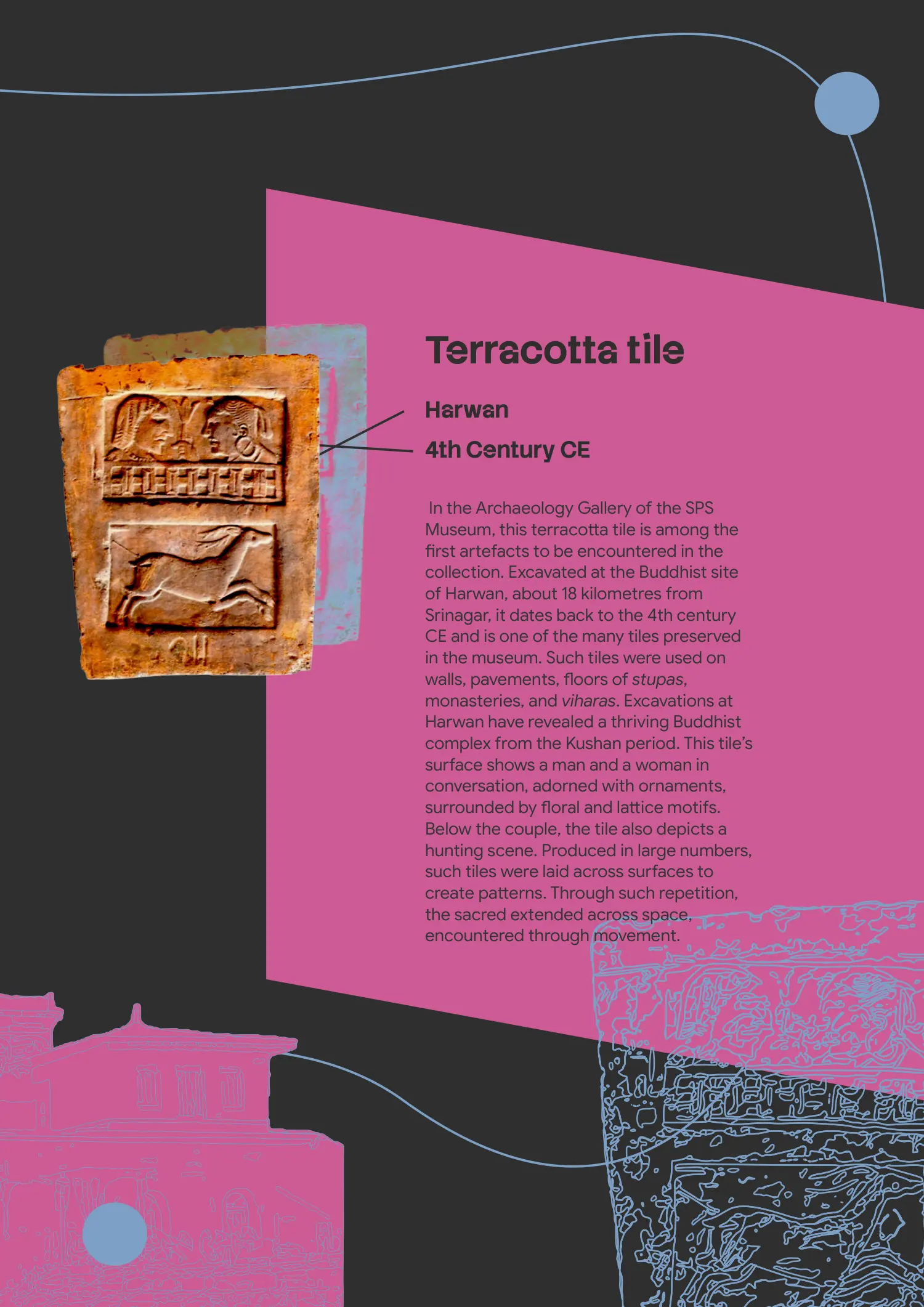
In the Archaeology Gallery of the SPS Museum, this terracotta tile is among the first artefacts to be encountered in the collection. Excavated at the Buddhist site of Harwan, about 18 kilometres from Srinagar, it dates back to the 4th century CE and is one of the many tiles preserved in the museum. Such tiles were used on walls, pavements, floors of stupas, monasteries, and viharas. Excavations at Harwan have revealed a thriving Buddhist complex from the Kushan period. This tile’s surface shows a man and a woman in conversation, adorned with ornaments, surrounded by floral and lattice motifs. Below the couple, the tile also depicts a hunting scene. Produced in large numbers, such tiles were laid across surfaces to create patterns. Through such repetition, the sacred extended across space, encountered through movement.
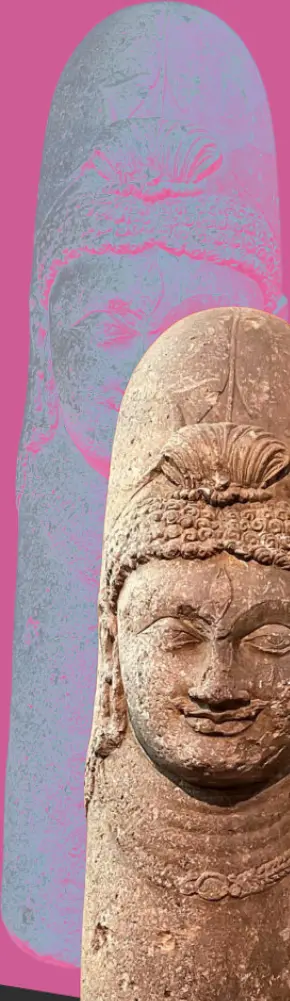
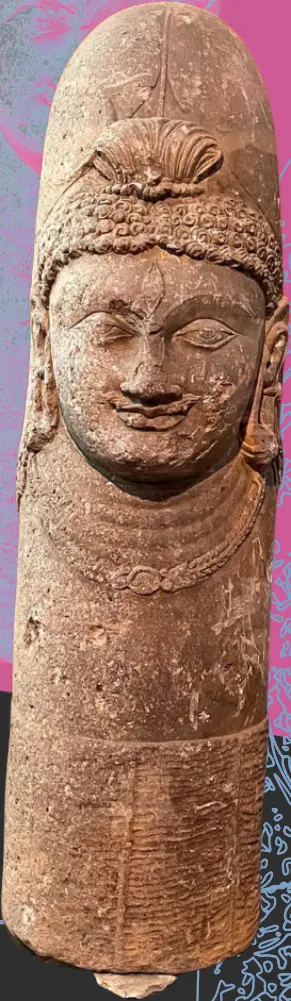
Ek Mukh Linga
Harwan
7th Century CE
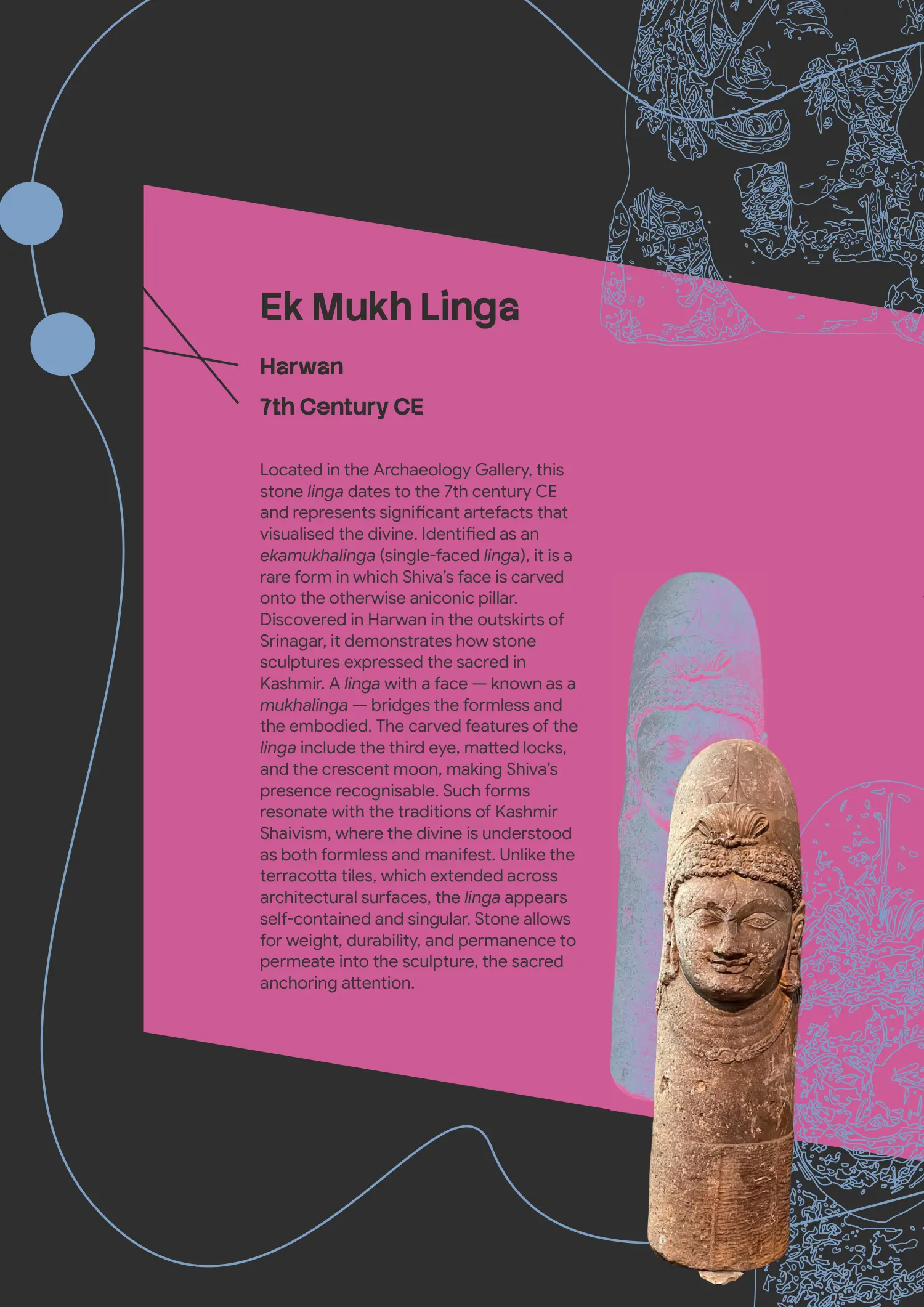
Located in the Archaeology Gallery, this stone linga dates to the 7th century CE and represents significant artefacts that visualised the divine. Identified as an ekamukhalinga (single-faced linga), it is a rare form in which Shiva’s face is carved onto the otherwise aniconic pillar. Discovered in Harwan in the outskirts of Srinagar, it demonstrates how stone sculptures expressed the sacred in Kashmir. A linga with a face — known as a mukhalinga — bridges the formless and the embodied. The carved features of the linga include the third eye, matted locks, and the crescent moon, making Shiva’s presence recognisable. Such forms resonate with the traditions of Kashmir Shaivism, where the divine is understood as both formless and manifest. Unlike the terracotta tiles, which extended across architectural surfaces, the linga appears self-contained and singular. Stone allows for weight, durability, and permanence to permeate into the sculpture, the sacred anchoring attention.
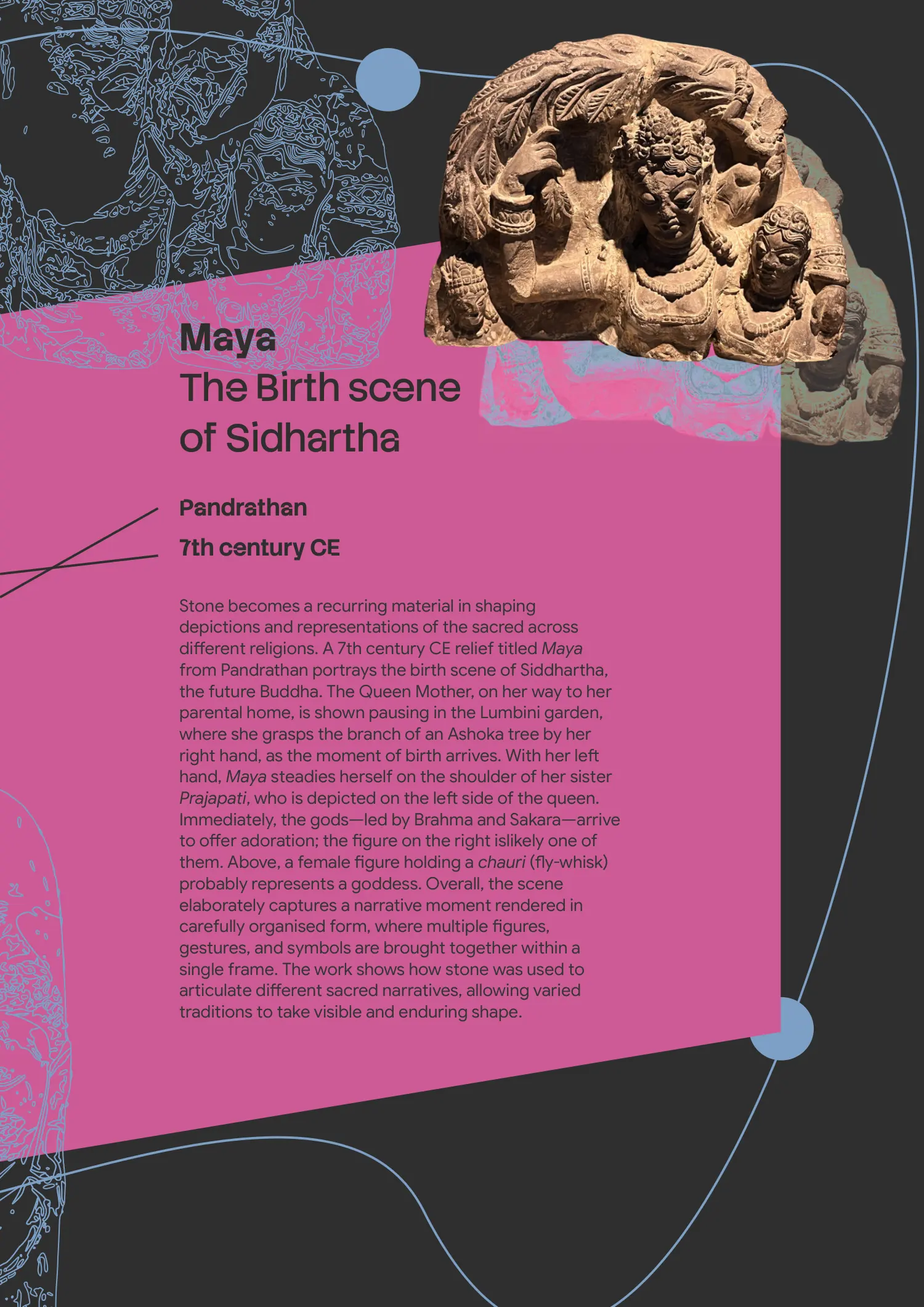
Maya The Birth scene of Sidhartha
Pandrathan
7th century CE
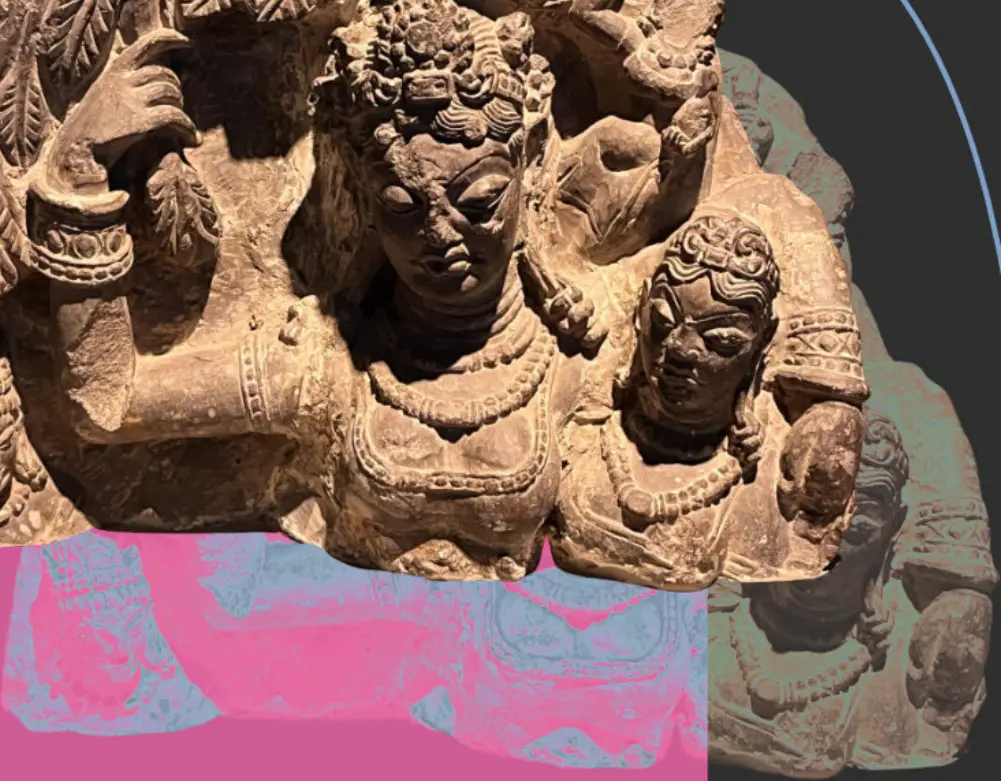
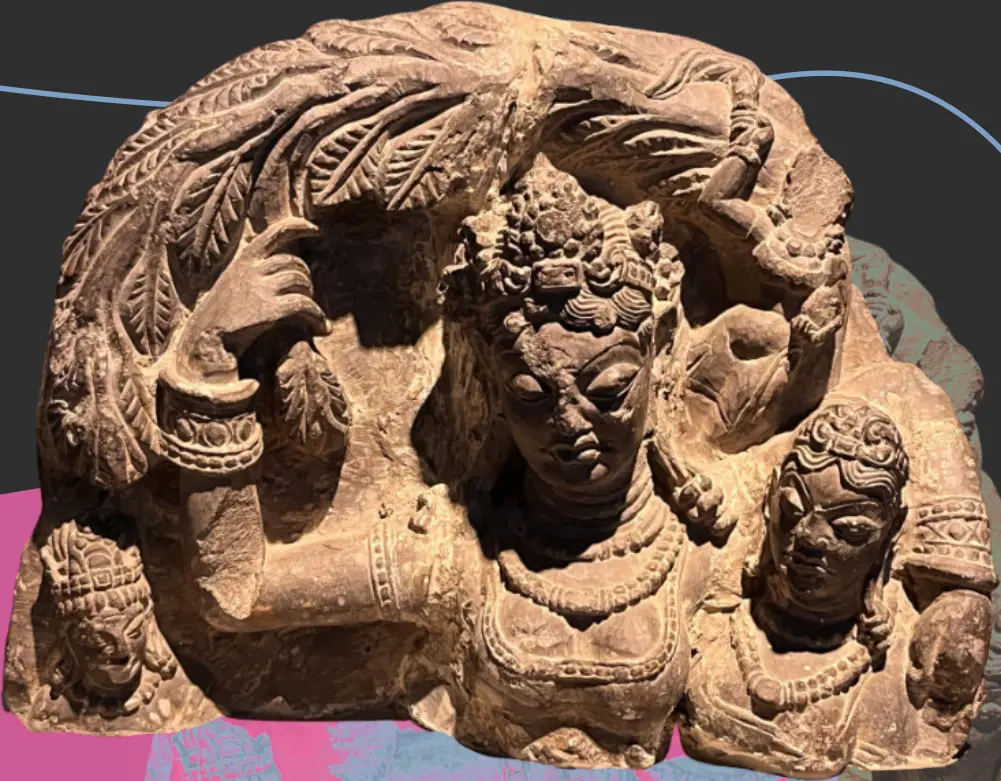
Stone becomes a recurring material in shaping depictions and representations of the sacred across different religions. A 7th century CE relief titled Maya from Pandrathan portrays the birth scene of Siddhartha, the future Buddha. The Queen Mother, on her way to her parental home, is shown pausing in the Lumbini garden, where she grasps the branch of an Ashoka tree by her right hand, as the moment of birth arrives. With her left hand, Maya steadies herself on the shoulder of her sister Prajapati, who is depicted on the left side of the queen. Immediately, the gods—led by Brahma and Sakara—arrive to offer adoration; the figure on the right islikely one of them. Above, a female figure holding a chauri (fly-whisk) probably represents a goddess. Overall, the scene elaborately captures a narrative moment rendered in carefully organised form, where multiple figures, gestures, and symbols are brought together within a single frame. The work shows how stone was used to articulate different sacred narratives, allowing varied traditions to take visible and enduring shape.
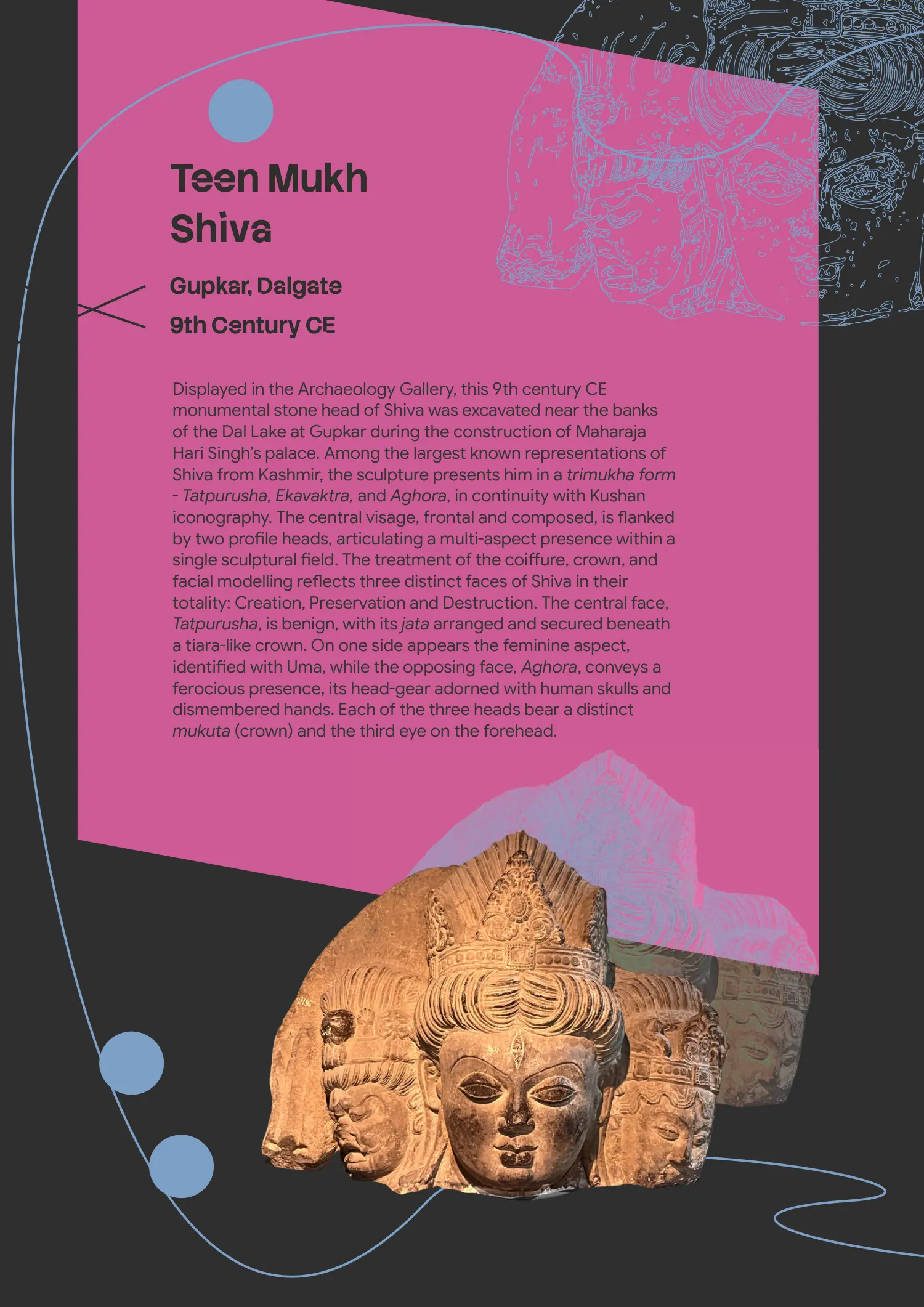
Teen Mukh Shiva
Gupkar, Dalgate
9th Century CE
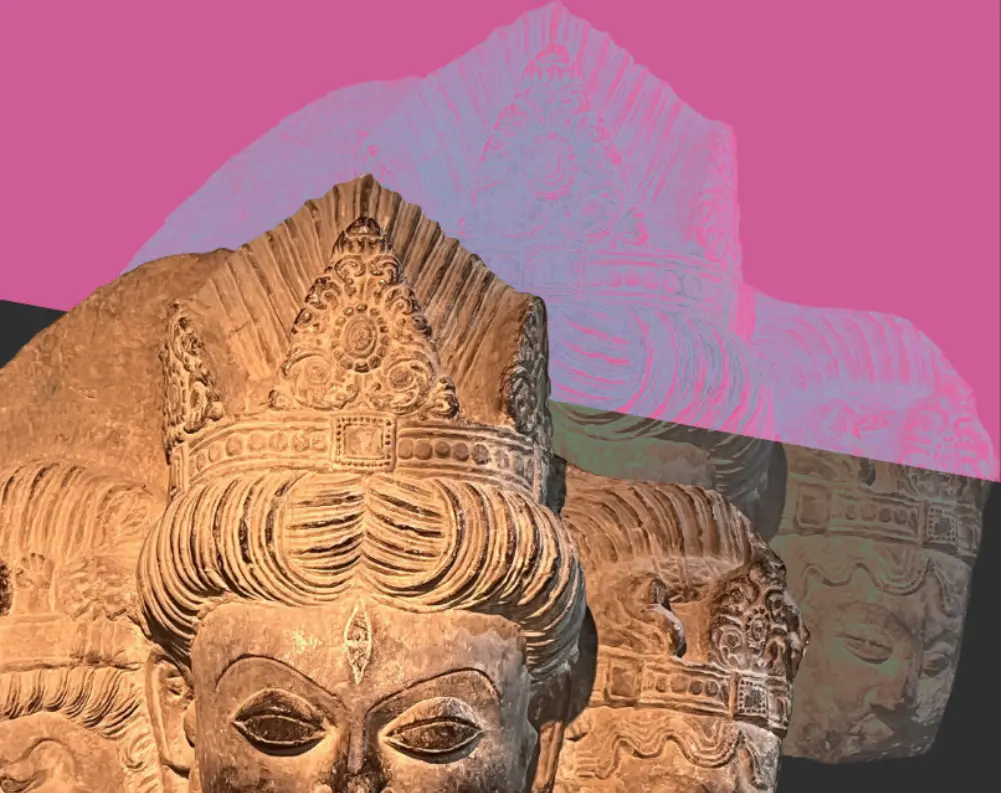
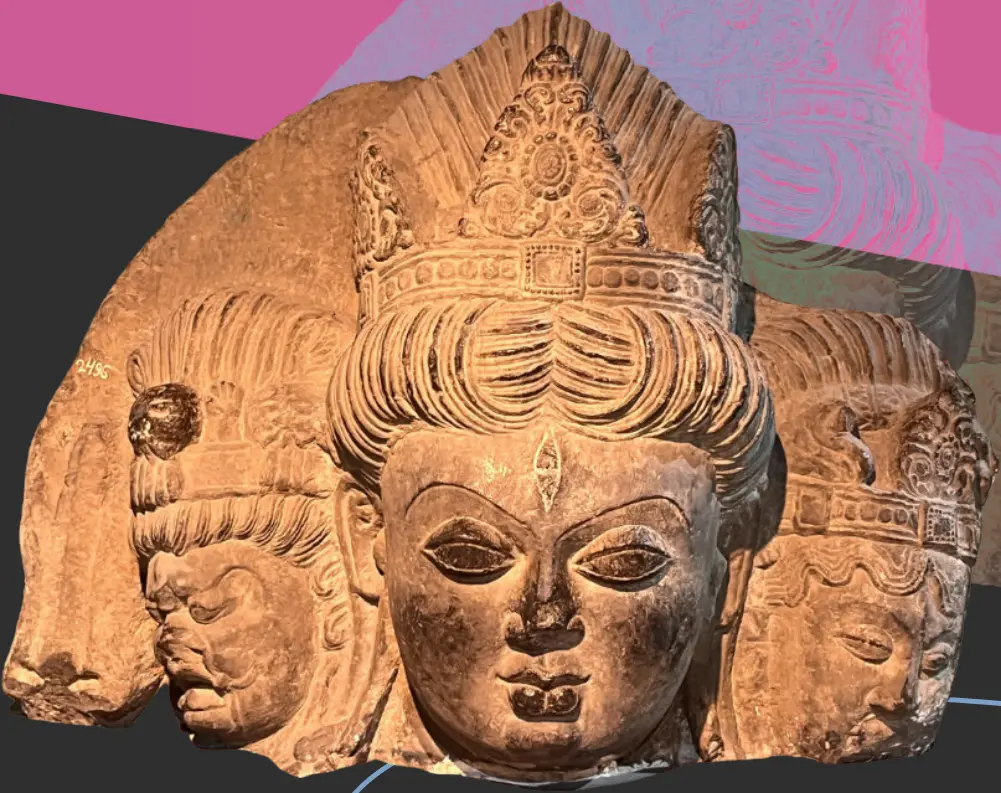
Displayed in the Archaeology Gallery, this 9th century CE monumental stone head of Shiva was excavated near the banks of the Dal Lake at Gupkar during the construction of Maharaja Hari Singh’s palace. Among the largest known representations of Shiva from Kashmir, the sculpture presents him in a trimukha form - Tatpurusha, Ekavaktra, and Aghora, in continuity with Kushan iconography. The central visage, frontal and composed, is flanked by two profile heads, articulating a multi-aspect presence within a single sculptural field. The treatment of the coiffure, crown, and facial modelling reflects three distinct faces of Shiva in their totality: Creation, Preservation and Destruction. The central face, Tatpurusha, is benign, with its jata arranged and secured beneath a tiara-like crown. On one side appears the feminine aspect, identified with Uma, while the opposing face, Aghora, conveys a ferocious presence, its head-gear adorned with human skulls and dismembered hands. Each of the three heads bear a distinct mukuta (crown) and the third eye on the forehead.
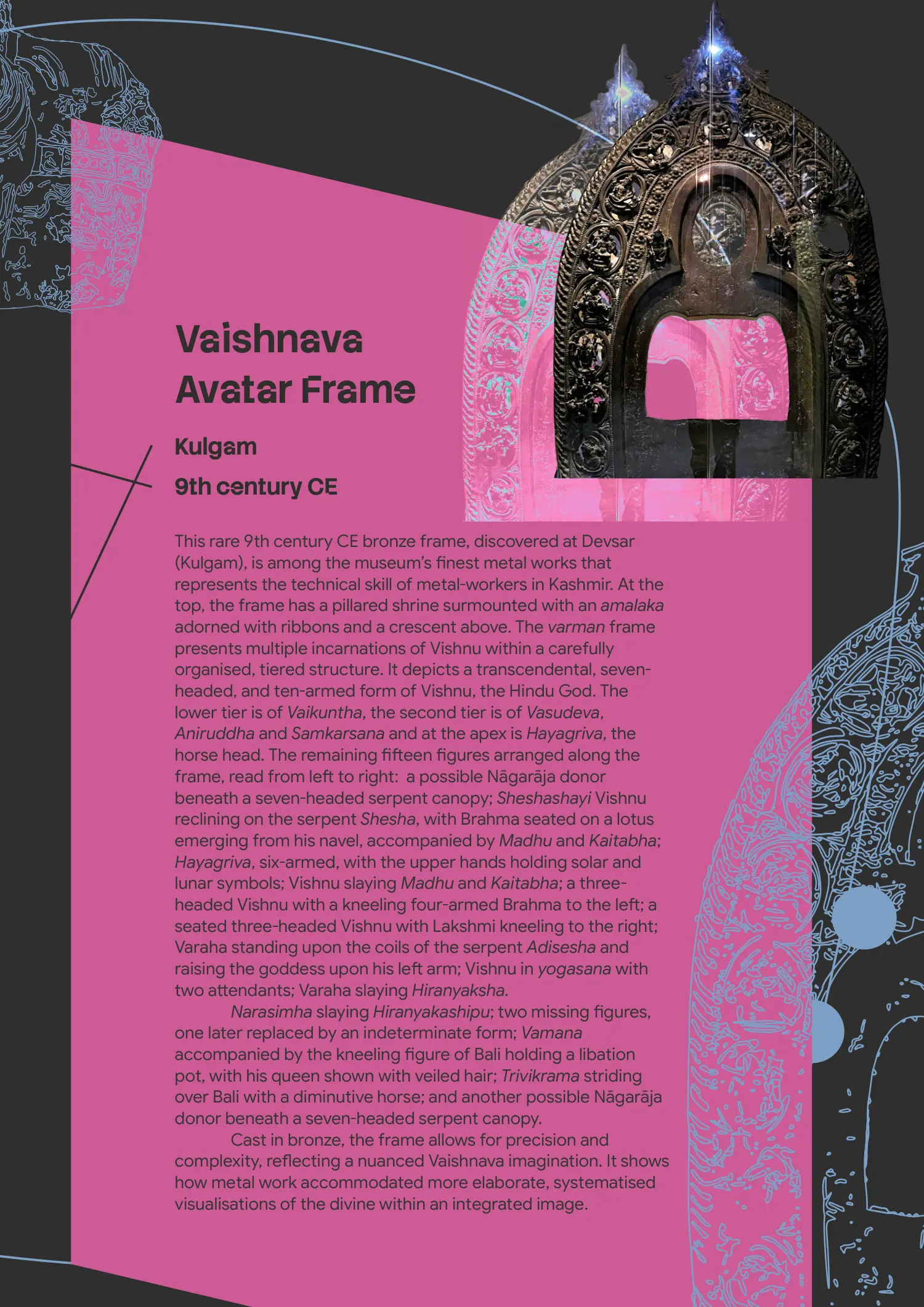
Vaishnava Avatar Frame
Kulgam
9th century CE
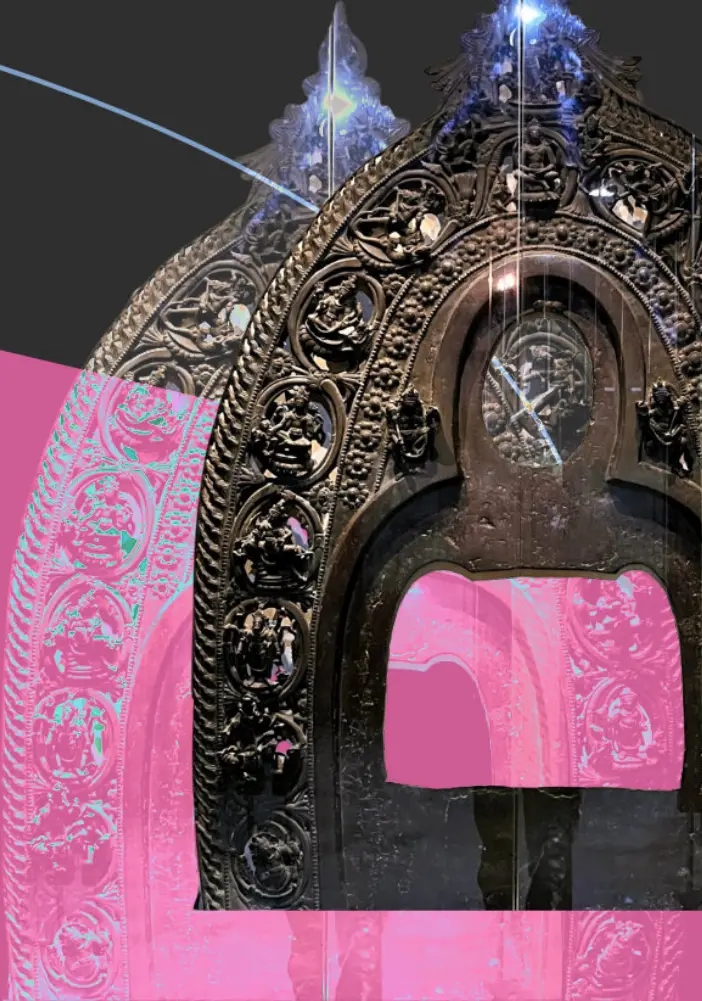
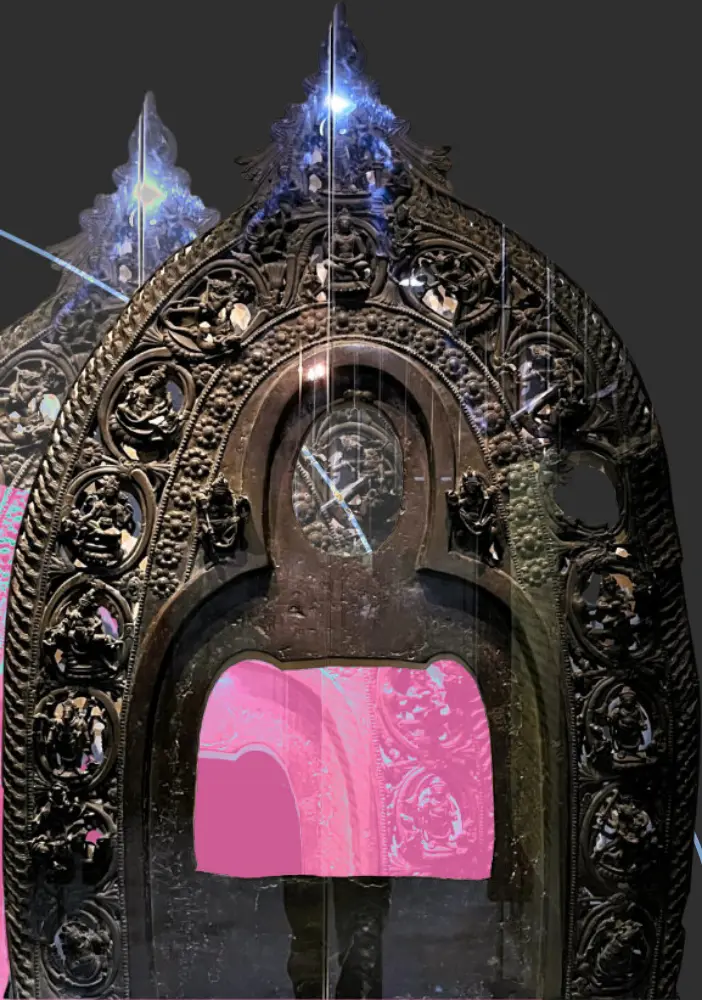
This rare 9th century CE bronze frame, discovered at Devsar (Kulgam), is among the museum’s finest metal works that represents the technical skill of metal-workers in Kashmir. At the top, the frame has a pillared shrine surmounted with an amalaka adorned with ribbons and a crescent above. The varman frame presents multiple incarnations of Vishnu within a carefully organised, tiered structure. It depicts a transcendental, seven- headed, and ten-armed form of Vishnu, the Hindu God. The lower tier is of Vaikuntha, the second tier is of Vasudeva, Aniruddha and Samkarsana and at the apex is Hayagriva, the horse head. The remaining fifteen figures arranged along the frame, read from left to right: a possible Nāgarāja donor beneath a seven-headed serpent canopy; Sheshashayi Vishnu reclining on the serpent Shesha, with Brahma seated on a lotus emerging from his navel, accompanied by Madhu and Kaitabha; Hayagriva, six-armed, with the upper hands holding solar and lunar symbols; Vishnu slaying Madhu and Kaitabha; a three- headed Vishnu with a kneeling four-armed Brahma to the left; a seated three-headed Vishnu with Lakshmi kneeling to the right; Varaha standing upon the coils of the serpent Adisesha and raising the goddess upon his left arm; Vishnu in yogasana with two attendants; Varaha slaying Hiranyaksha.
Narasimha slaying Hiranyakashipu; two missing figures, one later replaced by an indeterminate form; Vamana accompanied by the kneeling figure of Bali holding a libation pot, with his queen shown with veiled hair; Trivikrama striding over Bali with a diminutive horse; and another possible Nāgarāja donor beneath a seven-headed serpent canopy. Cast in bronze, the frame allows for precision and complexity, reflecting a nuanced Vaishnava imagination. It shows how metal work accommodated more elaborate, systematised visualisations of the divine within an integrated image.
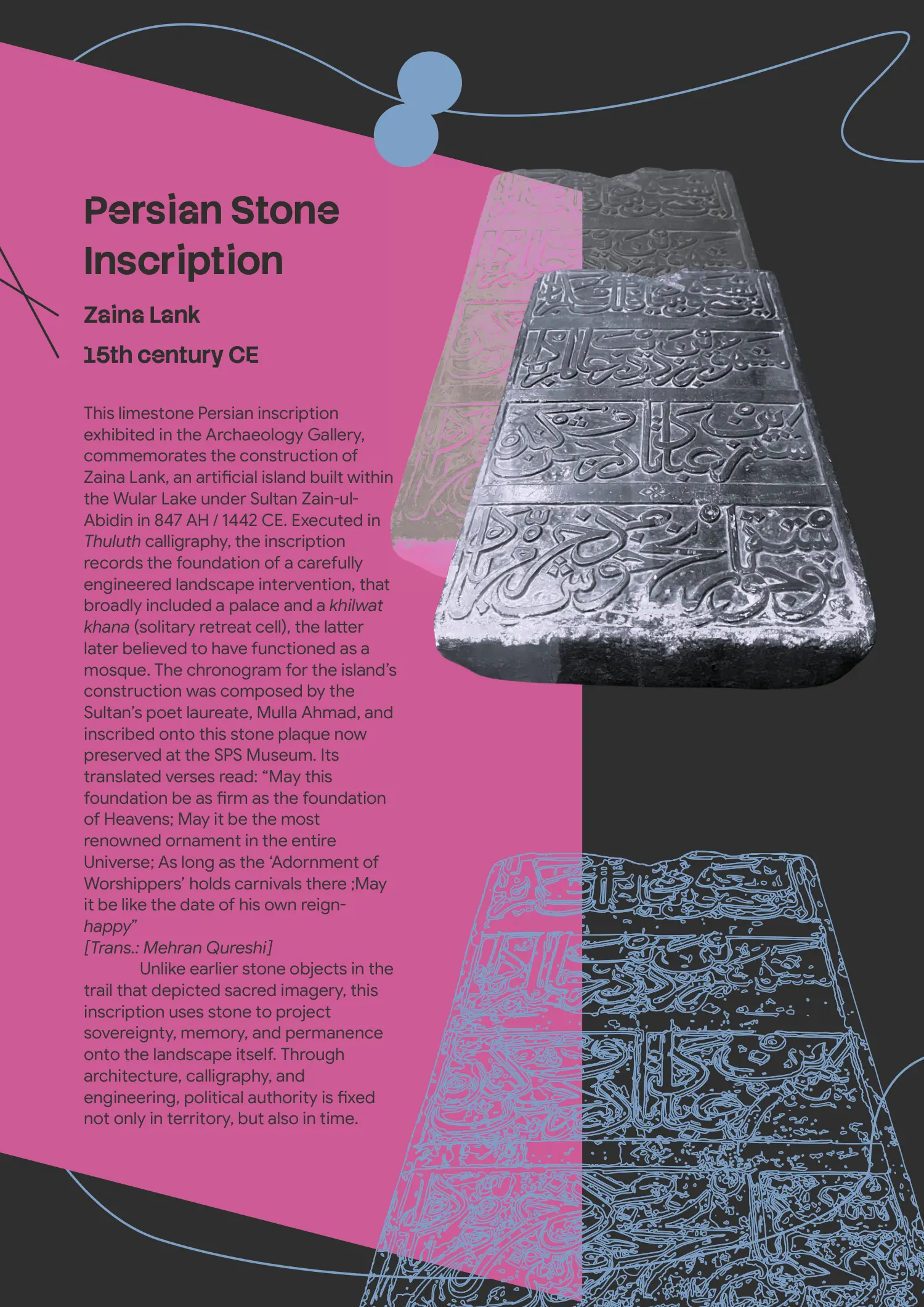
Persian Stone Inscription
Zaina Lank
15th century CE
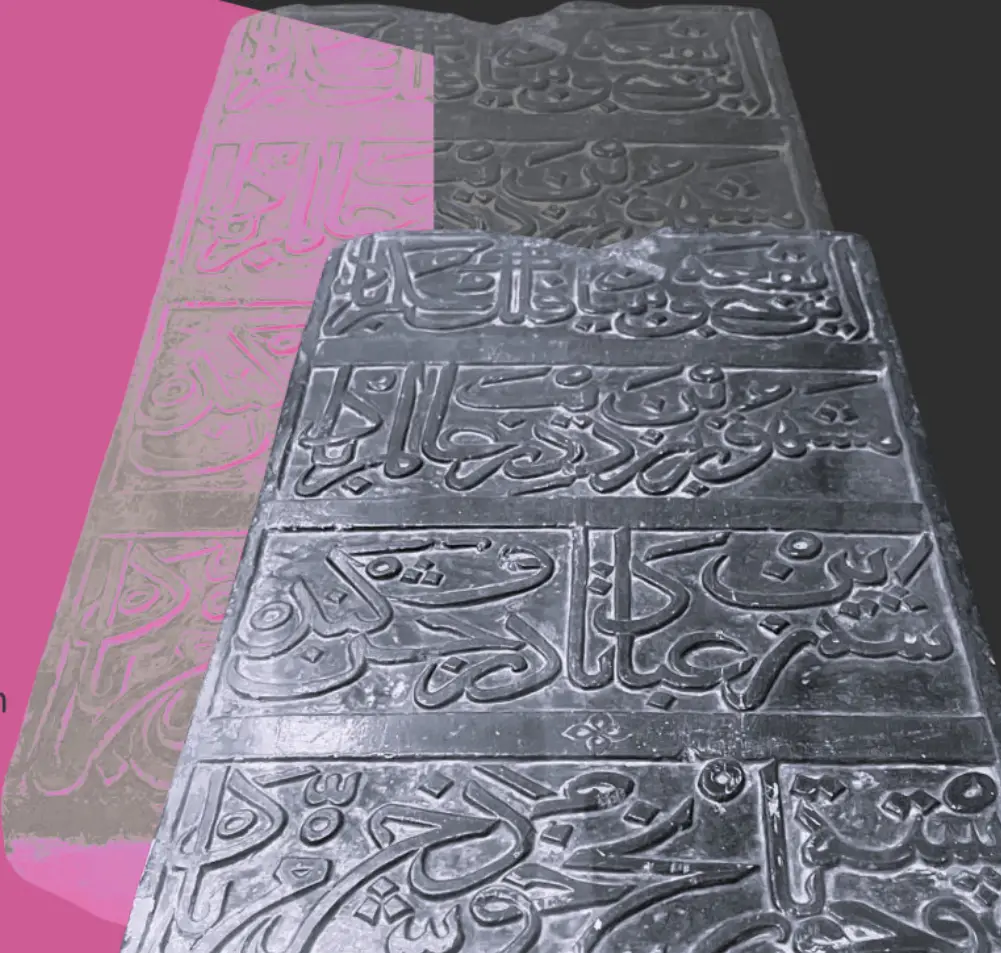
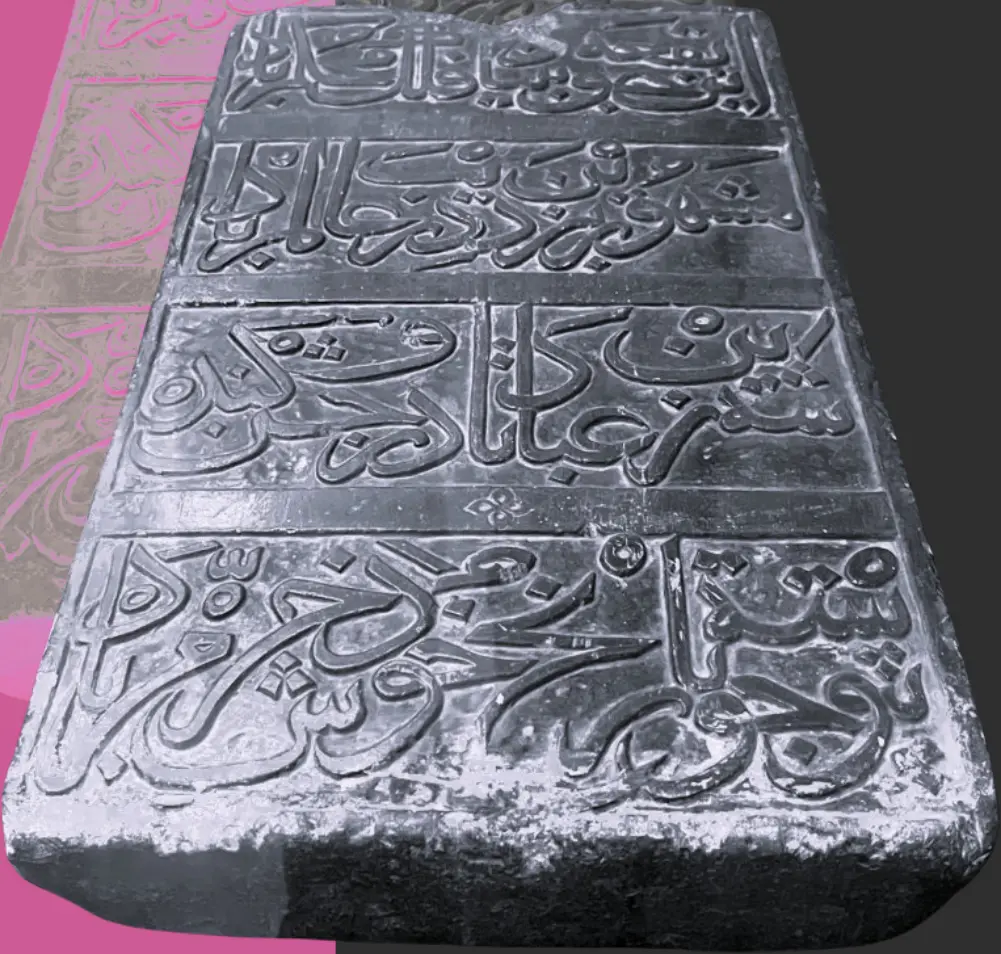
This limestone Persian inscription exhibited in the Archaeology Gallery, commemorates the construction of Zaina Lank, an artificial island built within the Wular Lake under Sultan Zain-ul- Abidin in 847 AH / 1442 CE. Executed in Thuluth calligraphy, the inscription records the foundation of a carefully engineered landscape intervention, that broadly included a palace and a khilwat khana (solitary retreat cell), the latter later believed to have functioned as a mosque. The chronogram for the island’s construction was composed by the Sultan’s poet laureate, Mulla Ahmad, and inscribed onto this stone plaque now preserved at the SPS Museum. Its translated verses read: “May this foundation be as firm as the foundation of Heavens; May it be the most renowned ornament in the entire Universe; As long as the ‘Adornment of Worshippers’ holds carnivals there ;May it be like the date of his own reign- happy” [Trans.: Mehran Qureshi] Unlike earlier stone objects in the trail that depicted sacred imagery, this inscription uses stone to project sovereignty, memory, and permanence onto the landscape itself. Through architecture, calligraphy, and engineering, political authority is fixed not only in territory, but also in time.
Glazed Tile Fragments
Madin Sahib Shrine
17th century CE
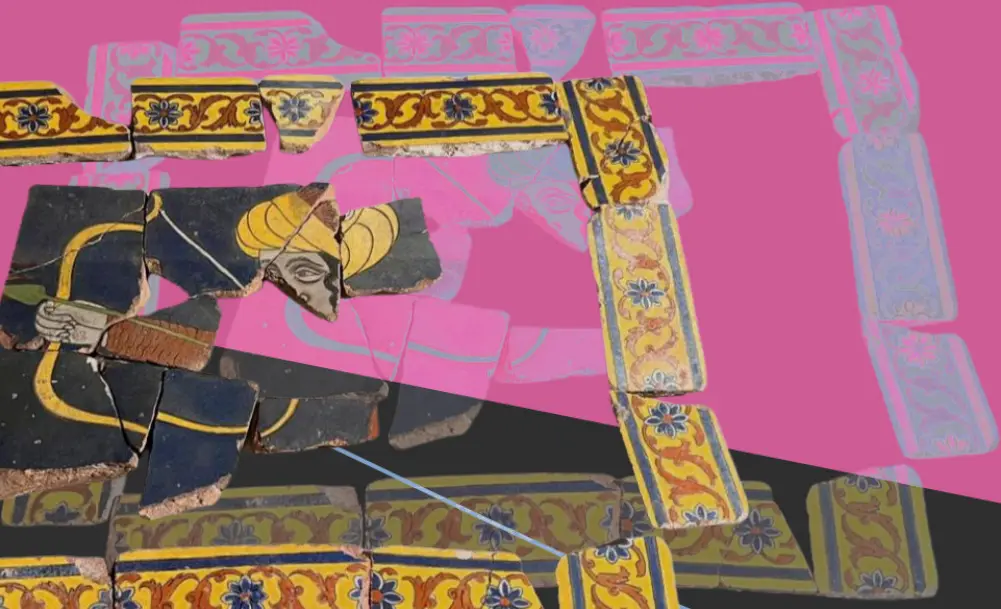
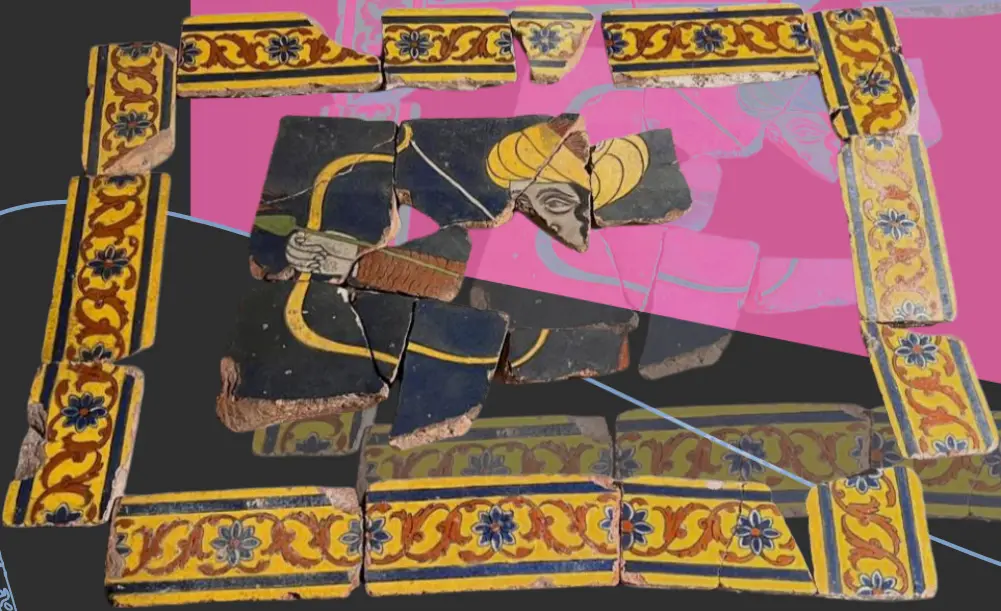
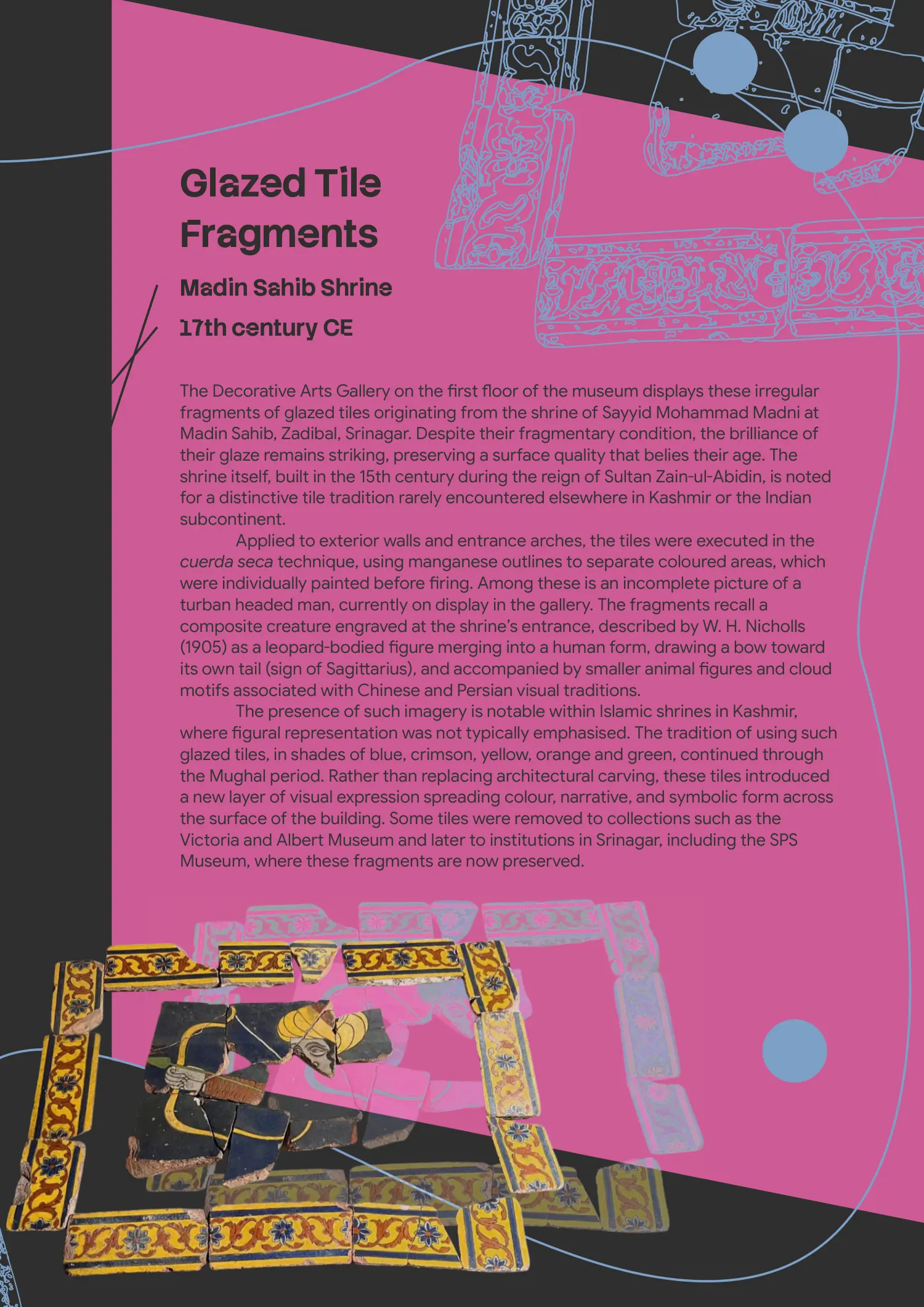
The Decorative Arts Gallery on the first floor of the museum displays these irregular fragments of glazed tiles originating from the shrine of Sayyid Mohammad Madni at Madin Sahib, Zadibal, Srinagar. Despite their fragmentary condition, the brilliance of their glaze remains striking, preserving a surface quality that belies their age. The shrine itself, built in the 15th century during the reign of Sultan Zain-ul-Abidin, is noted for a distinctive tile tradition rarely encountered elsewhere in Kashmir or the Indian subcontinent. Applied to exterior walls and entrance arches, the tiles were executed in the cuerda seca technique, using manganese outlines to separate coloured areas, which were individually painted before firing. Among these is an incomplete picture of a turban headed man, currently on display in the gallery. The fragments recall a composite creature engraved at the shrine’s entrance, described by W. H. Nicholls (1905) as a leopard-bodied figure merging into a human form, drawing a bow toward its own tail (sign of Sagittarius), and accompanied by smaller animal figures and cloud motifs associated with Chinese and Persian visual traditions. The presence of such imagery is notable within Islamic shrines in Kashmir, where figural representation was not typically emphasised. The tradition of using such glazed tiles, in shades of blue, crimson, yellow, orange and green, continued through the Mughal period. Rather than replacing architectural carving, these tiles introduced a new layer of visual expression spreading colour, narrative, and symbolic form across the surface of the building. Some tiles were removed to collections such as the Victoria and Albert Museum and later to institutions in Srinagar, including the SPS Museum, where these fragments are now preserved.
Alam
c. 18th century CE
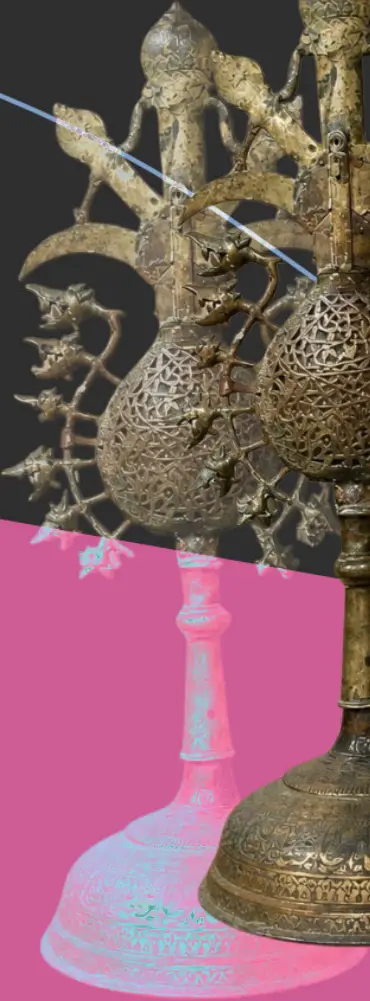
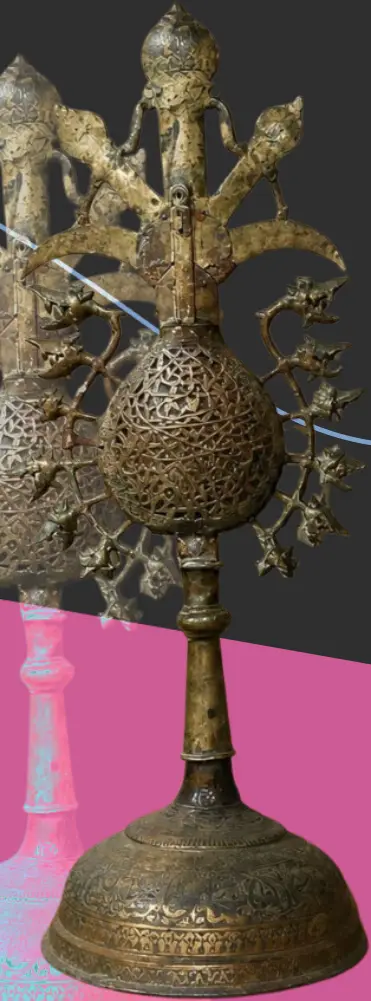
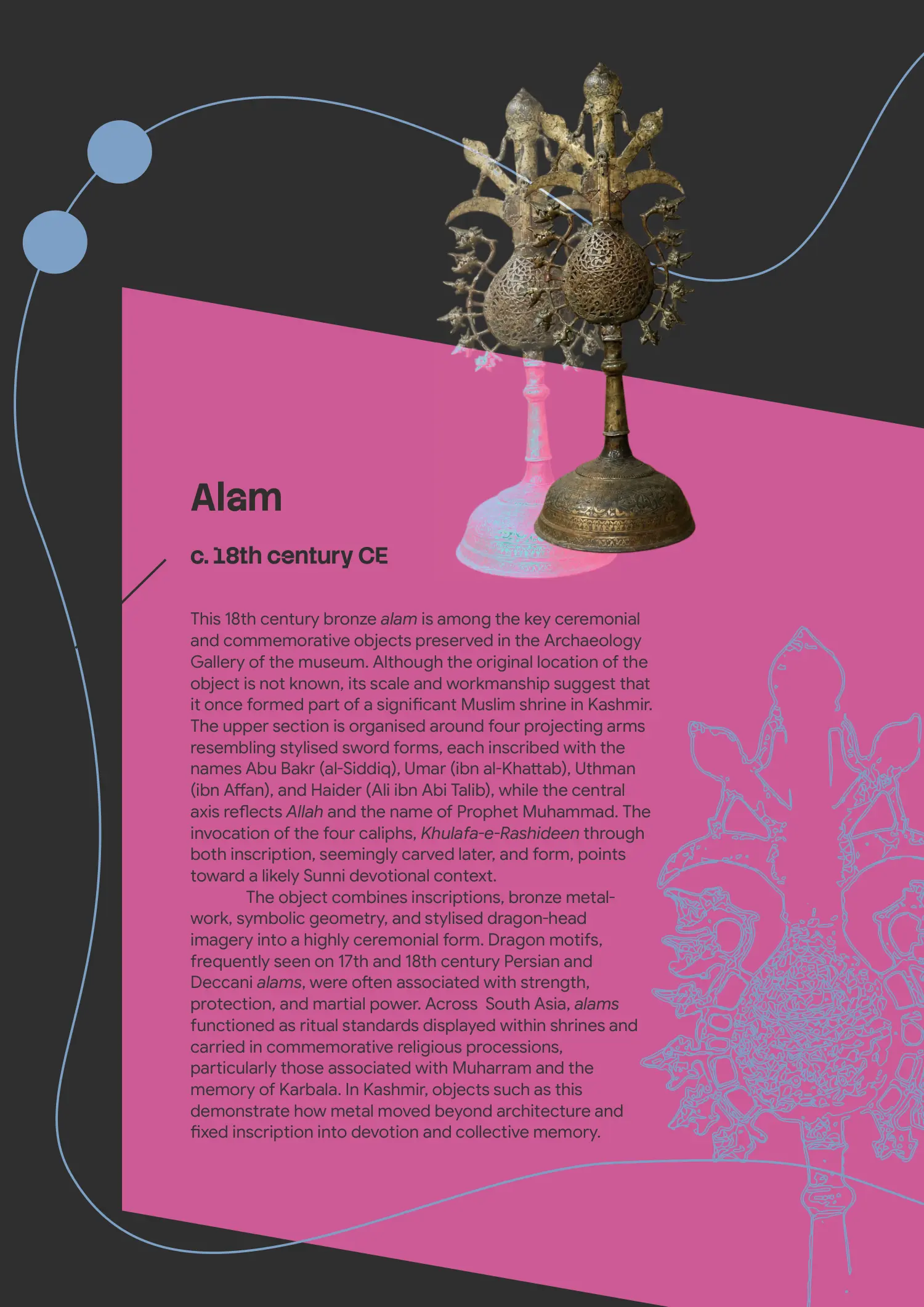
This 18th century bronze alam is among the key ceremonial and commemorative objects preserved in the Archaeology Gallery of the museum. Although the original location of the object is not known, its scale and workmanship suggest that it once formed part of a significant Muslim shrine in Kashmir. The upper section is organised around four projecting arms resembling stylised sword forms, each inscribed with the names Abu Bakr (al-Siddiq), Umar (ibn al-Khattab), Uthman (ibn Affan), and Haider (Ali ibn Abi Talib), while the central axis reflects Allah and the name of Prophet Muhammad. The invocation of the four caliphs, Khulafa-e-Rashideen through both inscription, seemingly carved later, and form, points toward a likely Sunni devotional context. The object combines inscriptions, bronze metal- work, symbolic geometry, and stylised dragon-head imagery into a highly ceremonial form. Dragon motifs, frequently seen on 17th and 18th century Persian and Deccani alams, were often associated with strength, protection, and martial power. Across South Asia, alams functioned as ritual standards displayed within shrines and carried in commemorative religious processions, particularly those associated with Muharram and the memory of Karbala. In Kashmir, objects such as this demonstrate how metal moved beyond architecture and fixed inscription into devotion and collective memory.
Coins Across Empires: Mughal, Durrani, and Sikh
16th - 19th century CE
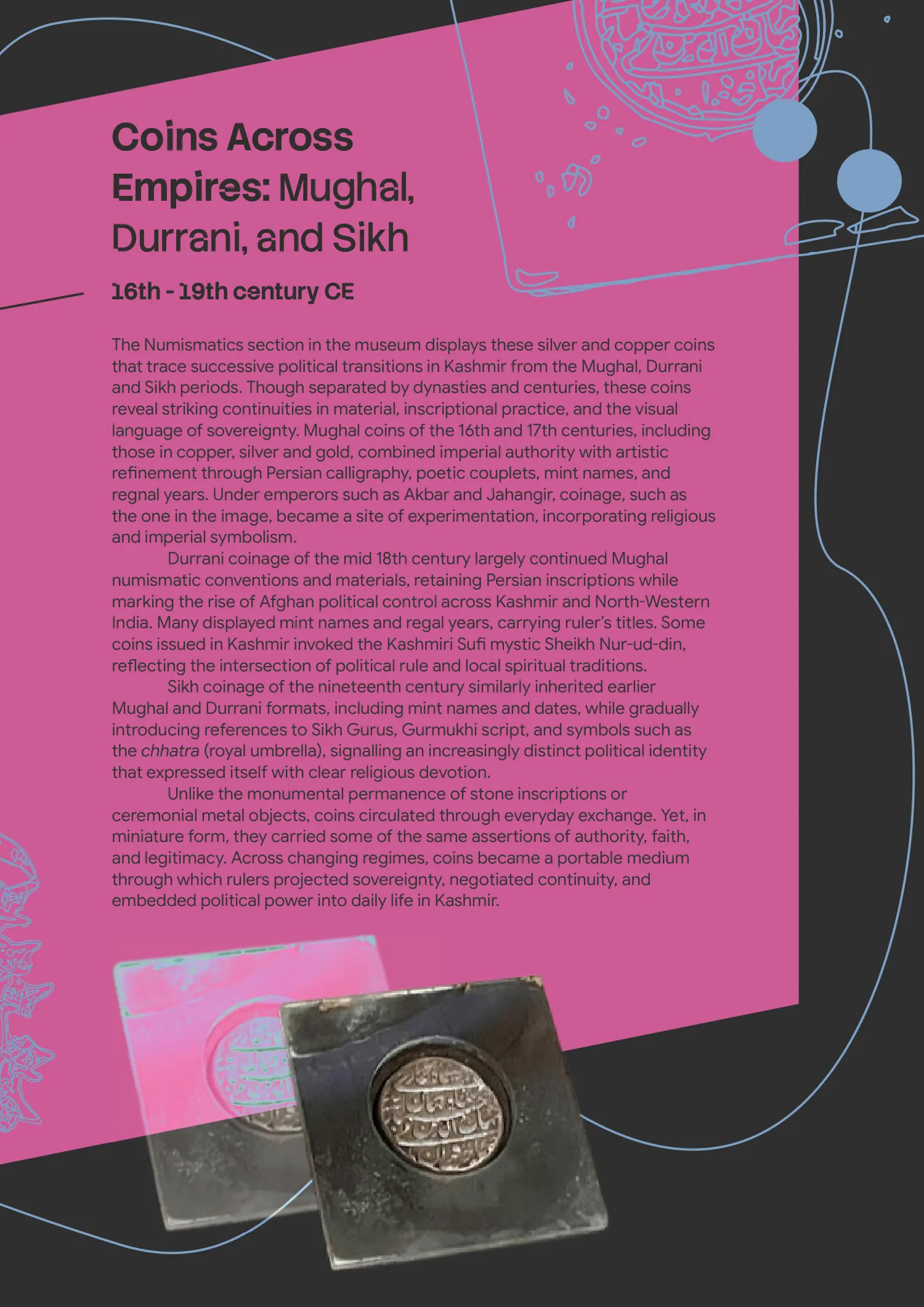
The Numismatics section in the museum displays these silver and copper coins that trace successive political transitions in Kashmir from the Mughal, Durrani and Sikh periods. Though separated by dynasties and centuries, these coins reveal striking continuities in material, inscriptional practice, and the visual language of sovereignty. Mughal coins of the 16th and 17th centuries, including those in copper, silver and gold, combined imperial authority with artistic refinement through Persian calligraphy, poetic couplets, mint names, and regnal years. Under emperors such as Akbar and Jahangir, coinage, such as the one in the image, became a site of experimentation, incorporating religious and imperial symbolism. Durrani coinage of the mid 18th century largely continued Mughal numismatic conventions and materials, retaining Persian inscriptions while marking the rise of Afghan political control across Kashmir and North-Western India. Many displayed mint names and regal years, carrying ruler’s titles. Some coins issued in Kashmir invoked the Kashmiri Sufi mystic Sheikh Nur-ud-din, reflecting the intersection of political rule and local spiritual traditions. Sikh coinage of the nineteenth century similarly inherited earlier Mughal and Durrani formats, including mint names and dates, while gradually introducing references to Sikh Gurus, Gurmukhi script, and symbols such as the chhatra (royal umbrella), signalling an increasingly distinct political identity that expressed itself with clear religious devotion. Unlike the monumental permanence of stone inscriptions or ceremonial metal objects, coins circulated through everyday exchange. Yet, in miniature form, they carried some of the same assertions of authority, faith, and legitimacy. Across changing regimes, coins became a portable medium through which rulers projected sovereignty, negotiated continuity, and embedded political power into daily life in Kashmir.
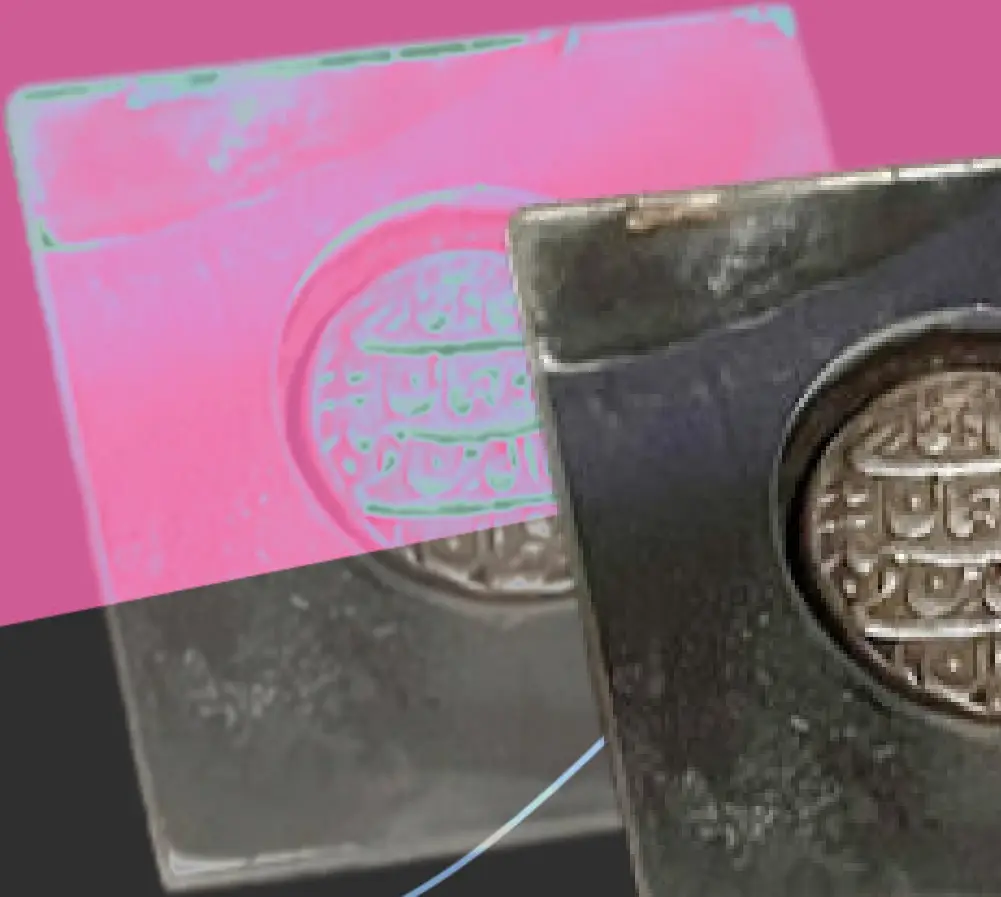
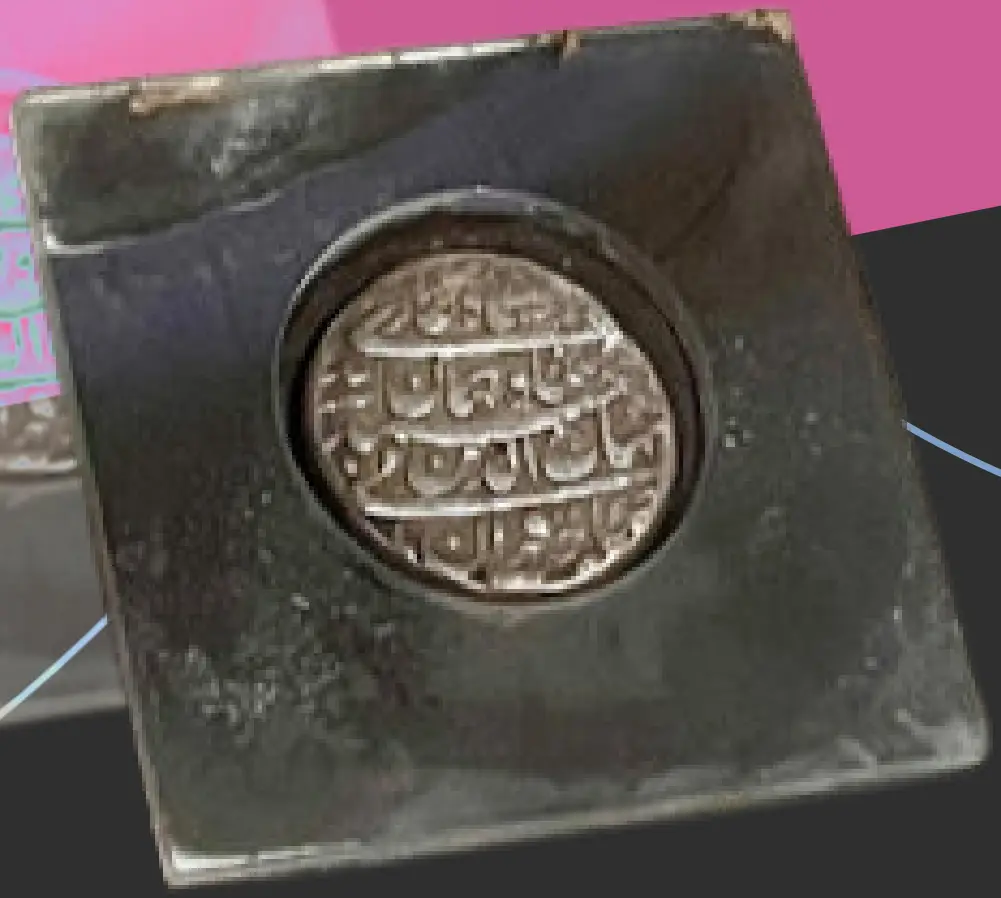
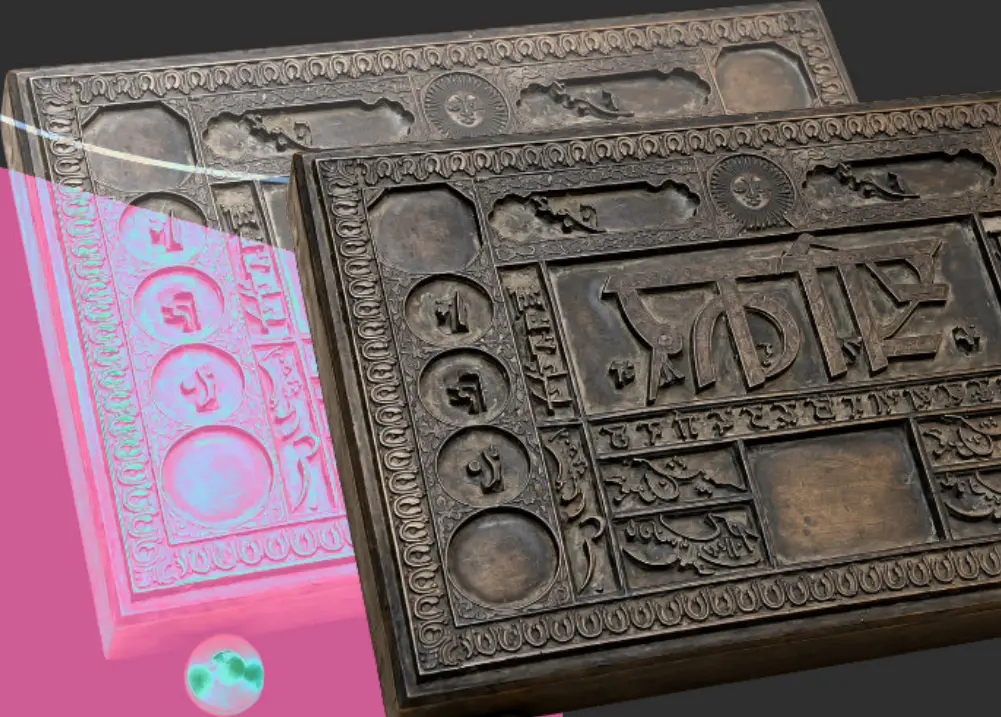
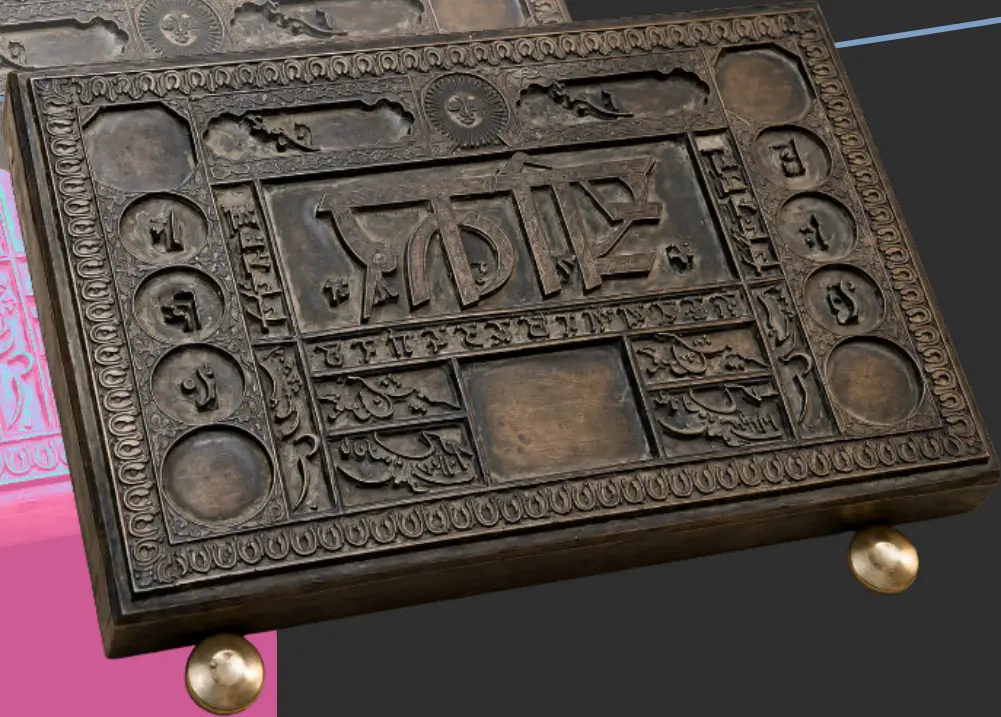
Brass Dogra Paper Currency Printing Block
19th century CE
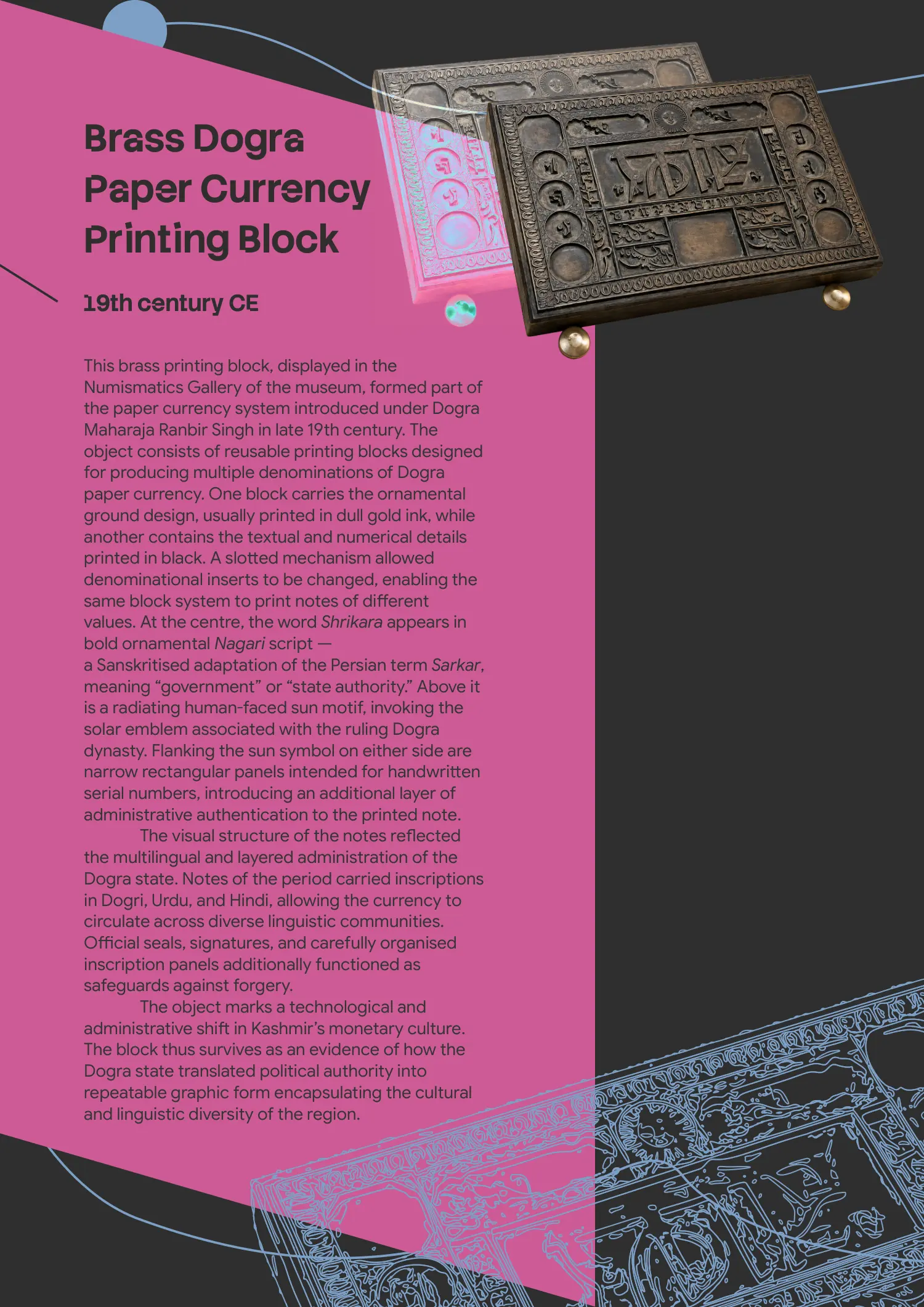
This brass printing block, displayed in the Numismatics Gallery of the museum, formed part of the paper currency system introduced under Dogra Maharaja Ranbir Singh in late 19th century. The object consists of reusable printing blocks designed for producing multiple denominations of Dogra paper currency. One block carries the ornamental ground design, usually printed in dull gold ink, while another contains the textual and numerical details printed in black. A slotted mechanism allowed denominational inserts to be changed, enabling the same block system to print notes of different values. At the centre, the word Shrikara appears in bold ornamental Nagari script — a Sanskritised adaptation of the Persian term Sarkar, meaning “government” or “state authority.” Above it is a radiating human-faced sun motif, invoking the solar emblem associated with the ruling Dogra dynasty. Flanking the sun symbol on either side are narrow rectangular panels intended for handwritten serial numbers, introducing an additional layer of administrative authentication to the printed note. The visual structure of the notes reflected the multilingual and layered administration of the Dogra state. Notes of the period carried inscriptions in Dogri, Urdu, and Hindi, allowing the currency to circulate across diverse linguistic communities. Official seals, signatures, and carefully organised inscription panels additionally functioned as safeguards against forgery. The object marks a technological and administrative shift in Kashmir’s monetary culture. The block thus survives as an evidence of how the Dogra state translated political authority into repeatable graphic form encapsulating the cultural and linguistic diversity of the region.
Wood Lattice Work
19th century CE
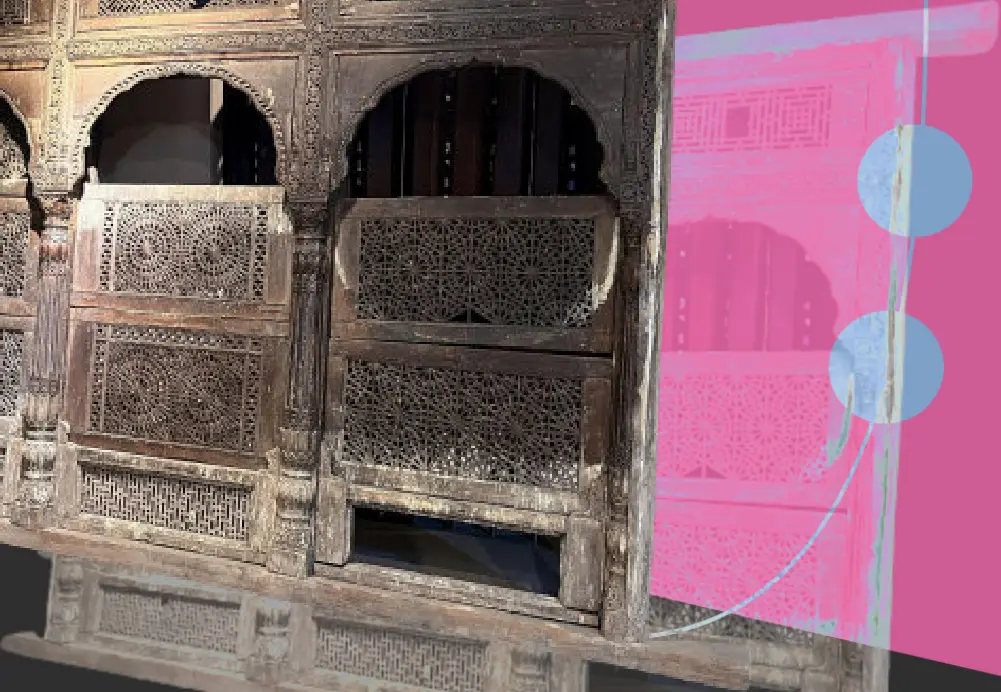
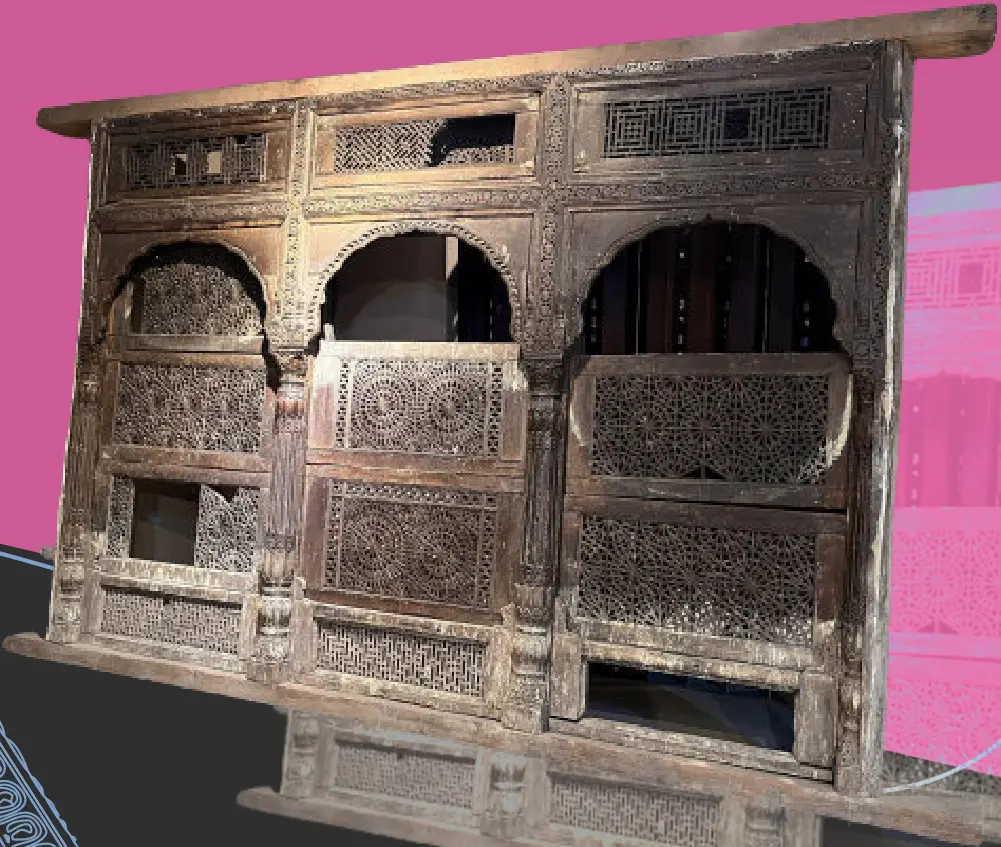
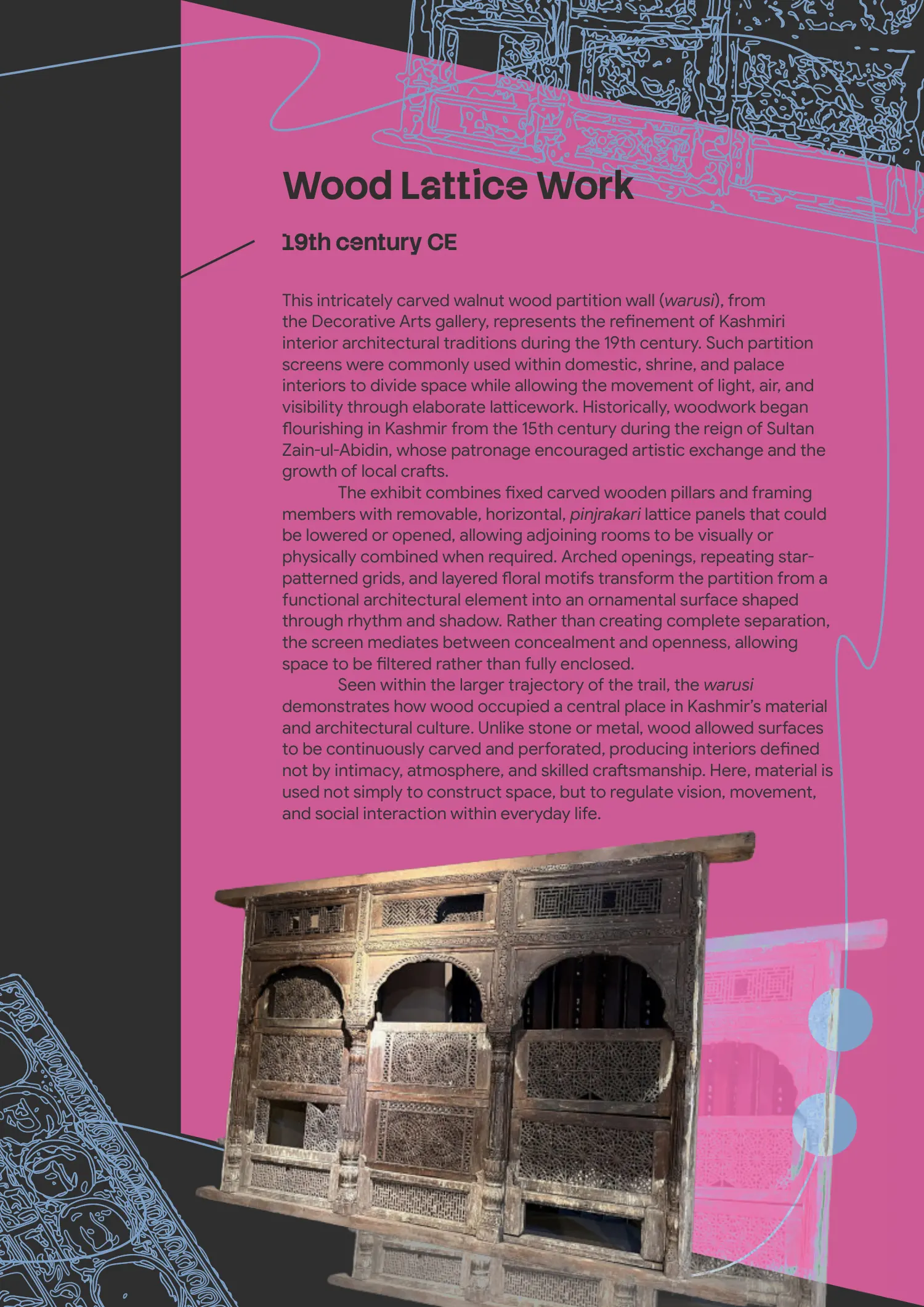
This intricately carved walnut wood partition wall (warusi), from the Decorative Arts gallery, represents the refinement of Kashmiri interior architectural traditions during the 19th century. Such partition screens were commonly used within domestic, shrine, and palace interiors to divide space while allowing the movement of light, air, and visibility through elaborate latticework. Historically, woodwork began flourishing in Kashmir from the 15th century during the reign of Sultan Zain-ul-Abidin, whose patronage encouraged artistic exchange and the growth of local crafts. The exhibit combines fixed carved wooden pillars and framing members with removable, horizontal, pinjrakari lattice panels that could be lowered or opened, allowing adjoining rooms to be visually or physically combined when required. Arched openings, repeating star- patterned grids, and layered floral motifs transform the partition from a functional architectural element into an ornamental surface shaped through rhythm and shadow. Rather than creating complete separation, the screen mediates between concealment and openness, allowing space to be filtered rather than fully enclosed. Seen within the larger trajectory of the trail, the warusi demonstrates how wood occupied a central place in Kashmir’s material and architectural culture. Unlike stone or metal, wood allowed surfaces to be continuously carved and perforated, producing interiors defined not by intimacy, atmosphere, and skilled craftsmanship. Here, material is used not simply to construct space, but to regulate vision, movement, and social interaction within everyday life.
Dogra Cannon
19th century CE
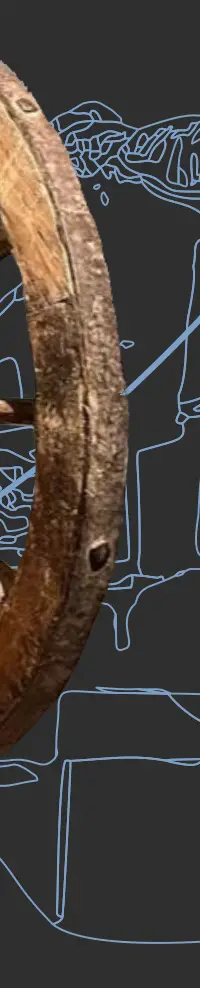
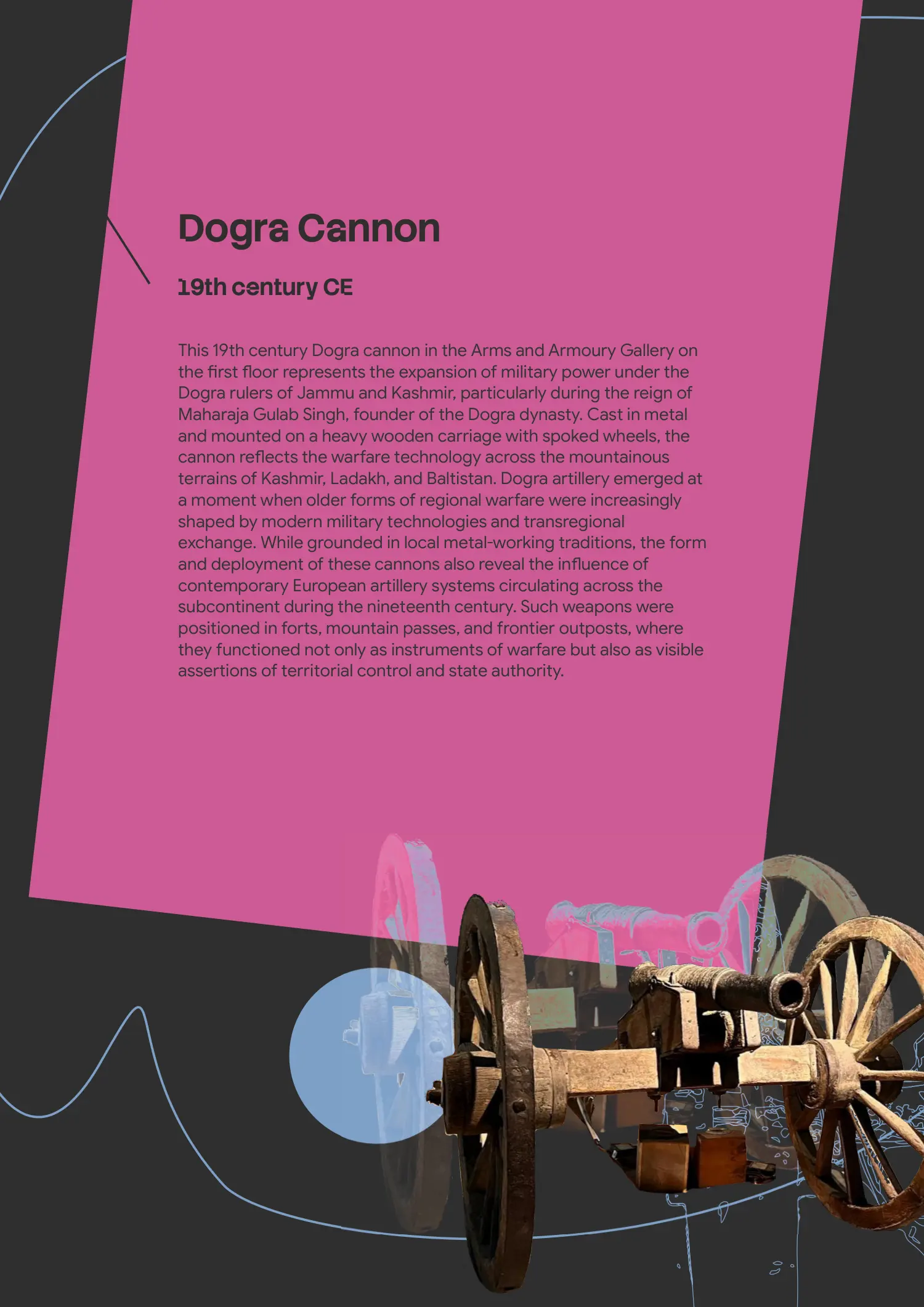
This 19th century Dogra cannon in the Arms and Armoury Gallery on the first floor represents the expansion of military power under the Dogra rulers of Jammu and Kashmir, particularly during the reign of Maharaja Gulab Singh, founder of the Dogra dynasty. Cast in metal and mounted on a heavy wooden carriage with spoked wheels, the cannon reflects the warfare technology across the mountainous terrains of Kashmir, Ladakh, and Baltistan. Dogra artillery emerged at a moment when older forms of regional warfare were increasingly shaped by modern military technologies and transregional exchange. While grounded in local metal-working traditions, the form and deployment of these cannons also reveal the influence of contemporary European artillery systems circulating across the subcontinent during the nineteenth century. Such weapons were positioned in forts, mountain passes, and frontier outposts, where they functioned not only as instruments of warfare but also as visible assertions of territorial control and state authority.
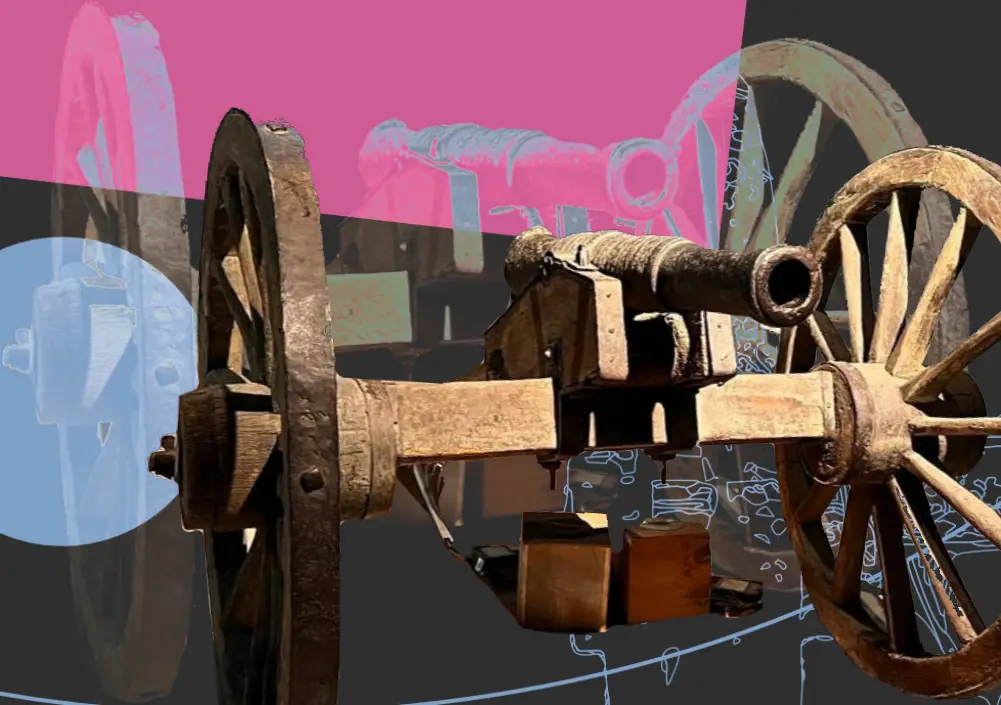
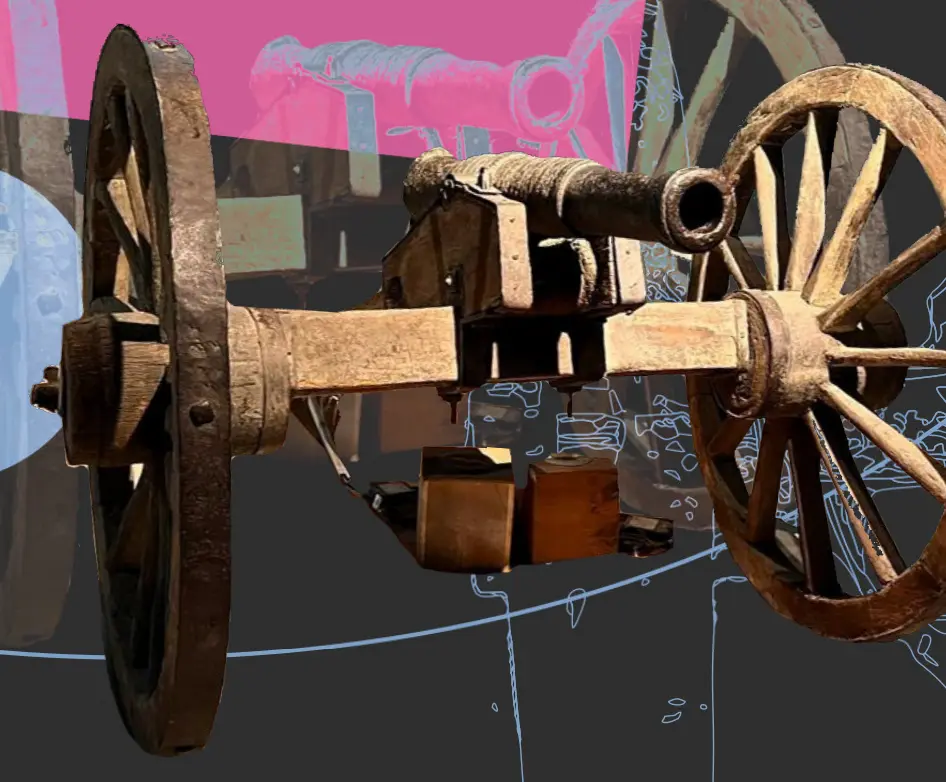
Like the coin, the inscription, the alam, or the printing block, it demonstrates how material objects in Kashmir were deeply tied to structures of power as much as ordinary daily lives of people. Here, however, metal is no longer cast into icons, ritual objects, or currency, but into artillery, transforming craftsmanship into an instrument through which territory, sovereignty, and political order were secured and maintained.
Notes:
1. Terracotta Tile Image Credits: Ab Rashid Lone, for Sahapedia. https://www.sahapedia.org/terracotta-art-kashmir-overview
2. a) We are thankful to the support extended by Ms. Rabia Qureshi, Curator SPS Museum, and Mr Shabir Ahmad Wani for their support. We also thank Dr Hakim Sameer Hamdani, art historian and author, and Mr Mehran Qureshi, Assistant Professor, Islamic University of Science and Technology for their key inputs. b) The text has borrowed itself from curatorial descriptions and records as provided by SPS Museum, and other research materials.
3. Photo Credits: Mohammad Fazil Panjwala.
View original pages, photographs & credits
Originally published in Museum Mosaic 2025, published May 2026.
Part of our annual review. Descriptions reflect the publication’s reporting period.