Dr. Bhau Daji Lad Museum, Mumbai
Beyond the beautiful Palladian-style museum, a meticulously curated vitrine of the Dr. Bhau Daji Lad Museum (formerly the Victoria and Albert Museum), lies a silent, outdoor stone purgatory. The museum is a testament to Victorian architecture and Mumbai’s industrial history — many visitors come for its gilded interiors, vibrant dioramas, and historic artefacts. However, what most visitors don’t know is that an assembly or graveyard of colonial icons, of famous British people, lies just next to it, watching them from the weeds. This is not a formal gallery, but a space where the once mighty have been retired to a patch of grass, stripped of their pedestals and dignity. They are the "unwanted" — for decades, they occupied the most prestigious intersections of Bombay, looking down from towering pedestals of basalt and marble. Today, they are at eye level, stripped of their heights and, in many cases, their faces. To find them, you must intentionally step off the beaten path, entering a "ghost garden" that the city has largely chosen to forget.
All images are provided by the author
The Anatomy of a Revolt
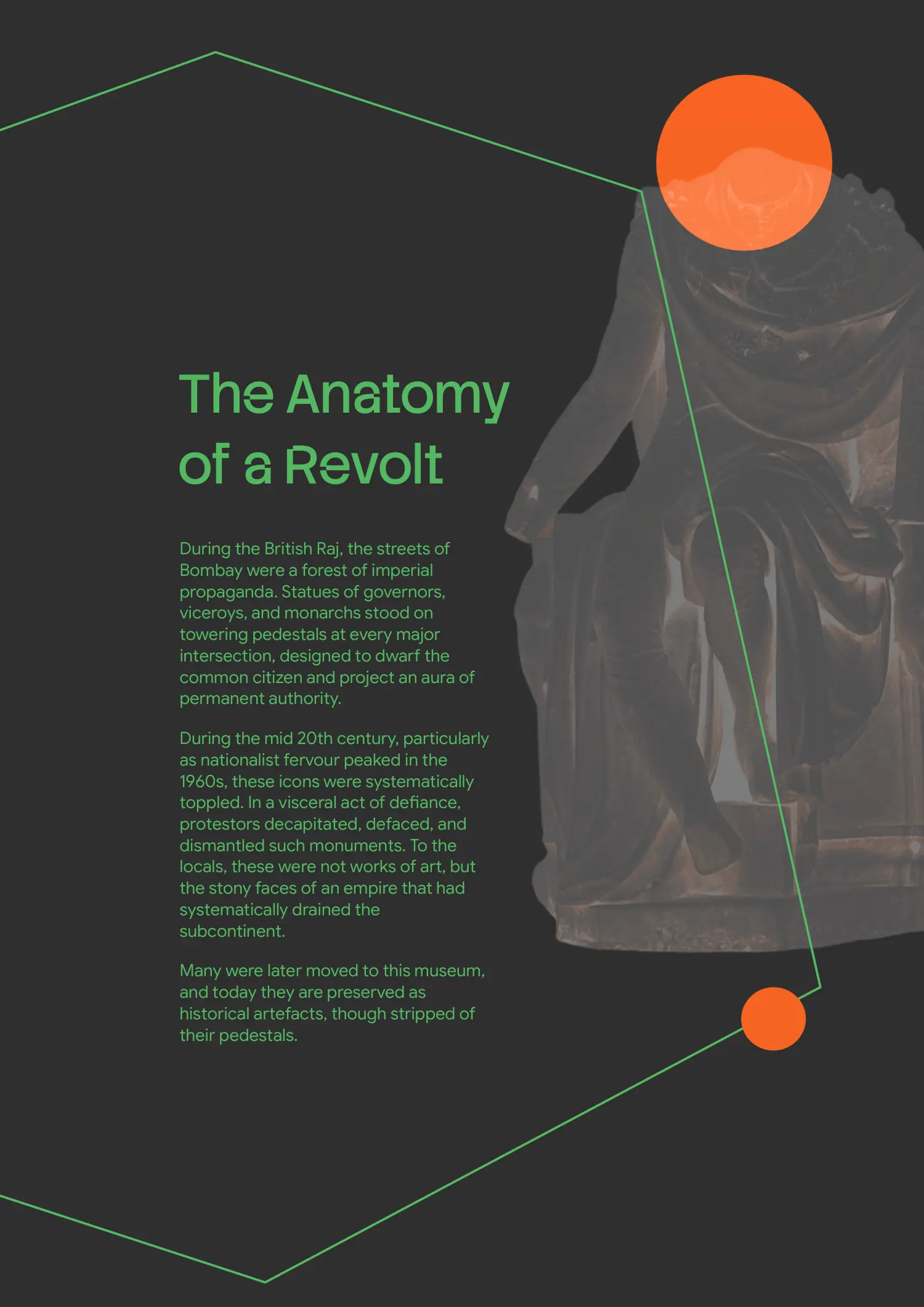
During the British Raj, the streets of Bombay were a forest of imperial propaganda. Statues of governors, viceroys, and monarchs stood on towering pedestals at every major intersection, designed to dwarf the common citizen and project an aura of permanent authority.
During the mid 20th century, particularly as nationalist fervour peaked in the 1960s, these icons were systematically toppled. In a visceral act of defiance, protestors decapitated, defaced, and dismantled such monuments. To the locals, these were not works of art, but the stony faces of an empire that had systematically drained the subcontinent.
Many were later moved to this museum, and today they are preserved as historical artefacts, though stripped of their pedestals.
Faces of the Displaced
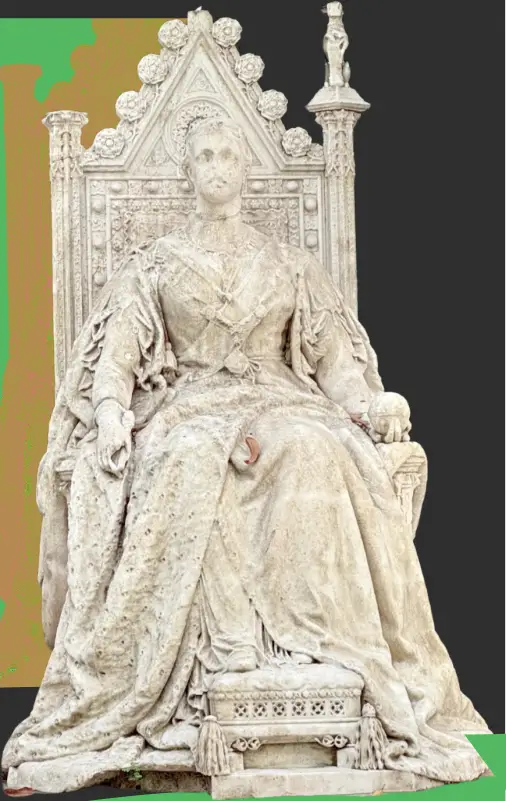
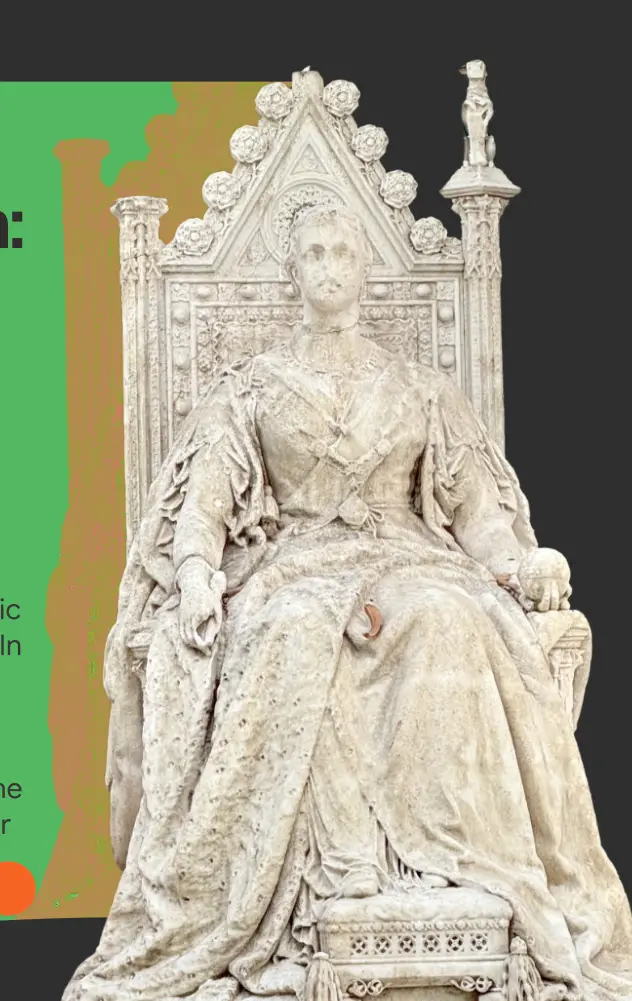
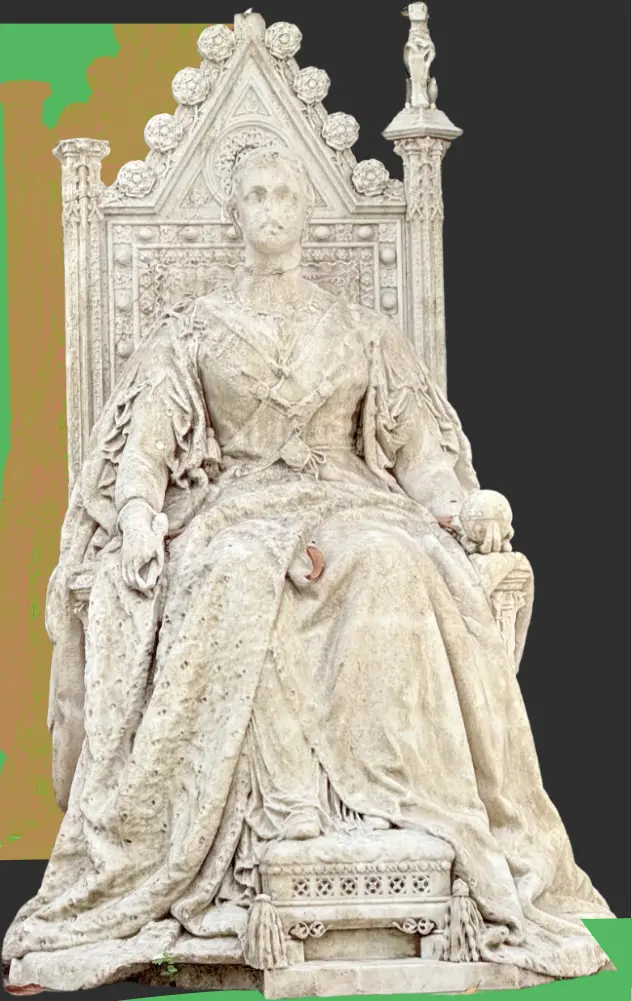
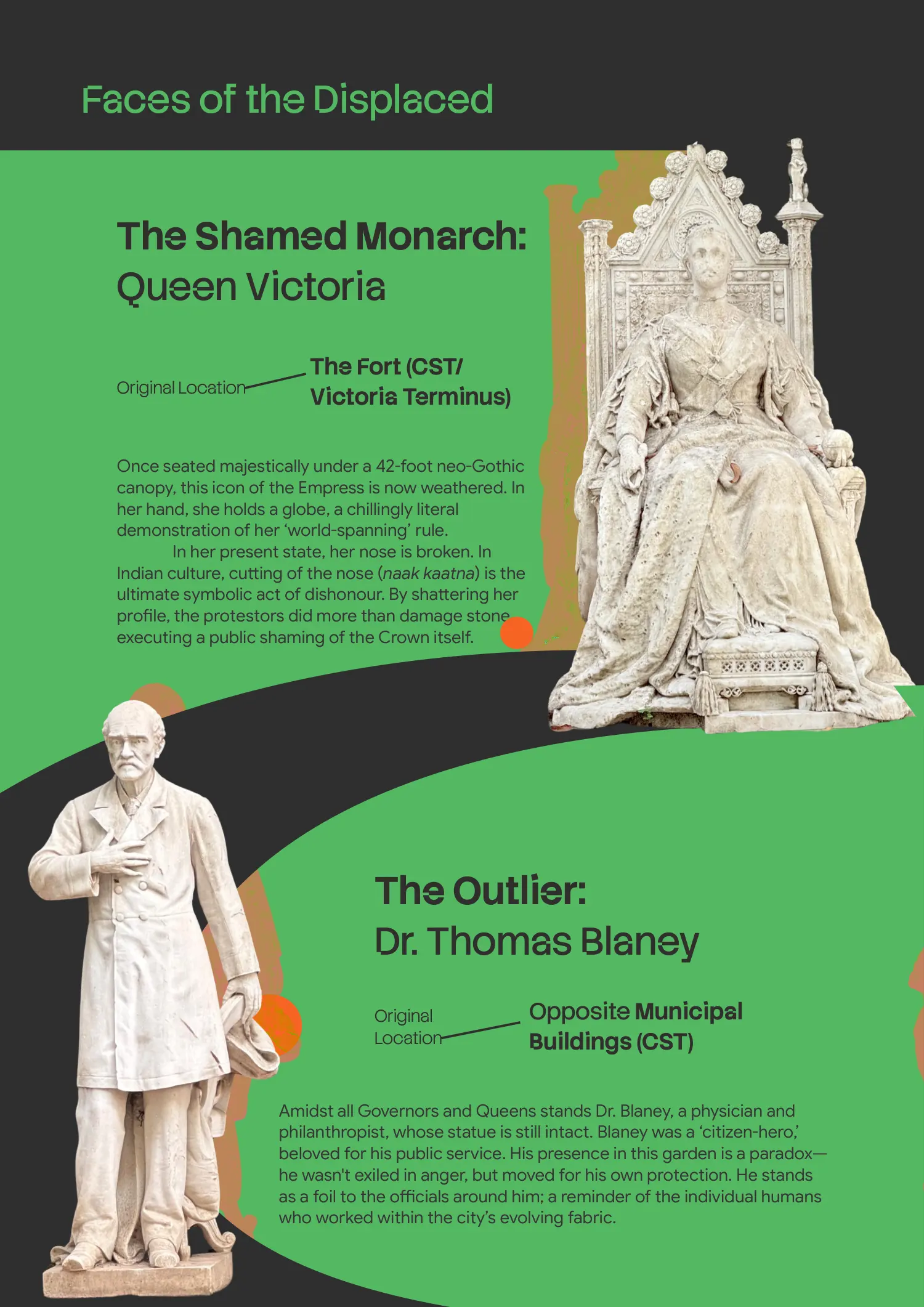
The Shamed Monarch: Queen Victoria
Original Location
The Fort (CST/ Victoria Terminus)
Once seated majestically under a 42-foot neo-Gothic canopy, this icon of the Empress is now weathered. In her hand, she holds a globe, a chillingly literal demonstration of her ‘world-spanning’ rule. In her present state, her nose is broken. In Indian culture, cutting of the nose (naak kaatna) is the ultimate symbolic act of dishonour. By shattering her profile, the protestors did more than damage stone executing a public shaming of the Crown itself.
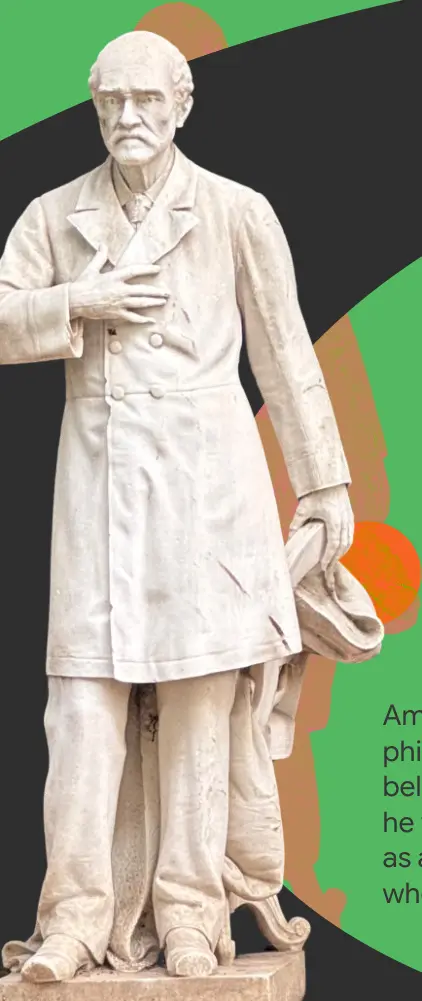
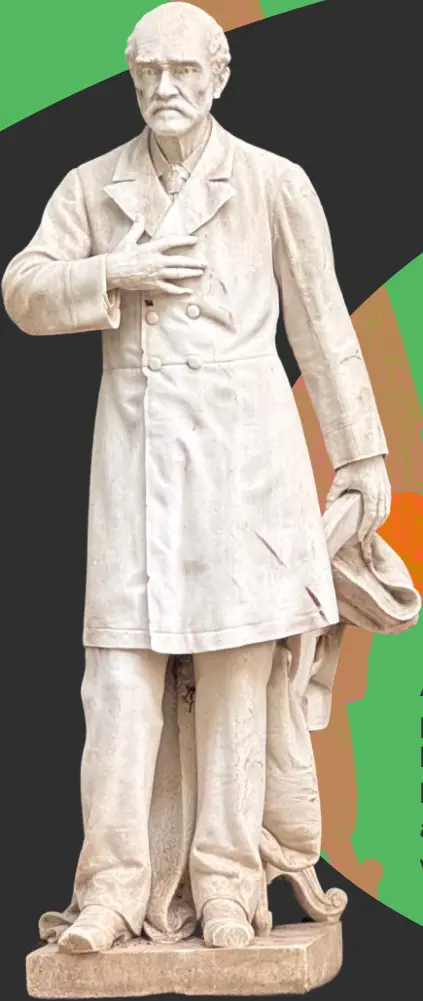
The Outlier: Dr. Thomas Blaney
Original Location
Opposite Municipal Buildings (CST)
Amidst all Governors and Queens stands Dr. Blaney, a physician and philanthropist, whose statue is still intact. Blaney was a ‘citizen-hero,’ beloved for his public service. His presence in this garden is a paradox— he wasn't exiled in anger, but moved for his own protection. He stands as a foil to the officials around him; a reminder of the individual humans who worked within the city’s evolving fabric.
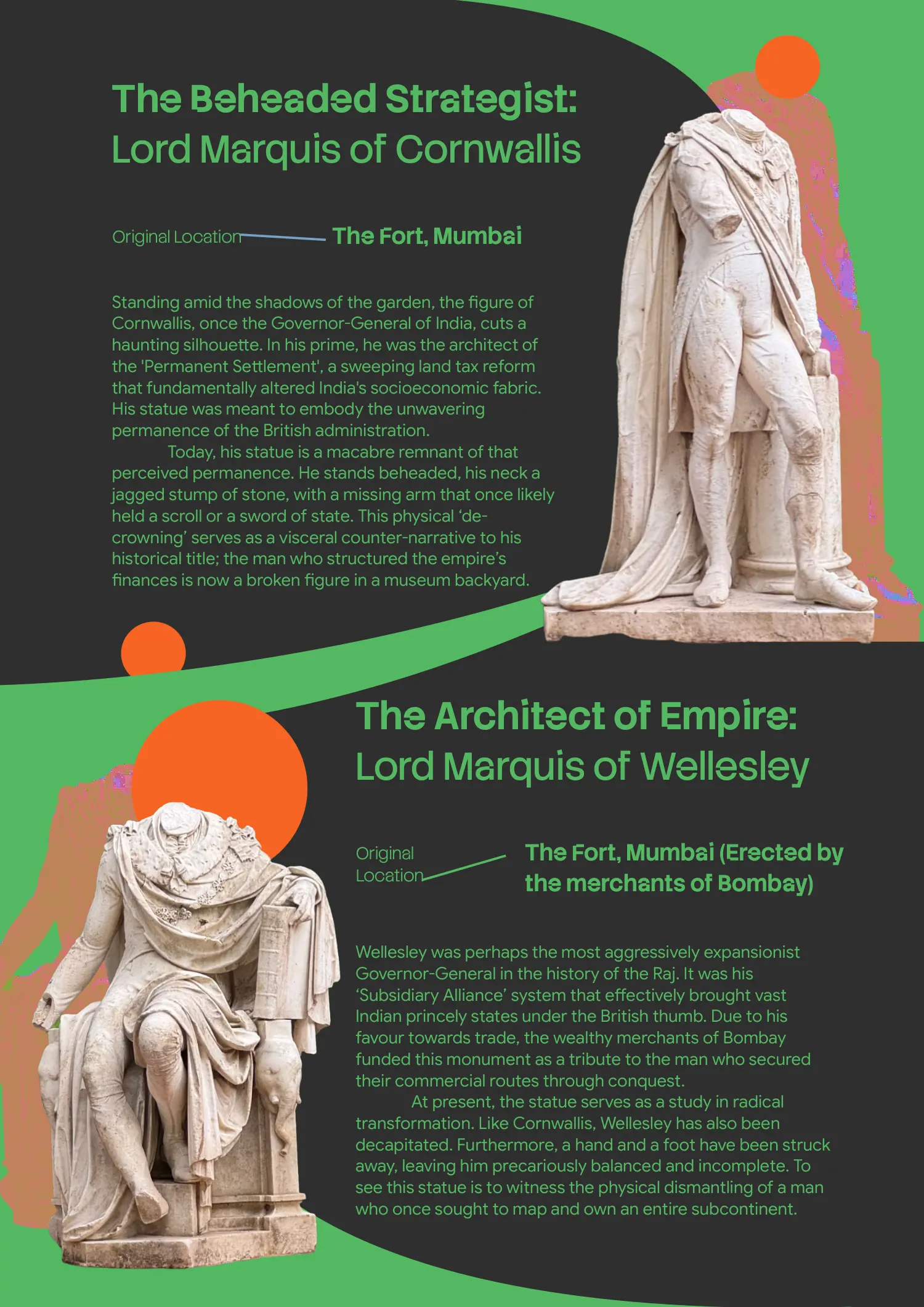
The Beheaded Strategist: Lord Marquis of Cornwallis
The Fort, Mumbai Original Location
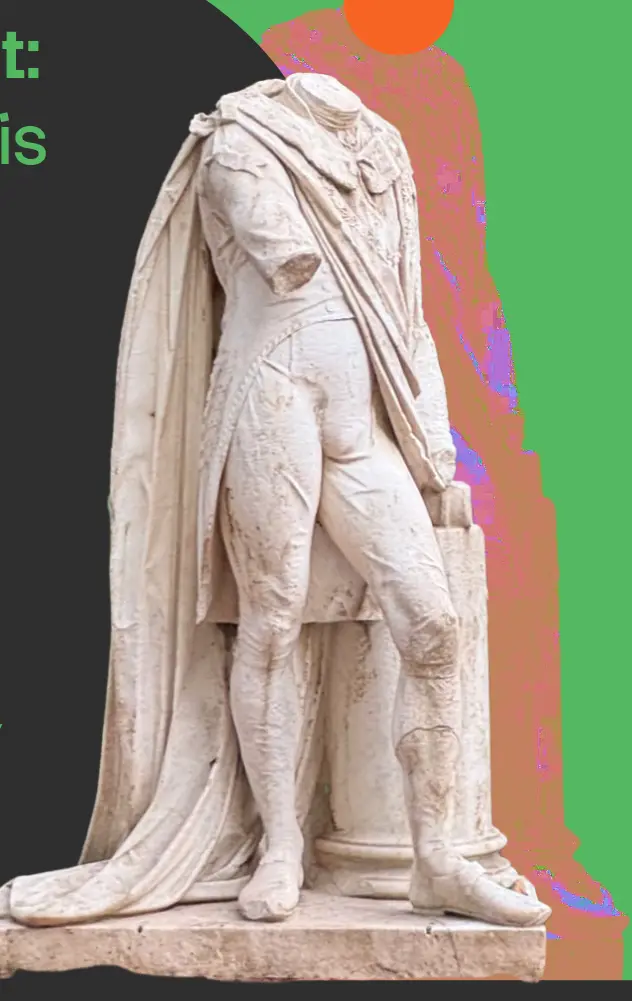
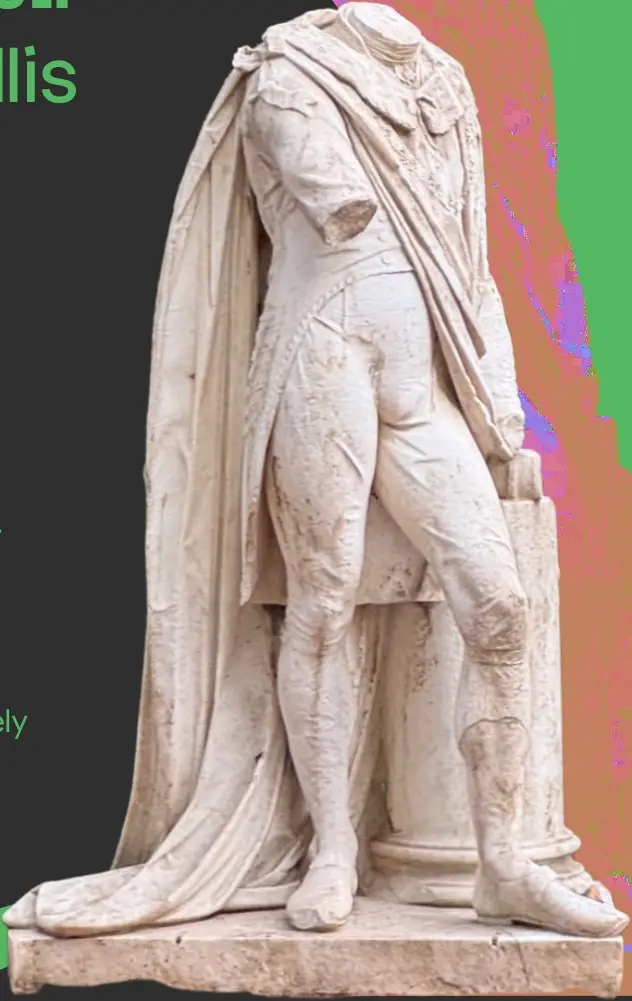
Standing amid the shadows of the garden, the figure of Cornwallis, once the Governor-General of India, cuts a haunting silhouette. In his prime, he was the architect of the 'Permanent Settlement', a sweeping land tax reform that fundamentally altered India's socioeconomic fabric. His statue was meant to embody the unwavering permanence of the British administration. Today, his statue is a macabre remnant of that perceived permanence. He stands beheaded, his neck a jagged stump of stone, with a missing arm that once likely held a scroll or a sword of state. This physical ‘de- crowning’ serves as a visceral counter-narrative to his historical title; the man who structured the empire’s finances is now a broken figure in a museum backyard.
The Architect of Empire: Lord Marquis of Wellesley
Original Location
The Fort, Mumbai (Erected by the merchants of Bombay)
Wellesley was perhaps the most aggressively expansionist Governor-General in the history of the Raj. It was his ‘Subsidiary Alliance’ system that effectively brought vast Indian princely states under the British thumb. Due to his favour towards trade, the wealthy merchants of Bombay funded this monument as a tribute to the man who secured their commercial routes through conquest. At present, the statue serves as a study in radical transformation. Like Cornwallis, Wellesley has also been decapitated. Furthermore, a hand and a foot have been struck away, leaving him precariously balanced and incomplete. To see this statue is to witness the physical dismantling of a man who once sought to map and own an entire subcontinent.
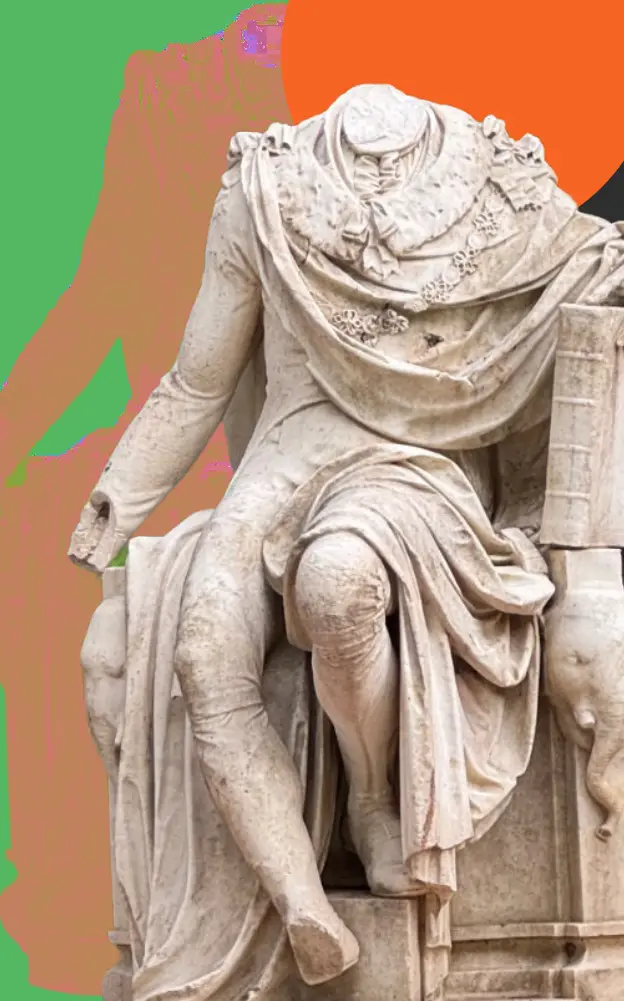
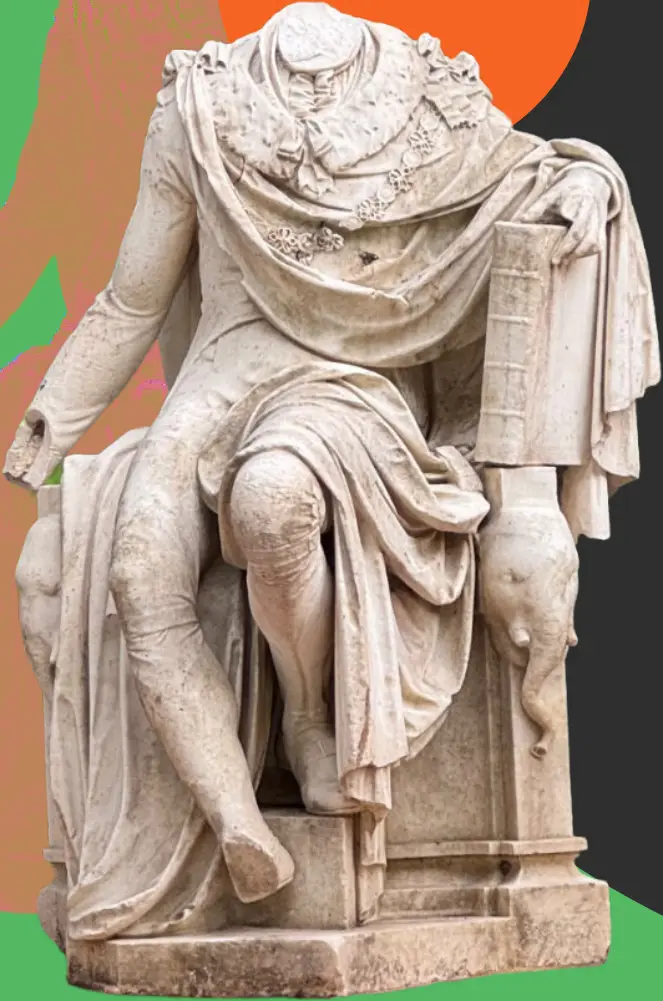
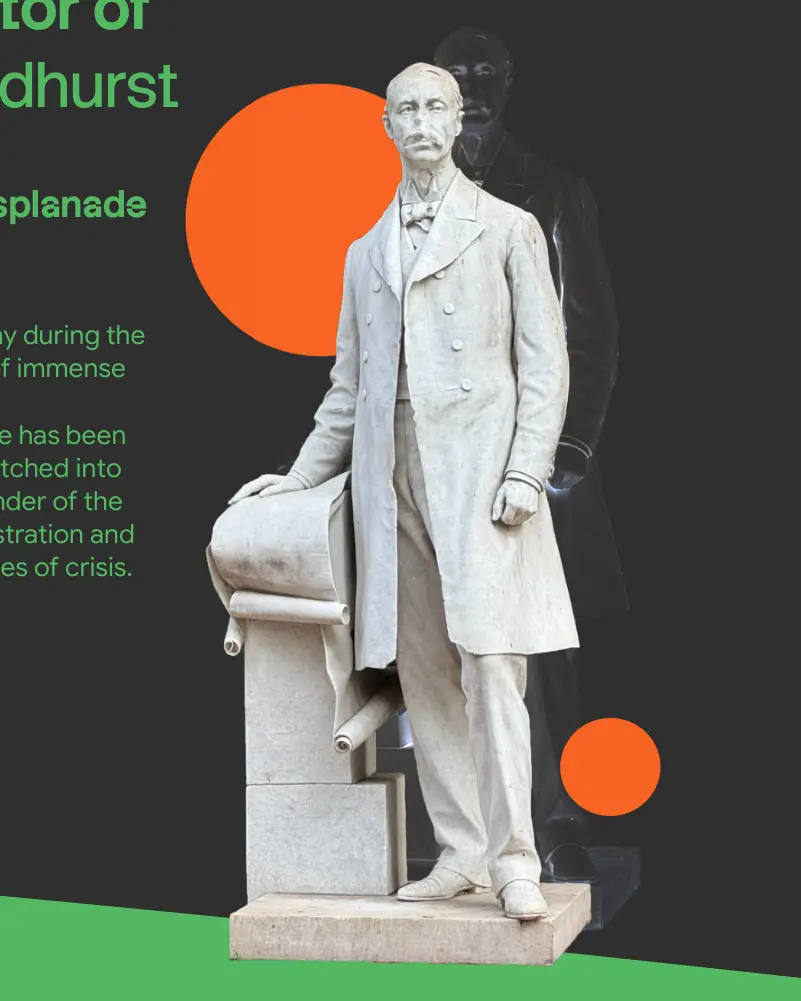
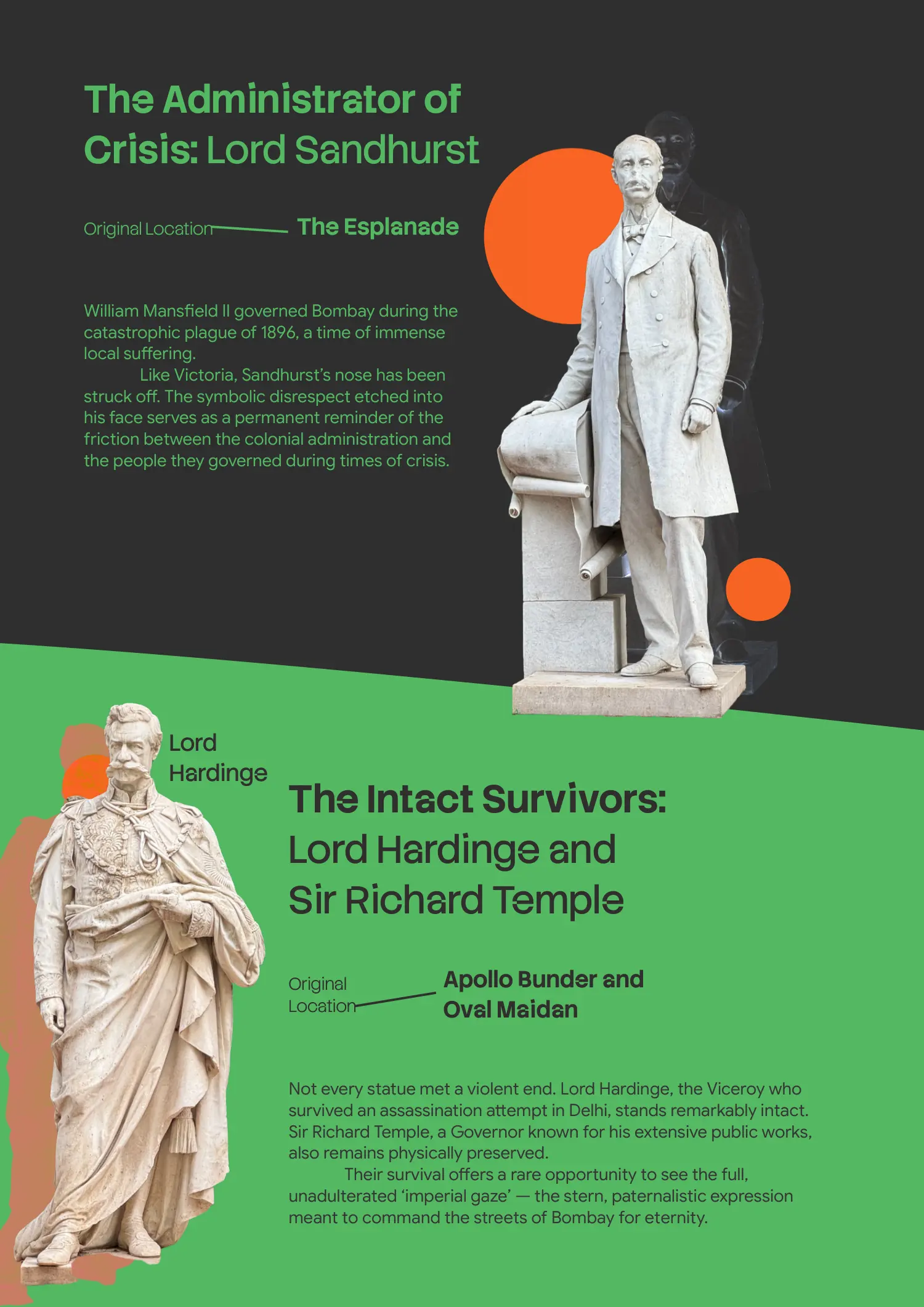
The Administrator of Crisis: Lord Sandhurst
The Esplanade Original Location
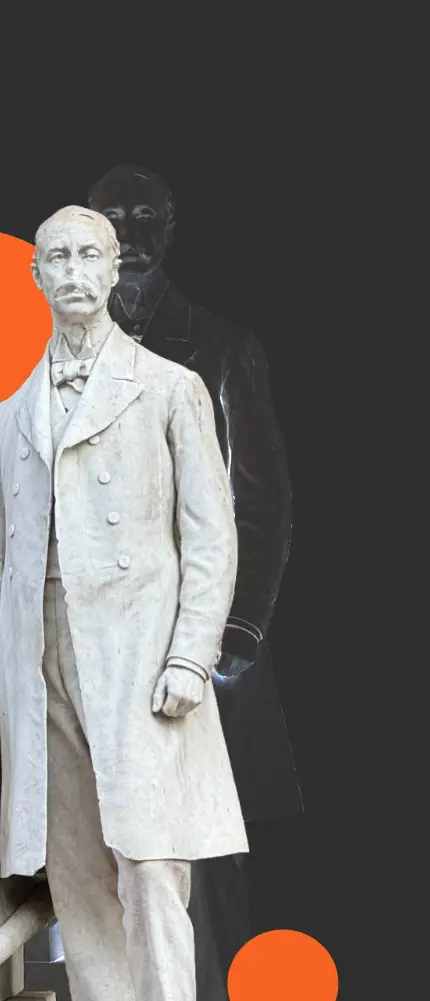
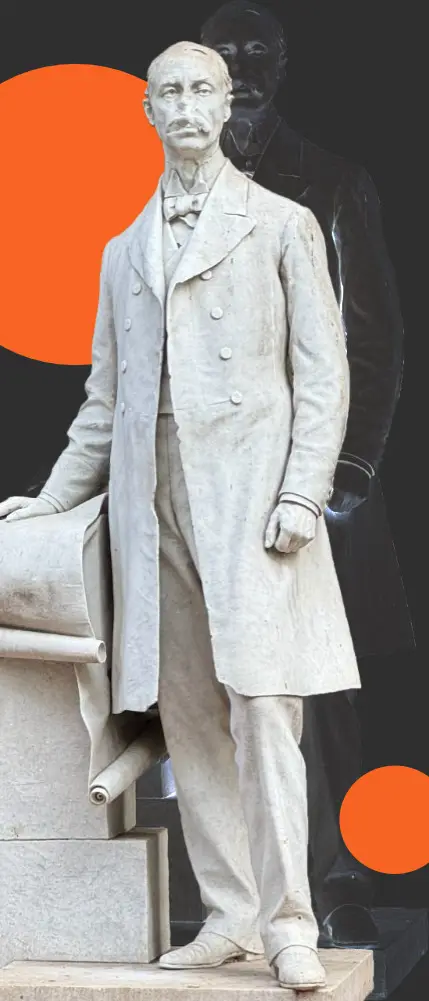
William Mansfield II governed Bombay during the catastrophic plague of 1896, a time of immense local suffering. Like Victoria, Sandhurst’s nose has been struck off. The symbolic disrespect etched into his face serves as a permanent reminder of the friction between the colonial administration and the people they governed during times of crisis.
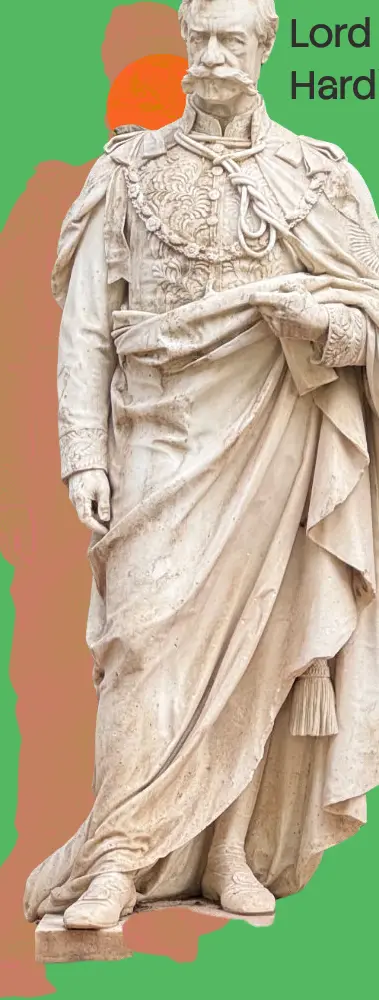
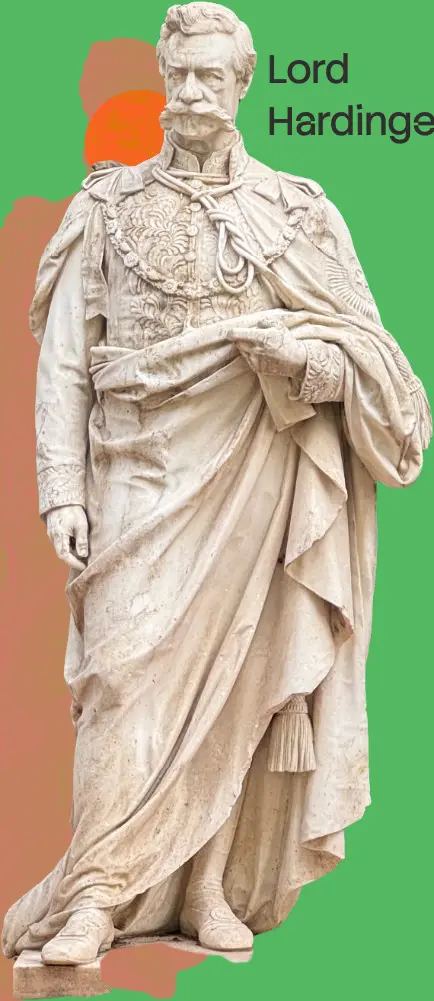
Lord Hardinge
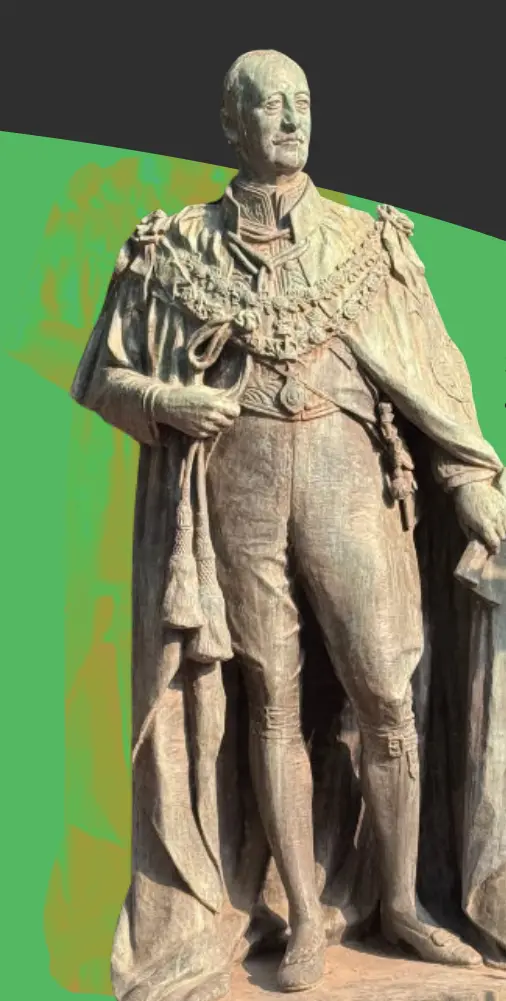
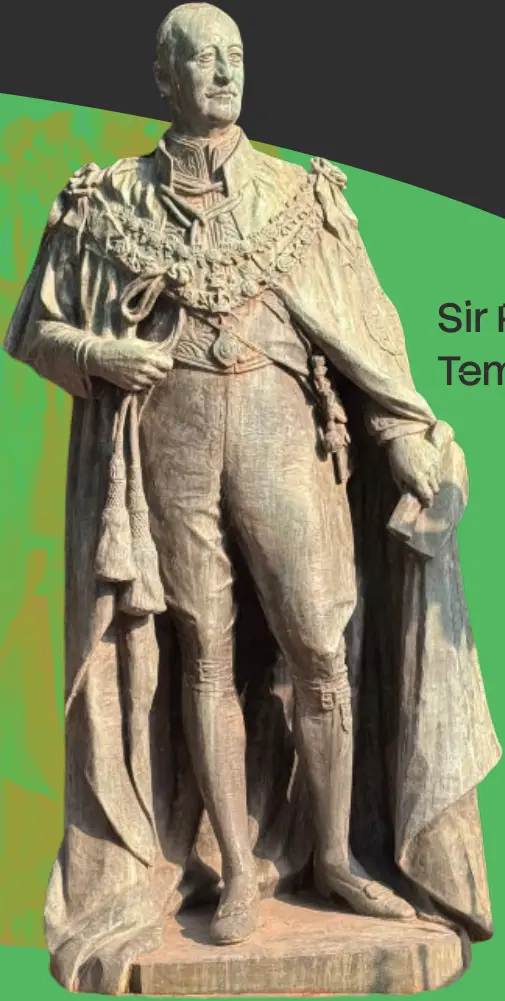
The Intact Survivors: Lord Hardinge and Sir Richard Temple
Original Location
Apollo Bunder and Oval Maidan
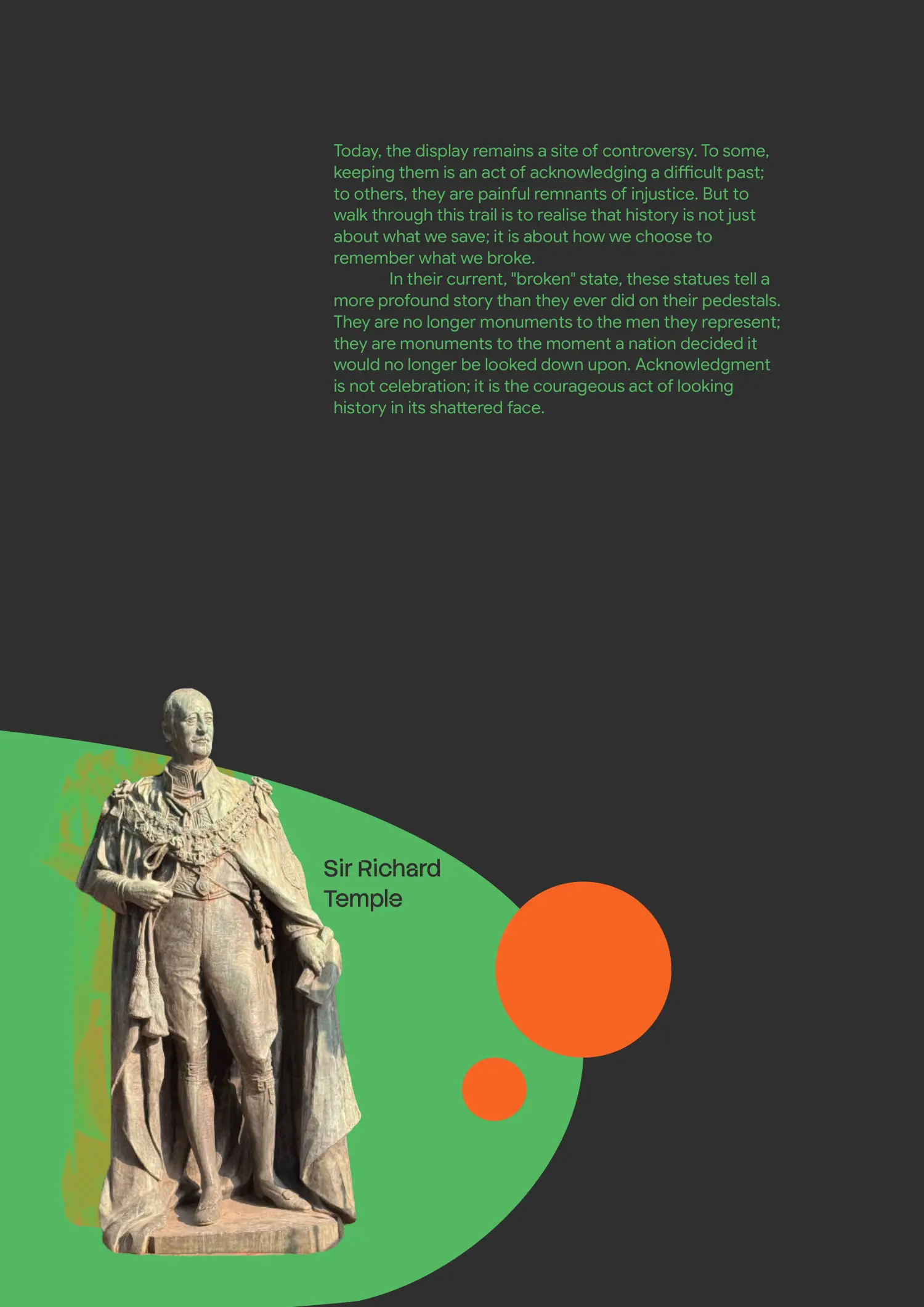
Not every statue met a violent end. Lord Hardinge, the Viceroy who survived an assassination attempt in Delhi, stands remarkably intact. Sir Richard Temple, a Governor known for his extensive public works, also remains physically preserved. Their survival offers a rare opportunity to see the full, unadulterated ‘imperial gaze’ — the stern, paternalistic expression meant to command the streets of Bombay for eternity.
Today, the display remains a site of controversy. To some, keeping them is an act of acknowledging a difficult past; to others, they are painful remnants of injustice. But to walk through this trail is to realise that history is not just about what we save; it is about how we choose to remember what we broke. In their current, "broken" state, these statues tell a more profound story than they ever did on their pedestals. They are no longer monuments to the men they represent; they are monuments to the moment a nation decided it would no longer be looked down upon. Acknowledgment is not celebration; it is the courageous act of looking history in its shattered face.
Sir Richard Temple
View original pages, photographs & credits
Originally published in Museum Mosaic 2025, published May 2026.
Part of our annual review. Descriptions reflect the publication’s reporting period.